Episode Details
Back to Episodes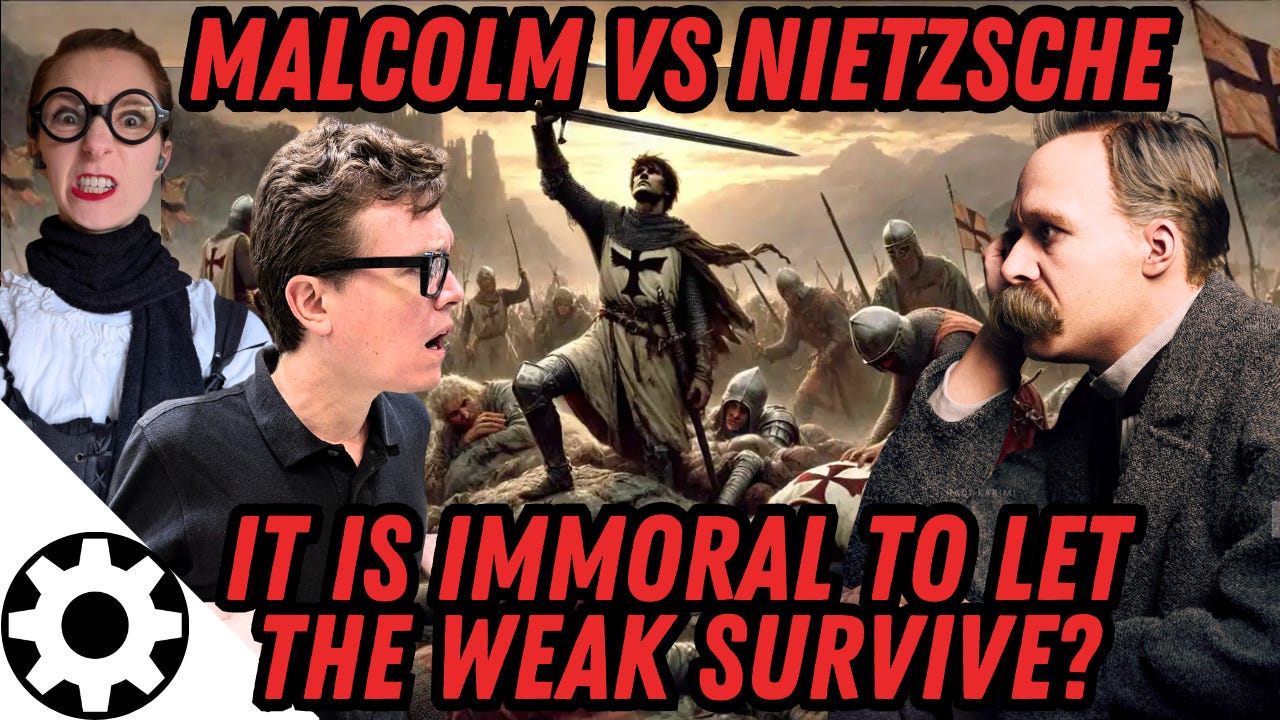
The Immorality of Weakness: Nietzschean vs. Collinsian Philosophy
Description
In this thought-provoking episode, we dive deep into the often misunderstood philosophy of Friedrich Nietzsche, exploring his ideas on the immorality of weakness, the concept of the Ubermensch, and how they relate to modern issues like woke culture and tribal morality. We differentiate our views from Nietzsche's, discuss the relevance of his ideas in today's world, and address the broader implications for cultural and societal development. Join us as we unravel complex philosophical concepts and their impact on contemporary thought.
[00:00:00]
Malcolm Collins: Hello, Simone. Today we are going to be talking. About the immorality of weakness, and I would note here that we are not going to be talking about this from the perspective of niche, but we will be talking a lot about Frederick Nietzsche throughout, especially at the end of this episode to differentiate our views on why weakness should be scorned versus Nietzsche's views on weakness leading fundamentally to immorality.
Because they're actually distinct, but not as distinct as I thought when I went into this subject. And I would say that me studying Nietzsche, very sad. It's just a bunch of instances of me being like, I don't want to be basic, but he actually makes a lot of good points. Very prescient about woke people, but we'll get to that in a second.
Okay. Well, that people will use the sympathy of others to try to exert power over them and that people will manipulate others by acting sympathetic to them [00:01:00] to keep them in a permanently infantilized state that glorifies themselves i. e. the person doing the infantilization. But before we get to all of that, where this was highlighted for me.
Was two things. One is a recent evolution in my understanding of our wider world perspective, which has become a lot more clear to me and sort of how I view clan based structures and how I view morality at the wider societal level than at the individual level, but also a clip that we ran in a recent episode that's a famous scene from Trigon or I don't know if it's a famous scene, but it's a scene that always hit me hard as a kid.
Because in it, there are two characters arguing and the character who is the villain says you have to kill the one character is trying to save a butterfly, the good guy. And then the villain says, well, you just need to kill the spider then basically.
Simone Collins: Because it's a butterfly caught in a web for those.
Because [00:02:00]
Malcolm Collins: if you free the butterfly. Then the spider will eventually starve. You can't, you're not doing a good thing by freeing the butterfly. You're just consigning the spider to a slow death. And the good guy character says no, there's always a way.
Speaker 6: That was the easiest way to stop him. I didn't want to kill the spider unless the spider caught the butterfly, it would die of starvation . You can't save both,
Speaker 5: it's not right to make that choice so easily. . BUt
Speaker 6: I'm not wrong about this, Rem. Wanting to save both is just a naive contradiction. And what would you have rather had us do, just think about it? In the meantime, while we do that, the spider eats the butterfly
Speaker 7: I wanted to save both of them, you idiot!
Malcolm Collins: And the entire Trigun series is based around this philosophy of No matter how bad things are, there is always a way to save the bad guy.
There is always a way to make things right. When in reality, by [00:03:00] attempting to save the bad guy, you often cause much more harm in the longterm. You are masturbating your own sense of justice. Like you being a good person, usually because you don't have to deal with the risk that that bad guy poses to society.
The famous example here, of course, I'm thinking of is the