Episode Details
Back to Episodes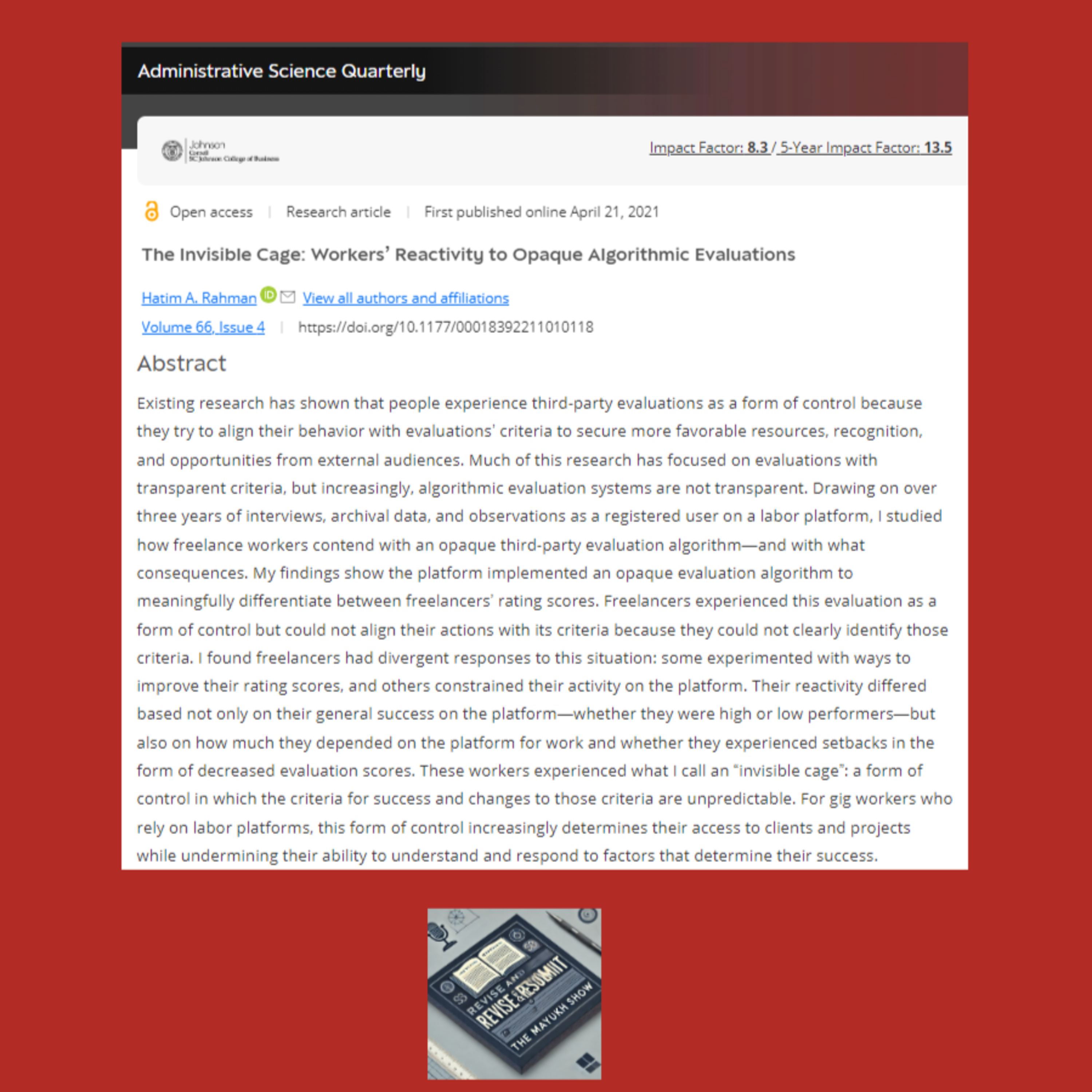
The Invisible Cage: Workers’ Reactivity to Opaque Algorithmic Evaluations (Rahman, 2021)
Description
Welcome to Revise and Resubmit. Today, we’re diving into the complex world of freelance workers and the invisible systems shaping their careers. We’ll explore Hatim A. Rahman’s groundbreaking article, “The Invisible Cage: Workers’ Reactivity to Opaque Algorithmic Evaluations,” published in the prestigious FT50 journal Administrative Science Quarterly by Sage Publishers.
Imagine this: You’re a freelance worker, relying on a labor platform to connect with clients. Your success depends on an algorithm’s evaluation, but there’s one problem—you have no idea what that algorithm is looking for. You try to adjust, to improve, to align your efforts with what you think the system wants, but it’s like shooting in the dark. This “invisible cage” traps you, controlling your opportunities while leaving you clueless about the rules. Some workers experiment and push forward, while others feel so powerless they pull back.
Here’s where it gets fascinating: Rahman’s study reveals that your response to this opaque system isn’t just about how good you are—it’s about how much you need the platform to survive, and how setbacks affect your trust in the process.
So, the question is: In a world where algorithms are increasingly calling the shots, how do workers navigate systems they can’t even see?
Stay with us as we unpack this invisible form of control, and a special thank you to Hatim A. Rahman and Administrative Science Quarterly for shedding light on this critical issue. Let’s get started!
Reference
Rahman, H. A. (2021). The Invisible Cage: Workers’ Reactivity to Opaque Algorithmic Evaluations. Administrative Science Quarterly, 66(4), 945-988. https://doi.org/10.1177/00018392211010118