Episode Details
Back to Episodes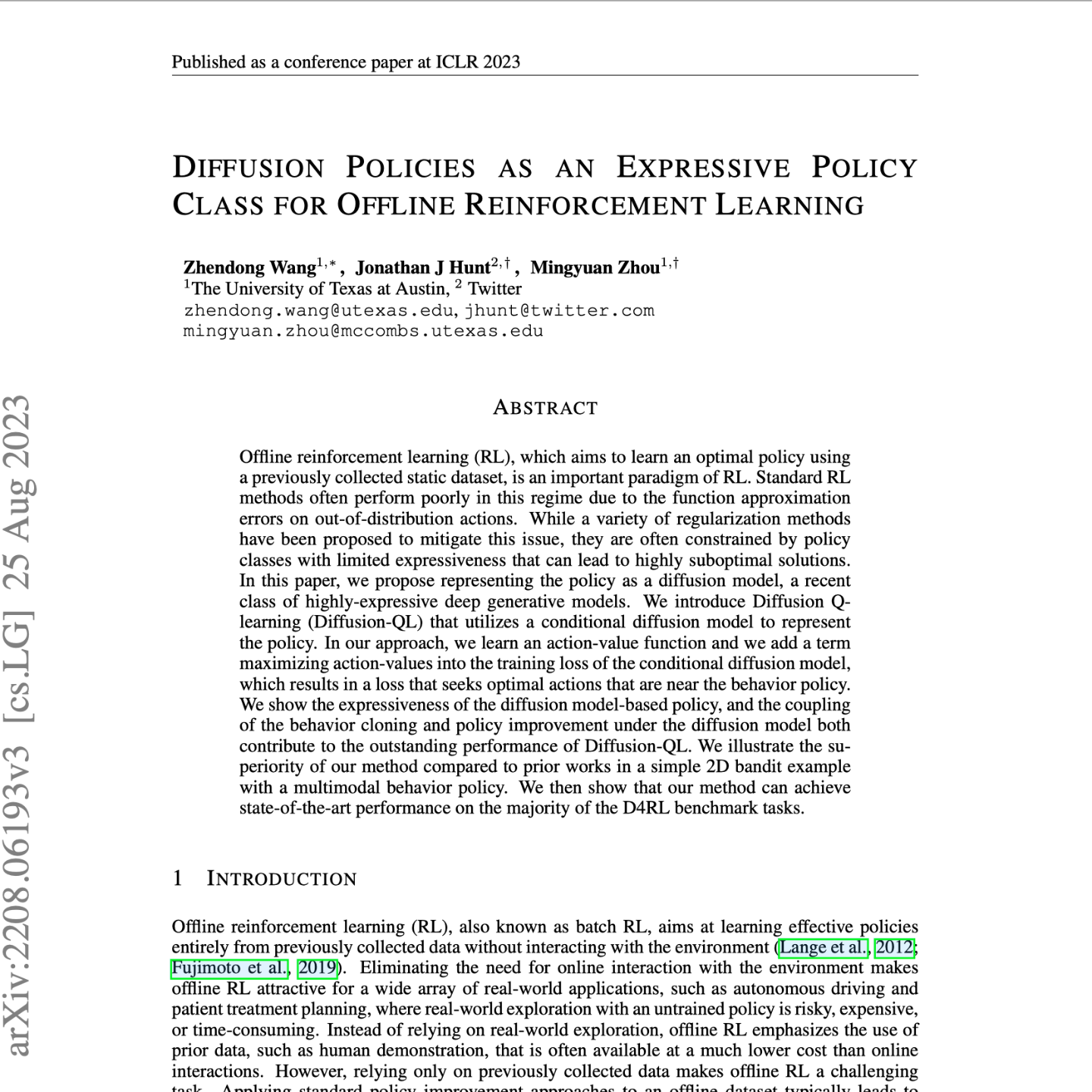
【第22期】Diffusion-Q Learning解读
Published 1 year, 11 months ago
Description
Seventy3: 用NotebookLM将论文生成播客,让大家跟着AI一起进步。
今天的主题是:
Diffusion Policies as an Expressive Policy Class for Offline Reinforcement Learning
Source: Wang, Z., Hunt, J.J., & Zhou, M. (2023). Diffusion Policies as an Expressive Policy Class for Offline Reinforcement Learning. arXiv preprint arXiv:2208.06193v3.
Main Theme: This paper proposes Diffusion Q-learning (Diffusion-QL), a novel offline reinforcement learning (RL) algorithm that utilizes diffusion models for precise policy regularization and leverages Q-learning guidance to achieve state-of-the-art performance on benchmark tasks.
Most Important Ideas/Facts:
- Limitations of Existing Policy Regularization Methods:
- Existing methods struggle with multimodal behavior policies, often found in real-world datasets collected from diverse sources.
- They rely on limited expressiveness policy classes like Gaussian distributions, which are inadequate for complex behavior patterns.
- Two-step regularization approaches involving behavior cloning before policy improvement introduce approximation errors, hindering performance.
- "The inaccurate policy regularization occurs for two main reasons: 1) policy classes are not expressive enough; 2) the regularization methods are improper."
- Advantages of Diffusion Models:
- High Expressiveness: Diffusion models can effectively capture multimodal, skewed, and complex dependencies in behavior policies, leading to more accurate regularization.
- Strong Distribution Matching: Diffusion model loss acts as a powerful sample-based regularization method, eliminating the need for separate behavior cloning.
- Iterative Refinement: Guidance from the Q-value function can be injected at each step of the reverse diffusion process, leading to a more directed search for optimal actions.
- "Applying a diffusion model here has several appealing properties. First, diffusion models are very expressive and can well capture multi-modal distributions."
- Diffusion-QL Algorithm:
- Diffusion Policy: A conditional diffusion model generates actions conditioned on the current state, representing the RL policy.
- Loss Function: Combines a behavior-cloning term encouraging actions similar to the dataset and a Q-learning term maximizing action-values.
- Q-learning Guidance: Backpropagates gradients through the entire diffusion chain to learn a Q-value function guiding the policy towards optimal actions.
- "Our contribution is Diffusion-QL, a new offline RL algorithm that leverages diffusion models to do precise policy regularization and successfully injects the Q-learning guidance into the reverse diffusion chain to seek optimal actions."
- Experimental Results:
- Superior Performance: Diffusion-QL achieves state-of-the-art results across various D4RL benchmark tasks, including challenging domains like AntMaze, Adroit, and Kitchen.
- Improved Behavior Cloning: Diffusion models outperform traditional methods like BC-MLE, BC-CVAE, and BC-MMD, demonstrating their ability to capture complex behavior patterns.
- Effectiveness of Q-learning Guidance: The combined loss function ensures that the learned policy not only mimics the dataset but also actively seeks optimal actions within the explored region.
- "We test Diffusion-QL on the D4RL benchmark tasks for offline RL and show this method outperforms prior methods on the majority of tasks."
- Limitations and Future Wo