Episode Details
Back to Episodes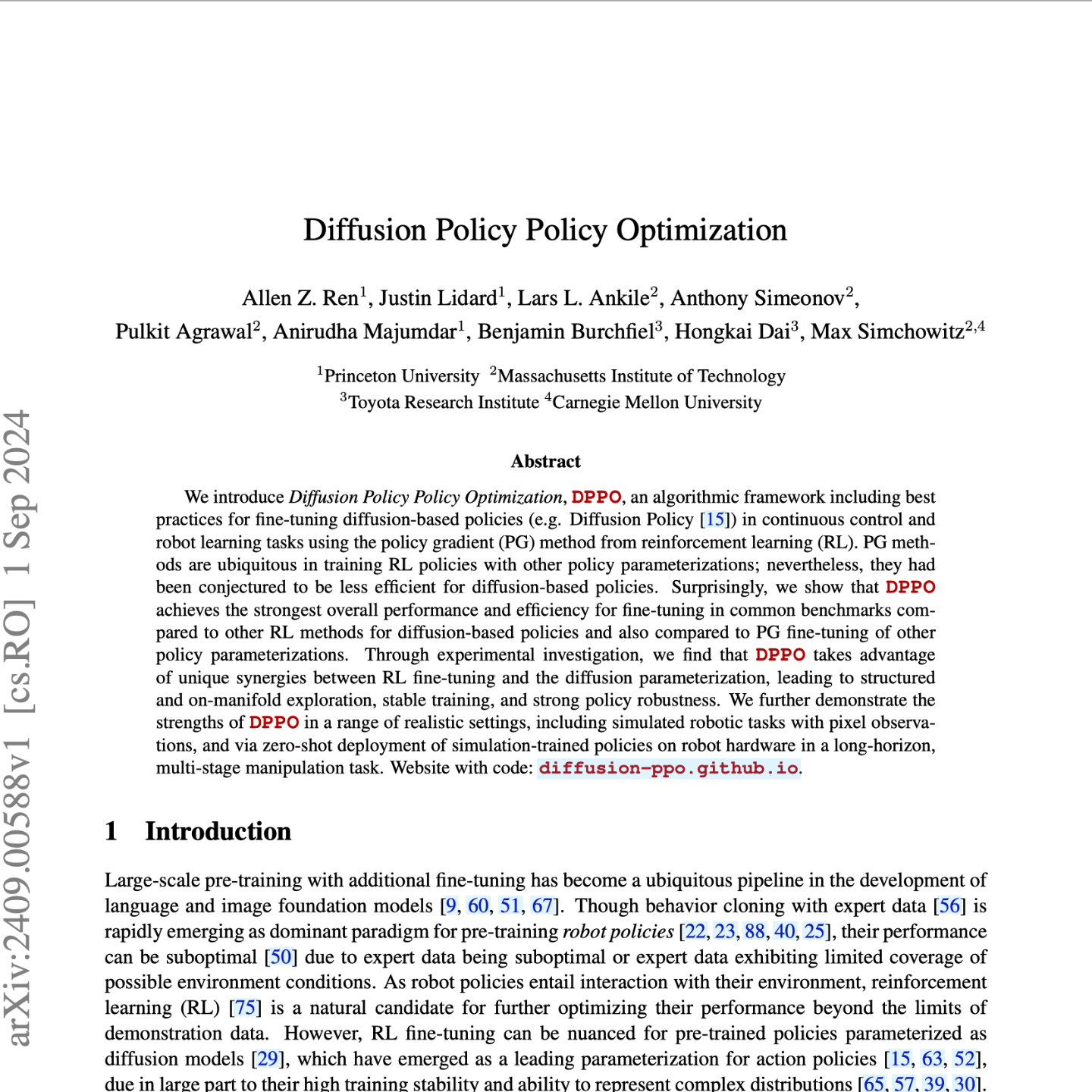
【第21期】DPPO解读
Published 1 year, 11 months ago
Description
Seventy3: 用NotebookLM将论文生成播客,让大家跟着AI一起进步。
今天的主题是:
Diffusion Policy Policy Optimization
This briefing document reviews the key themes and findings presented in the research paper "DPPO: Diffusion Policy Policy Optimization" (arXiv:2409.00588v1). The paper introduces DPPO, a novel method for fine-tuning pre-trained robot policies parameterized as diffusion models using reinforcement learning (RL).
Key Themes
- Limitations of Behavior Cloning: While behavior cloning with expert data is a popular method for pre-training robot policies, it can result in suboptimal performance due to limitations in expert data quality and coverage.
- Diffusion Models as Policies: Diffusion models are emerging as a leading parameterization for action policies due to their training stability and ability to represent complex distributions.
- RL for Fine-tuning Diffusion Policies: DPPO leverages RL, specifically Proximal Policy Optimization (PPO), to fine-tune pre-trained diffusion policies, enabling them to surpass the limitations of demonstration data.
Important Ideas and Facts
- Two-Layer Diffusion Policy MDP: DPPO conceptualizes the fine-tuning process as a two-layer Markov Decision Process (MDP). The outer layer represents the environment MDP, while the inner layer represents the denoising MDP within the diffusion model. This allows for applying policy gradient updates through the entire process.
- Structured Exploration: DPPO facilitates structured exploration by leveraging the inherent noise within the diffusion model. This is in contrast to traditional Gaussian policies that rely on unstructured exploration noise.
- Training Stability: DPPO exhibits high training stability attributed to the smooth and gradual refinement of the action distribution during the denoising process.
- Policy Robustness: DPPO produces robust policies that can handle noise injected into the actions during fine-tuning, further demonstrating its stability.
- Generalization: DPPO showcases strong generalization capabilities, outperforming baseline methods in various benchmark tasks, including complex long-horizon manipulation tasks.
Key Findings
- Superior Performance: DPPO consistently outperforms existing diffusion-based RL algorithms and traditional policy parameterizations in benchmark tasks, including locomotion and manipulation.
- Successful Sim-to-Real Transfer: DPPO demonstrates successful sim-to-real transfer in challenging furniture assembly tasks, highlighting its real-world applicability.
- Corrective Behavior: The fine-tuned policies exhibit corrective behavior, adapting to errors and uncertainties in the environment.
Supporting Quotes
- Suboptimality of Expert Data: "Though behavior cloning with expert data is rapidly emerging as dominant paradigm for pre-training robot policies, their performance can be suboptimal due to expert data being suboptimal or expert data exhibiting limited coverage of possible environment conditions."
- Diffusion Models as Policies: "Diffusion models [29], which have emerged as a leading parameterization for action policies [15, 63, 52], due in large part to their high training stability and ability to represent complex distributions [65, 57, 39, 30]."
- Two-Layer Diffusion Policy MDP: "We extend this formalism by embedding the Diffusion MDP into the environmental MDP, obtaining a larger 'Diffusion Policy MDP' denoted MDP, visualized in Fig. 3."
- Structured Exploration: "DPPO explores in wide coverage around the expert data manifold, whereas Gaussian generates less structured ex