Episode Details
Back to Episodes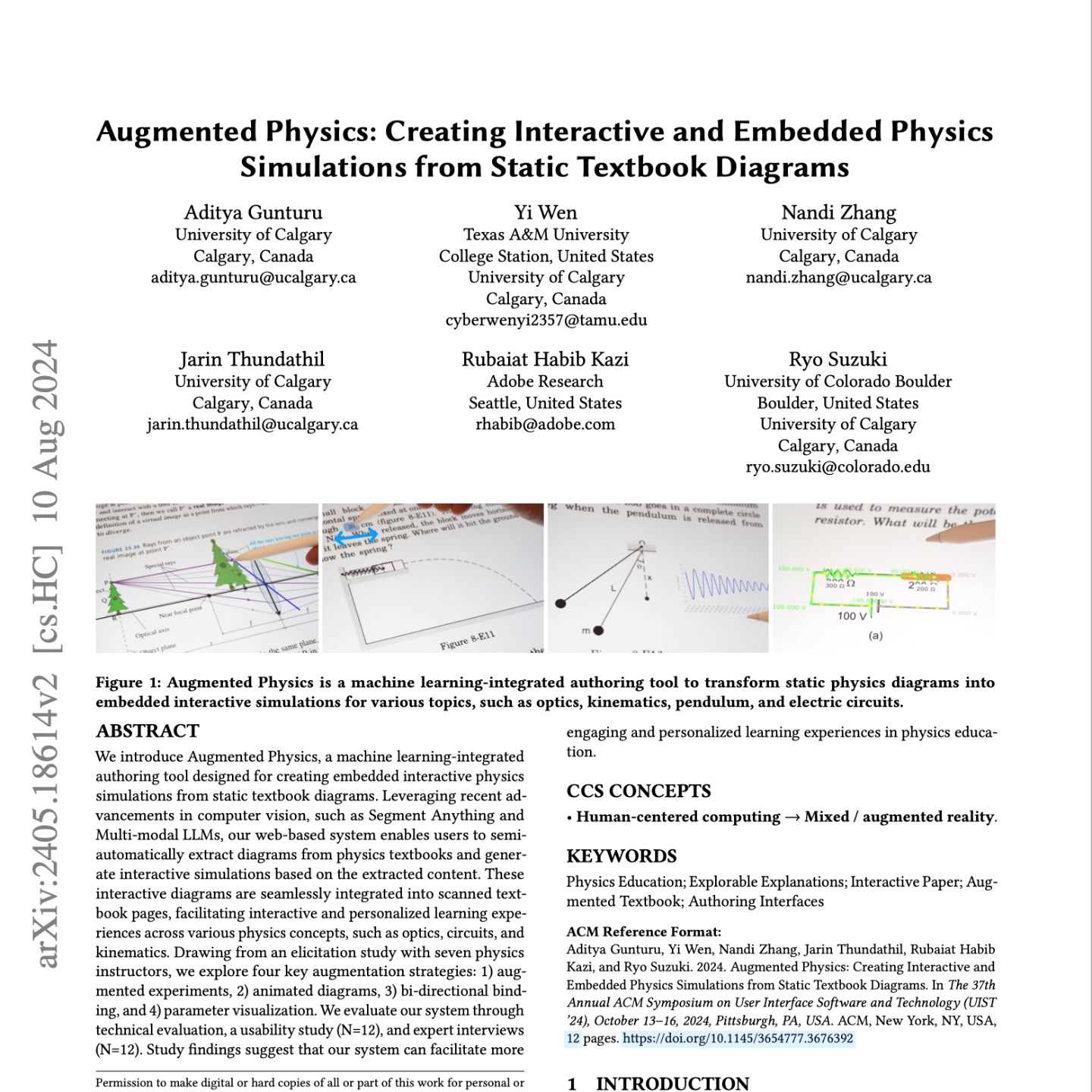
【第19期】Augmented Physics
Published 1 year, 11 months ago
Description
Seventy3: 用NotebookLM将论文生成播客,让大家跟着AI一起进步。
今天的主题是:
Augmented Physics: Bringing Textbook Diagrams to LifAugmented Physics: Creating Interactive and Embedded Physics
Problem: The limitations of static learning materials
The authors identify several key challenges in current physics education stemming from the reliance on static visualizations:
- Difficulty representing time-dependent concepts: Static diagrams struggle to effectively convey concepts involving motion or dynamic systems.
- Limited interactivity in videos: While videos offer a dynamic representation, they lack the interactivity crucial for intuitive learning and experimentation.
- Lack of instructional scaffolding in online simulators: Existing simulators often lack the context and guidance found in textbooks, making them challenging for novice learners.
- Misalignment and distractions from external content: Sourcing external resources like YouTube videos can introduce inconsistencies with classroom materials and lead to distractions.
Solution: Augmented Physics, an interactive learning tool
Augmented Physics is a machine learning-integrated authoring tool designed to address these challenges. The system enables users to:
- Semi-automatically extract diagrams from textbooks: Leveraging advanced computer vision techniques like Segment-Anything and Multi-modal LLMs, users can easily isolate and segment elements from textbook images.
- Generate interactive simulations based on extracted content: The segmented images are converted into simulation-ready objects, allowing for dynamic manipulation and real-time feedback.
- Seamlessly integrate simulations into textbook pages: The interactive simulations are directly overlaid onto the textbook PDF, providing a contextualized and integrated learning experience.
Four Key Augmentation Strategies
Informed by a formative study with physics instructors, the authors implemented four key augmentation strategies:
- Augmented Experiments: Users can manipulate textbook diagrams and observe real-time changes based on physics principles. For example, adjusting the position of a lens in an optics diagram or modifying resistance values in a circuit.
- Animated Diagrams: Static diagrams are converted into looped animations to demonstrate dynamic processes. This can involve animating an object's trajectory or visualizing wave propagation.
- Bi-Directional Binding: Linking parameter values from text to the simulation allows users to modify values within the text and observe real-time effects on the simulation, and vice-versa.
- Parameter Visualization: Users can visualize selected parameter values through dynamic graphs, providing insights into changing variables like velocity or energy.
Technical Evaluation and User Studies
The system was evaluated through technical evaluations, a usability study with 12 participants, and expert interviews with 12 physics instructors. Key findings include:
- High success rate for object segmentation: The system achieved an 86% success rate in accurately segmenting objects from diagrams.
- Varying success rates across simulation types: The overall success rates for generating functional simulations without modification were 64% for kinematics, 44% for optics, and 40% for circuits.
- Positive user feedback: Users found the system intuitive and engaging, particularly appreciating the Parameter Visualization and Bi-Directional Binding features.
- Complementary role to existing resources: Experts viewed Augmented Physics as a v