Episode Details
Back to Episodes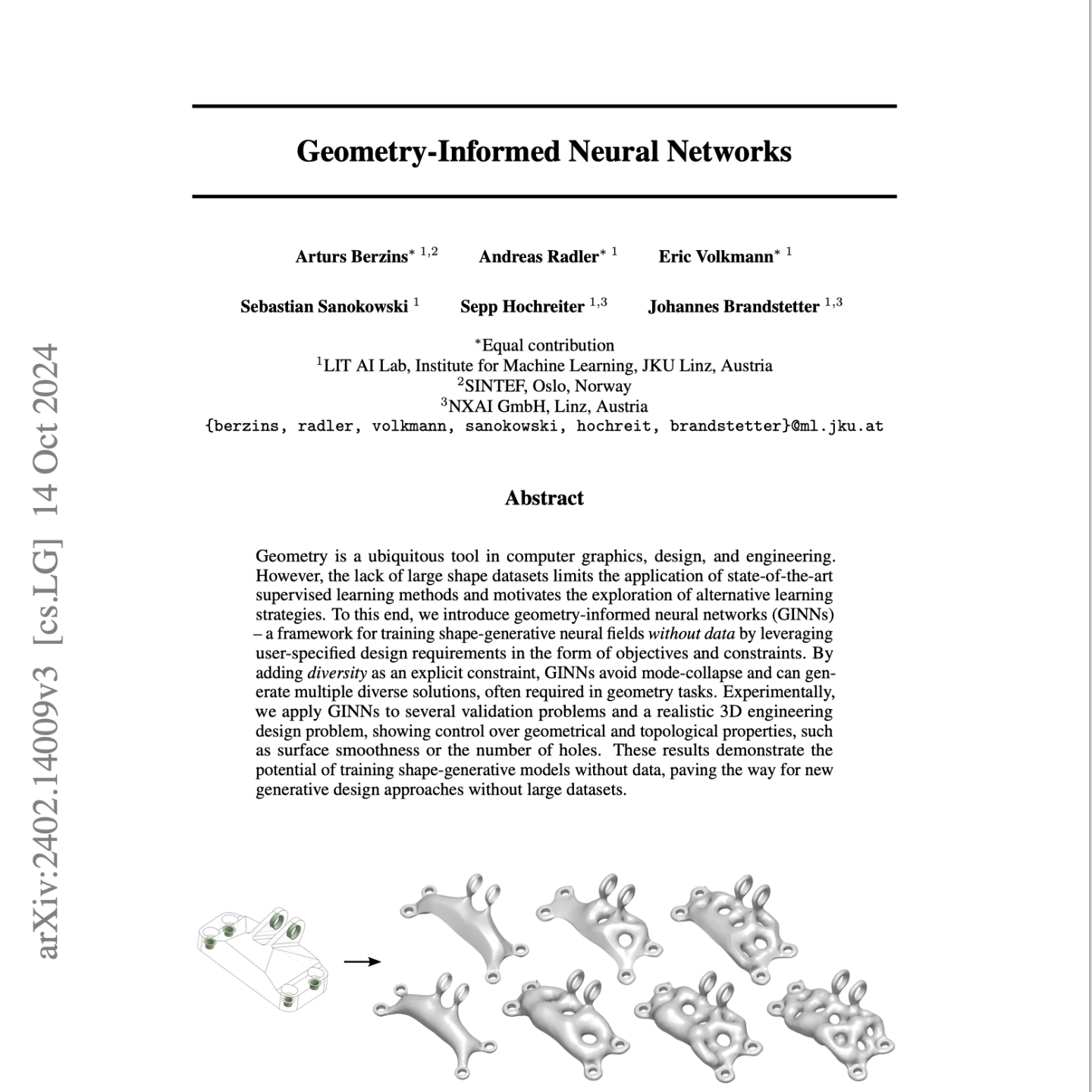
【第18期】Geometry-Informed Neural Networks
Published 1 year, 11 months ago
Description
Seventy3: 用NotebookLM将论文生成播客,让大家跟着AI一起进步。
今天的主题是:
Geometry-Informed Neural Networks
This document briefs you on the main themes and important findings of the research paper "Geometry-Informed Neural Networks" by Berzins et al. The paper introduces a novel framework called GINNs, which are neural networks trained to generate 3D shapes solely based on user-defined geometric constraints and objectives, without relying on any training data.
Key Themes:
- Data-Free Shape Generation: GINNs address the challenge of limited shape datasets in computer graphics and engineering by using pre-existing knowledge in the form of geometric constraints and objectives. This opens up new possibilities for generative design, especially in domains where data is scarce.
- Leveraging Geometric Constraints: The core idea behind GINNs is to represent shapes implicitly using neural fields and then train these networks to satisfy user-defined constraints. These constraints can include requirements on shape topology (e.g., number of holes, connectedness), smoothness, interface connections, and more.
- Generating Diverse Solutions: GINNs incorporate a diversity constraint to prevent mode collapse and encourage the generation of multiple, distinct solutions that meet the specified requirements. This diversity is crucial for design exploration and finding optimal solutions.
- Structured Latent Space: The use of a latent variable z to condition the neural field enables GINNs to learn a structured latent space. This means that traversing the latent space results in smooth and interpretable variations in the generated shapes, allowing for efficient design space exploration.
Key Findings:
- GINNs Successfully Solve Geometric Problems: The researchers demonstrated the effectiveness of GINNs on various validation problems, including Plateau's problem and generating a parabolic mirror. They also showcased a realistic 3D engineering design task of creating a jet engine bracket, illustrating how GINNs can generate diverse and feasible solutions under complex constraints.
- Diversity Constraint is Crucial: Experiments showed that adding a diversity constraint significantly improves the performance of GINNs, preventing mode collapse and leading to a wider range of generated shapes. Without the diversity constraint, the network often converged to a single solution, limiting its utility for design exploration.
- Emergent Latent Space Structure: The diversity constraint also led to the emergence of a structured latent space where similar shapes are clustered together. This structure allows designers to intuitively navigate the latent space and explore different design variations.
Important Quotes:
- "Is it possible to train a shape-generative model on objectives and constraints alone, without relying on any data?" - This question sets the stage for the paper's central theme and the development of GINNs.
- "GINNs are trained to satisfy specified design constraints and to produce feasible shapes without any training samples." - This highlights the key characteristic of GINNs, differentiating them from traditional data-driven methods.
- "By complementing the design requirements with a diversity constraint, we can train a shape-generative model without data..." - This emphasizes the importance of the diversity constraint in achieving data-free shape generation.
- "...this induces a structured latent space, with generalization capacity and interpretable directions." - This showcases the emergent structure of the latent space and its benefits for design exploration.
Limitations and Future Work:
- F