Episode Details
Back to Episodes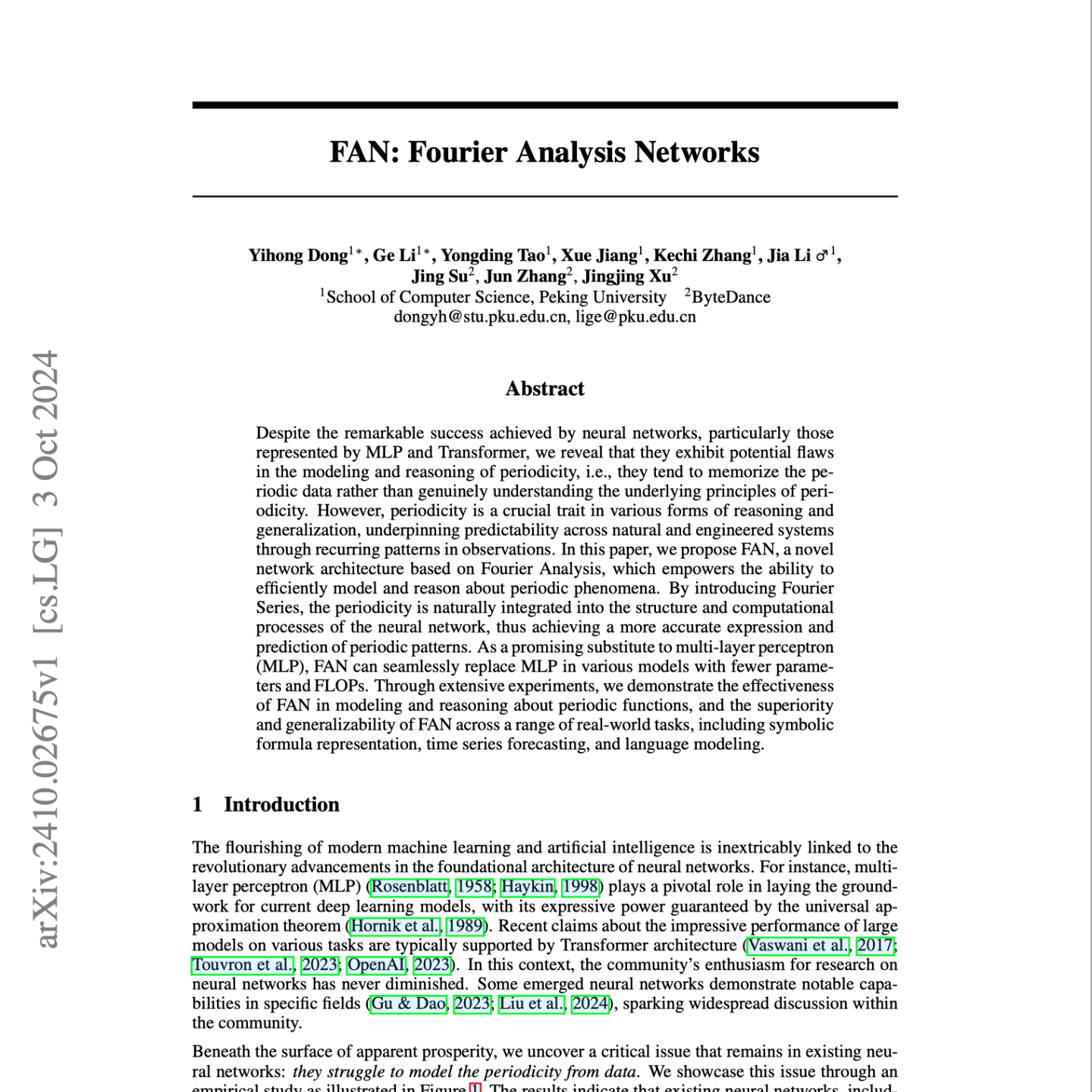
加餐003-FAN (Fourier Analysis Network)
Description
Seventy3: 用NotebookLM将论文生成播客,让大家跟着AI一起进步。
今天的主题是:
FAN: Fourier Analysis Networks
This briefing document reviews the key themes and findings from the research paper "FAN: Fourier Analysis Networks". The paper tackles the challenge of modeling periodicity in neural networks, a crucial aspect often overlooked by popular architectures like MLPs and Transformers.
Key Problem: Existing neural networks excel at interpolation within the training data domain but struggle with extrapolation, especially when dealing with periodic functions. They tend to memorize periodic data instead of understanding the underlying principles of periodicity, hindering their generalization capabilities.
Proposed Solution: The paper introduces FAN (Fourier Analysis Network), a novel architecture that explicitly integrates periodicity into the network structure using Fourier Series. This addresses the limitation of data-driven optimization in traditional networks by introducing an inherent understanding of periodic patterns.
Key Features of FAN:
- Fourier Series Integration: By incorporating Fourier Series, FAN decomposes functions into their constituent frequencies, directly encoding periodic patterns.
*"By leveraging the power of Fourier Series, we explicitly encode periodic patterns within the neural network, offering a way to model the general principles from the data." *
- Enhanced Periodicity Modeling: FAN demonstrates superior performance in fitting both simple and complex periodic functions compared to MLPs, Transformers, and KAN. This advantage is particularly evident in out-of-domain scenarios.
"FAN significantly outperforms the baselines in all these tasks of periodicity modeling...Moreover, FAN performs exceptionally well on test data both within and outside the domain of the training data, indicating that it is genuinely modeling periodicity rather than merely memorizing the training data."
- Improved Generalization: Despite being designed for periodicity, FAN demonstrates strong performance in broader applications, including symbolic formula representation, time series forecasting, and language modeling. This suggests that incorporating periodicity modeling can benefit various machine learning tasks, even those without explicit periodic requirements.
- Efficiency: FAN can seamlessly replace MLP layers in existing models, often leading to reduced parameters and FLOPs without sacrificing performance.
"As a promising substitute to MLP, FAN improves the model’s generalization performance meanwhile reducing the number of parameters and floating point of operations (FLOPs) employed."
Experimental Results:
- Periodicity Modeling: FAN significantly outperforms MLP, KAN, and Transformer in fitting a range of periodic functions, demonstrating its capability to capture and extrapolate periodic patterns effectively.
- Symbolic Formula Representation: FAN consistently outperforms baselines in representing mathematical and physical functions, indicating its applicability even for partially periodic or non-periodic functions.
- Time Series Forecasting: Transformer models enhanced with FAN layers achieve superior performance on four public time series datasets, showcasing the benefits of explicit periodicity modeling in forecasting tasks.
- Language Modeling: Transformer with FAN demonstrates substantial improvements over the standard Transformer and other sequence models on sentiment analysis tasks, highlighting the potential of periodicity modeling in language understanding and cross-domain generalization.
Future Directions:
The a