Episode Details
Back to Episodes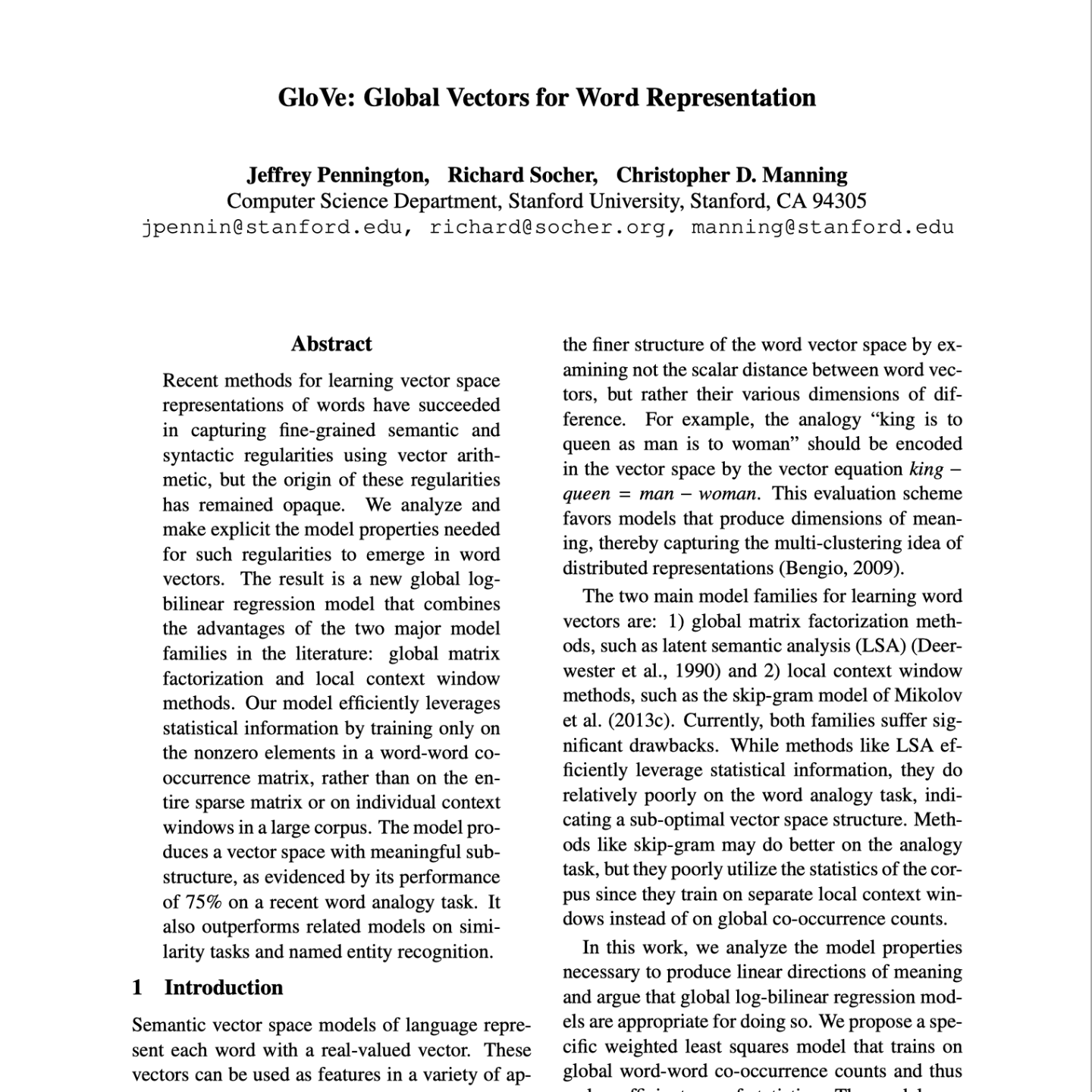
【第12期】GloVe解读
Published 1 year, 11 months ago
Description
Seventy3: 用NotebookML将论文生成播客,让大家跟着AI一起进步。
今天的主题是:
GloVe: Global Vectors for Word Representation
This briefing document reviews the main themes and key findings of the paper "GloVe: Global Vectors for Word Representation" by Pennington, Socher, and Manning. The paper introduces GloVe, a novel model for learning word embeddings that combines the strengths of global matrix factorization and local context window methods.
Key Themes:
- Limitations of Existing Methods: The authors highlight the drawbacks of existing word representation learning methods:
- Global matrix factorization methods (e.g., LSA) efficiently leverage global corpus statistics but fail to capture the finer linear structure of word relationships, performing poorly on tasks like word analogy.
- Local context window methods (e.g., skip-gram) excel at capturing semantic and syntactic relationships through vector arithmetic but underutilize global co-occurrence statistics by focusing on local contexts.
- Derivation of GloVe: The authors propose a new model, GloVe, designed to address these limitations. They argue that:
- Ratios of co-occurrence probabilities are more informative than raw probabilities for capturing word relationships. They illustrate this with the example of "ice" and "steam" where the ratio P(k|ice)/P(k|steam) effectively distinguishes relevant context words ("solid," "gas") from irrelevant ones ("water," "fashion").
- A log-bilinear regression model naturally encodes these ratios in a vector space.
- A weighted least squares objective is introduced to train the model on global co-occurrence counts while mitigating the impact of noisy, infrequent co-occurrences:
- J = ∑_{i, j} f(X_{i j}) (w_{i}^{T} \tilde{w}_{j} + b_{i} + \tilde{b}_{j} - log X_{i j})^{2}
- where:
- X_{ij} is the co-occurrence count of words i and j
- w_i, \tilde{w}_j are word and context word vectors
- b_i, \tilde{b}_j are biases for words i and j
- f(X_{ij}) is a weighting function that emphasizes frequent co-occurrences without overemphasizing extremely frequent pairs.
- Relationship to Other Models: The authors demonstrate that while seemingly different, GloVe shares underlying connections with skip-gram and related models. They show how modifying the skip-gram objective function by grouping similar terms and employing a weighted least squares approach leads to a formulation equivalent to GloVe.
Key Findings:
- State-of-the-art Performance: GloVe achieves state-of-the-art results on several benchmark tasks:
- Word Analogy: Outperforms previous models, including word2vec, achieving 75% accuracy on a large dataset.
- Word Similarity: Achieves higher Spearman's rank correlation compared to other models on multiple datasets like WordSim-353 and MC.
- Named Entity Recognition: Improves F1 scores on the CoNLL-2003 dataset compared to baselines using discrete features and other word vector models.
- Impact of Hyperparameters: The study analyzes the effect of different hyperparameters:
- Vector size: Increasing vector dimension provides diminishing returns beyond 200 dimensions.
- Context window size: Larger windows favor semantic tasks while smaller, asymmetric windows are better for syntactic tasks.
- Corpus size: Larger corpora consistently improve performance on syntactic tasks, while the choice of corpus influences performance on semantic tasks depending on the dataset.
- Com