Episode Details
Back to Episodes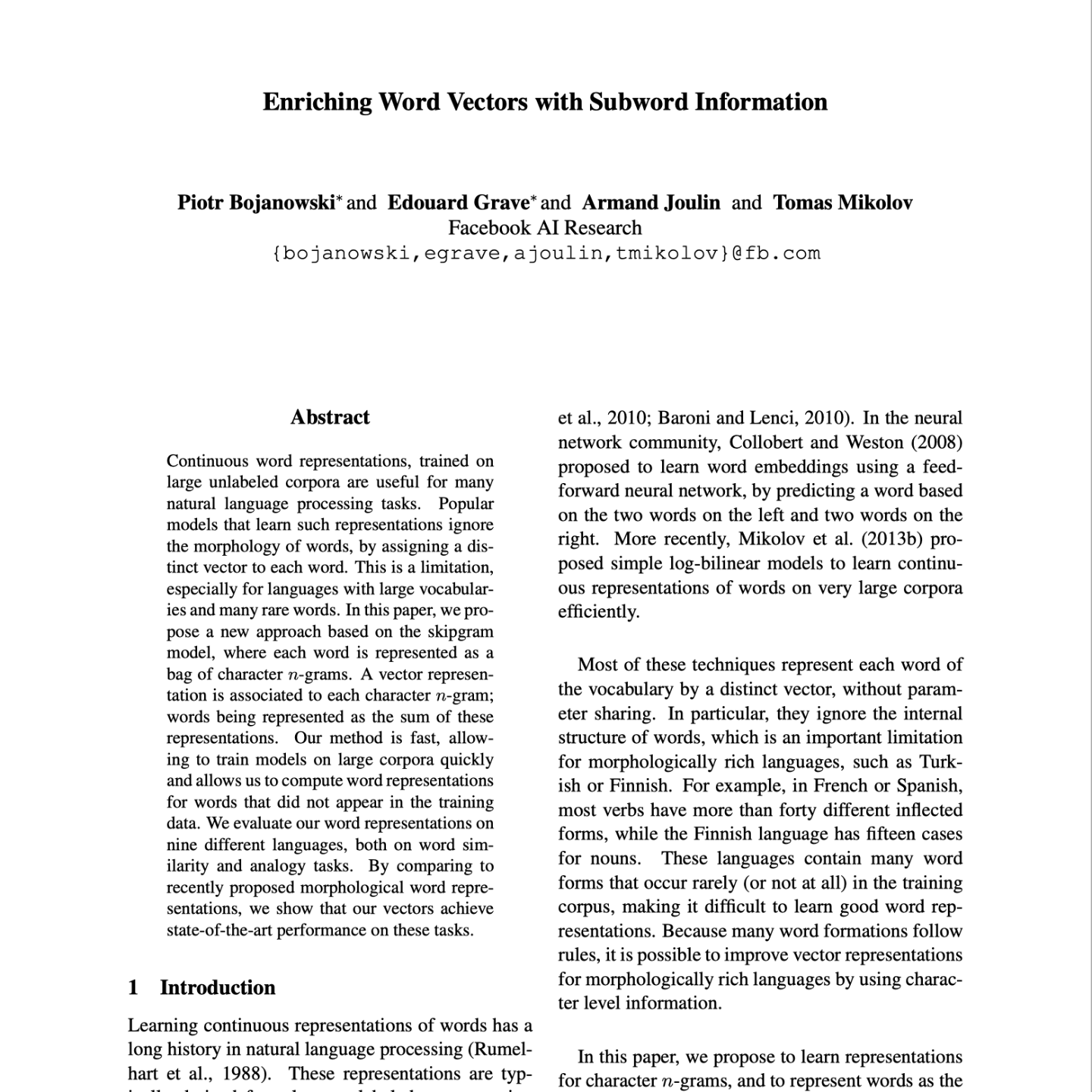
【第13期】n-gram解读
Description
Seventy3: 用NotebookML将论文生成播客,让大家跟着AI一起进步。
今天的主题是:
Enriching Word Vectors with Subword Information
Source: Bojanowski, Piotr, et al. "Enriching Word Vectors with Subword Information." arXiv preprint arXiv:1607.04606 (2016).
Main Theme: This paper introduces a novel method for improving continuous word representations by incorporating subword information, specifically character n-grams, into the skip-gram model. This approach proves particularly beneficial for morphologically rich languages and in scenarios with limited training data.
Key Ideas & Facts:
- Problem: Traditional word representation models assign distinct vectors to each word, neglecting morphology and struggling with rare words.
- Proposed Solution: Represent each word as a bag of character n-grams (3-6 characters). Each n-gram receives a vector representation, and the word vector is the sum of its n-gram vectors.
- Advantages:Captures morphological similarities between words.
- Enables learning representations for out-of-vocabulary (OOV) words.
- Shows robustness to training data size, achieving good performance even with limited data.
- Model: Extends the continuous skip-gram model with negative sampling.
- Evaluation:Word Similarity: Outperforms baselines (Word2Vec) on datasets across nine languages, demonstrating significant improvements for morphologically rich languages like German and Russian.
- Word Analogies: Shows considerable improvements in syntactic analogies, particularly for morphologically rich languages, while semantic analogies show mixed results.
- Comparison with Morphological Representations: Achieves comparable or superior performance to other methods incorporating morphological information, including those using complex morphological analysis.
- Effect of Training Data Size: Outperforms baselines even with significantly smaller training datasets (e.g., 5% of full data).
- Effect of N-gram Size: Experiments suggest using n-grams of 3-6 characters provides a good balance, with longer n-grams proving more beneficial for languages with compound words (e.g., German).
- Language Modeling: Initializing a recurrent neural network language model with these subword-informed word vectors reduces perplexity, particularly for morphologically rich languages.
- Qualitative Analysis:Nearest neighbor analysis shows that the model identifies semantically relevant neighbors for rare and technical words more effectively than the baseline.
- Analysis of influential n-grams reveals they often correspond to meaningful morphemes, capturing prefixes, suffixes, and roots.
- Visualization of n-gram similarities for OOV words demonstrates the model's ability to capture relationships based on meaningful subword units.
Quotes:
- "By exploiting the character-level similarities between “Tischtennis” and “Tennis”, our model does not represent the two words as completely different words."
- "This has a very important practical implication: well performing word vectors can be computed on datasets of a restricted size and still work well on previously unseen words."
- "This shows the importance of subword information on the language modeling task and exhibits the usefulness of the vectors that we propose for morphologically rich languages."
Conclusion: This paper presents a simple yet effective approach for enriching word representations by leveraging subword information. This method exhibits significant advantages over traditional approaches, especially for morphologically rich languages and wh