Episode Details
Back to Episodes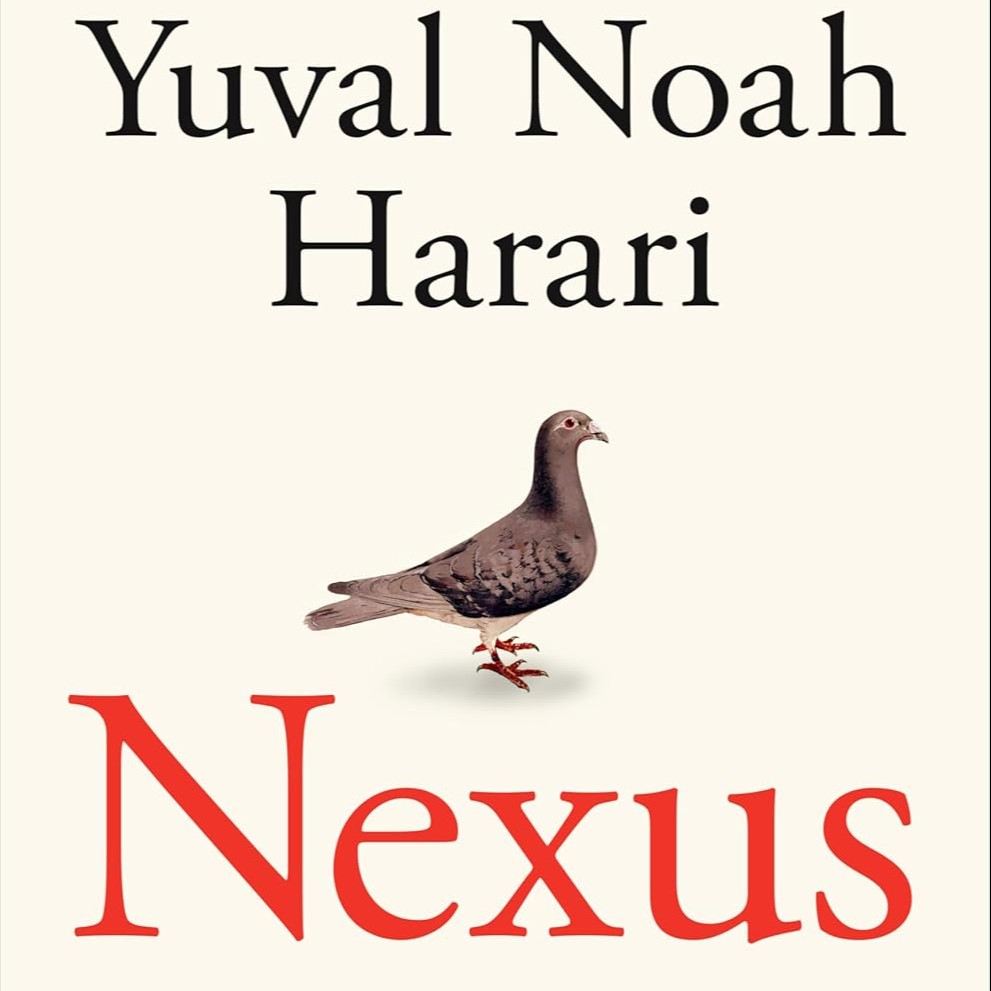
Harris-Trump Debate + Nexus by Yuval Noah Harari covers the entire information age
Description
I share reflections on last night's Harris-Trump Debate in the first two minutes of this podcast.
In the rest of the podcast, I review Yuval Noah Harari's newest book.
Harari is one of my top three favorite authors. I also love Bill Bryson and Walter Isaacson.
Therefore, I was thrilled that a few months ago, I got an advanced copy of Nexus: A Brief History of Information Networks from the Stone Age to AI, which launches today, September 10, 2024.
It's a 515-page book but is filled with headers over its 11 chapters, making it modular and readable.
I also reviewed his previous book, 21 Lessons for the 21st Century.
I loved Nexus, although Homo Deus is still my favorite Harari book.
Nexus explores the evolution of information networks from prehistoric times to the present, focusing mainly on the impact of artificial intelligence (AI) on society.
Outline
There are 3 parts:
Part 1: Human Networks focuses on history and how information went from clay tablets to silicon.
Part 2: The Inorganic Network focuses on the internet age and the birth of AI. It discusses how computers differ from printing presses and how the information networks are relentless and fallible.
Part 3: Computer Politics focuses on how AI will enter every aspect of our lives, governments, and businesses. He discusses democracies, totalitarianism, and the Silicon Curtain (how China and the West have different internets and AIs).
Overview and Themes
In Nexus, Harari argues that human history has been profoundly shaped by our ability to create and share narratives, which he identifies as the foundation of our social structures.
He posits that information networks—from oral traditions to the internet—serve as the "glue" that holds societies together.
The book emphasizes the dual nature of information: while it can foster cooperation and understanding, it can also propagate falsehoods and manipulation, particularly in the age of AI.
Nexus is more urgent and personal than Harari's previous works. It tackles contemporary issues related to AI, warning about its potential to manipulate human behavior without direct control.
Harari connects historical developments, such as the rise of farming and cities, to the evolution of information networks.
Nexus mixes historical analysis and philosophical reflection with Harari's trademark ability to provoke thought about the implications of modern technology.
His exploration of how AI could reshape human existence is captivating and unsettling, prompting you to reconsider your relationship with technology.
One fascinating observation is that governments used to spend 80% of their budgets on the military. Today, they spend about 10% on the military and more on healthcare.
Critique
Harari makes the same error that many nonfiction books do: they spend 95% of the book complaining and 5% of the time discussing the solution.
Conclusion
Happily, Harari isn't bleak or hopeless. He isn't overly pessimistic about our future. He believes we're at a critical crossroads, akin to when Christian scholars decided what books would make it into the Bible. What we do today will have an impact forever.
Totalitarianism loves AI's ability to survey and process data to keep the population in check.
However, totalitarianism hates that AI is a black box that is unpredictable and hard to control. Totalitarianism may become dependent on AI to make wise decisions, and it may falter, especially if the AI doesn't do what's best for the totalitarian leader.
Harari believes that democracy will triumph over totalitarianism because democra