Episode Details
Back to Episodes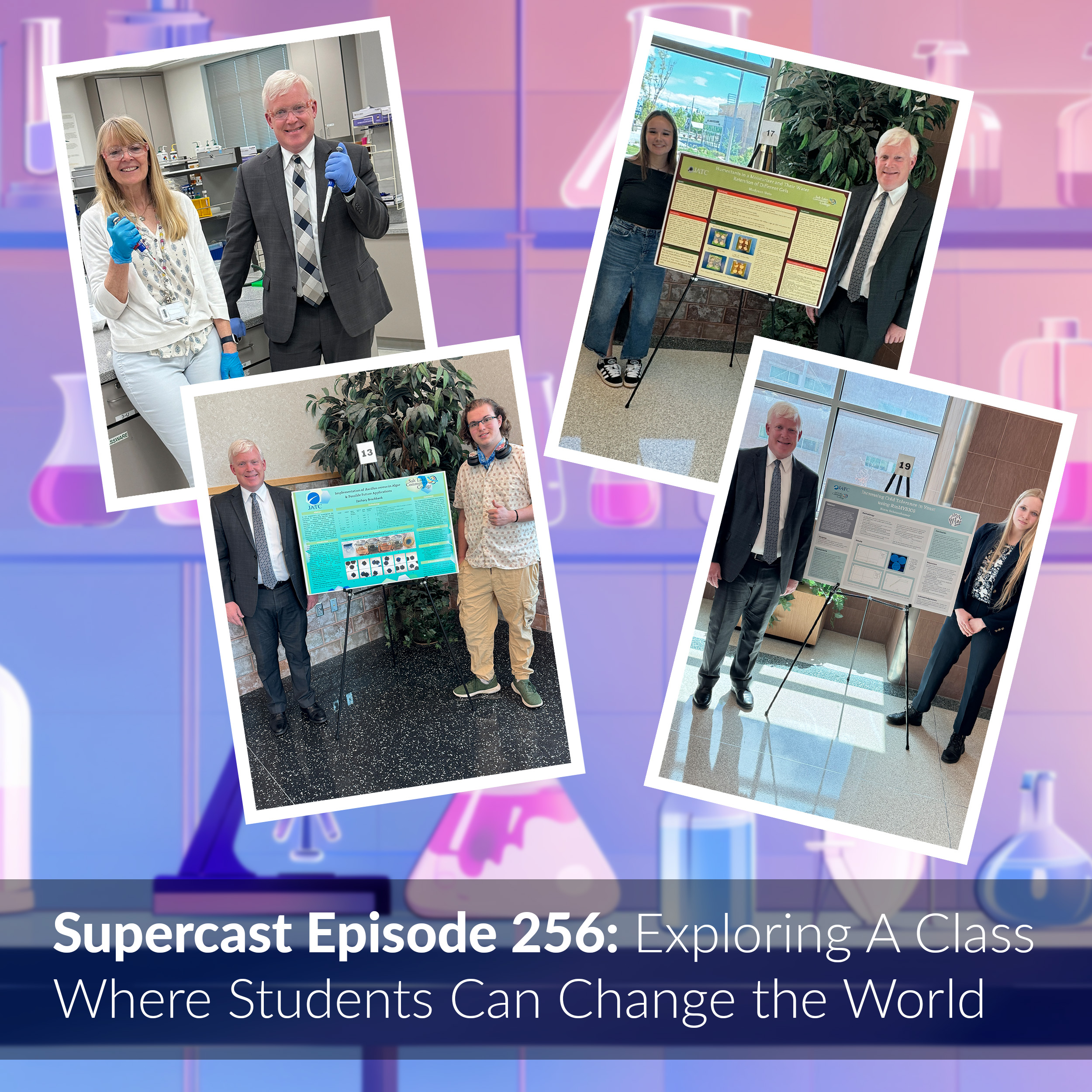
Exploring A Class Where Students Can Change the World
Description
It is a class that combines biology and technology giving students the tools to change the world for the better and improve people’s lives.
On this episode of the Supercast, join us as we take our own microscopic look into the Bio Tech program inside JATC North. It is a program where young student scientists study things like genetics, DNA isolation, protein methodologies, and much more. Some students are even engaged in finding cures for life-threatening illnesses like cancer.
Audio Transcription
[MUSIC]Anthony Godfrey:
Hello and welcome to the Supercast. I'm your host, Superintendent Anthony Godfrey. It is a class that combines biology and technology, giving students the tools to change the world for the better and improve people's lives.
On this episode of the Supercast, join us as we take our own microscopic look into the biotech program inside JATC North. It is a program where young student scientists study things like genetics, DNA isolation, protein methodologies, and much more. Some students are even engaged in finding cures for life-threatening illnesses like cancer.
[MUSIC]We're here at JATC North to learn more about the biotechnology class. And here to talk with us about it is the teacher, Dr. Carlson. Thank you very much for talking with us.
Dr. Carlson:
It's my pleasure. I really love to talk about this.
Anthony Godfrey:
I'm most focused on your role as a teacher, but you have a storied resume leading up to your time here at JATC North. So tell us about your background.
Dr. Carlson:
I would love to. I first started in a lab years ago in a human genetics lab, and we were some of the first individuals to develop markers that were placed on chromosome maps. From there-
Anthony Godfrey:
Wow.
Dr. Carlson:
-From there I participated in a group that cloned a gene that causes 1% of colon cancer. It's a hereditary form of the gene. It's called adenomatous polyposis coli, APC. And because of that work, if families have that mutation, they can be better screened so that their risk of cancer goes down.
Anthony Godfrey:
And you said it's APC?
Dr. Carlson:
Yes.
Anthony Godfrey:
I believe I know a family that has that gene because in their family, they get tested in their 20s.
Dr. Carlson:
Yes.
Anthony Godfrey:
Even as a teen, they get tested early on because of that gene that's been identified.
Dr. Carlson:
Absolutely, yeah.
Anthony Godfrey:
So before we talk about more of your resume, you right from the start saw the positive impact this has on humanity all over the world.
Dr. Carlson:
Absolutely. I was always interested in cancer biology. I got my PhD in cancer biology and felt like I was able to contribute to that field. I'm very proud of that contribution. Later on, I decided that I wanted to share my research background with students and try to encourage young women to pursue careers in science. And so that's really why I'm here now.
Anthony Godfrey:
And you worked at the Huntsman Cancer Center as well?
Anthony Godfrey:
I got my PhD at the Huntsman Cancer Institute, yes.
Anthony Godfrey:
And after getting your PhD, how long have you been here?
Dr. Carlson:
This is my 10th year teaching biotechnology.
Anthony Godfrey:
Wonderful.
Dr. Carlson:
Yeah.
Anthony Godfrey:
And have some of your students gone on to pursue this as a career?
Dr. Carlson:
They have. I've had some students go on to obtain graduate studies in biochemistry, or chemistry rather. I've had others that have gone into biomedical engineering.
Anthony Godfrey:
Okay.
Dr. Carlson:
So they've graduated in biomedical engineering. I've had others go on into the medical laboratory sci