Episode Details
Back to Episodes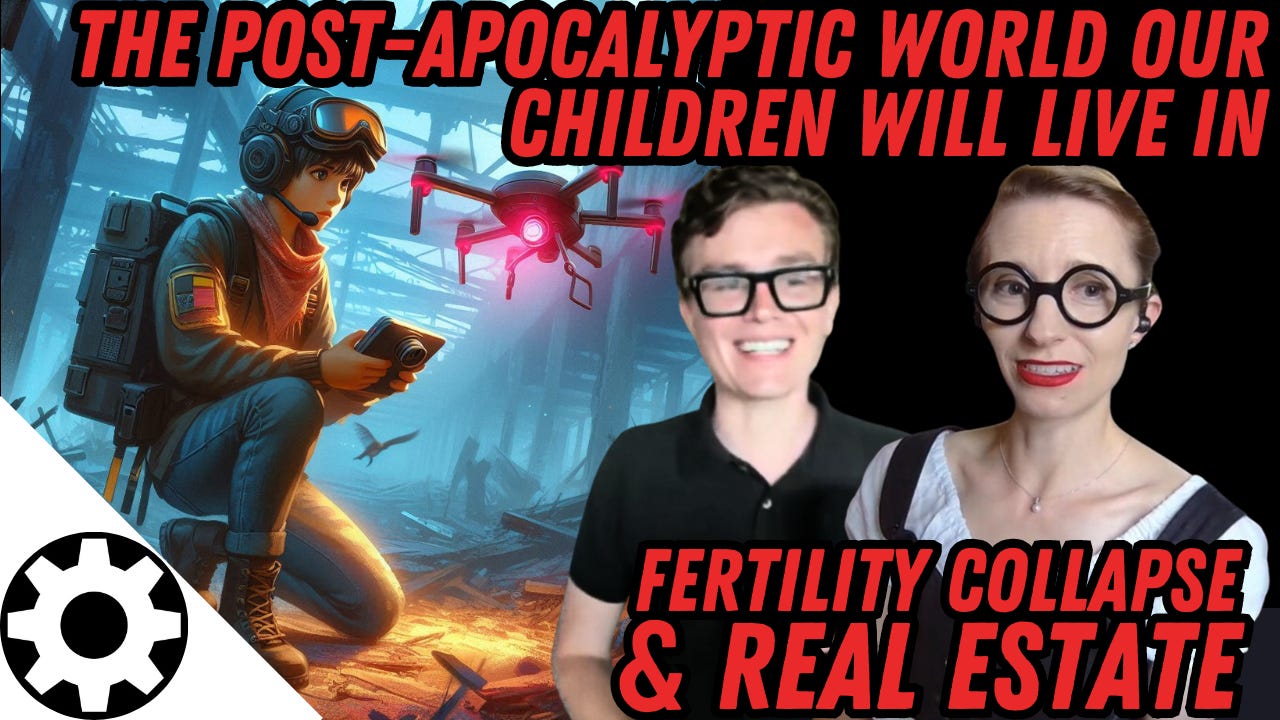
Real Estate & Fertility Collapse: Exploring the Post-Apocalyptic World Our Children Will Live In
Description
In this eye-opening discussion, Malcolm and Simone Collins explore the grim reality of housing markets in a world facing demographic collapse. They delve into the rapid decay of abandoned properties, the unsustainability of cities and suburbs, and speculate on a future where technologically advanced "havens" emerge amidst the ruins of our current civilization. This video offers a stark look at the potential consequences of population decline and technological advancement on our living spaces and social structures.
Key topics covered:
* The rapid deterioration of abandoned properties
* The unsustainability of modern cities and suburbs
* The impact of climate change on housing markets and insurance
* Speculation on future "haven" communities and their characteristics
* The potential divide between technophilic and technophobic societies
* The role of AI and advanced technology in shaping future communities
* Geopolitical implications of demographic collapse and technological advancement
Whether you're interested in urban planning, futurism, or the long-term consequences of current demographic trends, this video provides a thought-provoking look at the potential shape of our future world.
Malcolm Collins: [00:00:00] So here I am showing you some abandoned cathedrals.
Abandoned for fairly short times. These are in Detroit, this stuff. I am showing you abandoned schools. And abandoned pools. And abandoned stadiums. It is Genuinely nightmarish. You would be safer sleeping in the woods than in what our urban centers are going to become.
And so you can see that typically by the time you get to around 10 years without regular maintenance, you are looking at rubble.
I'm just
Simone Collins: getting increasingly nervous.
Malcolm Collins: Well, I'm going to give you a little short story that'll make you maybe not so nervous.
about one of our descendants a hundred years from now.
This person. Is hiking. They've got a drone companion flying alongside them. It's doing regular scans on the environment around them. So they don't step into like a basement that could collapse or something like that. They are having a blast [00:01:00] exploring the ruins of a dead world. And then they come across a tribe, one of the technophobic groups LARPing some version of 1950s life.
Would you like to know more?
Simone Collins: Hello,
Malcolm Collins: Simone. I'm excited to be here with you today. Today, we are going to be discussing one of the most misunderstood side effects of demographic collapse, which is.
Cheap housing. Oh, hooray. Everyone always says, they say, well, when the population is 5 percent of its current size, then housing will cost almost nothing. And that will be fantastic. Because then all of the young people will be able to afford houses and everything will stabilize and go back to normal.
Except that isn't what's going to happen. Talk about how quickly A house that is worth nothing begins to fall apart. And this is something that we saw [00:02:00] in Detroit. So we are going to go over timelines in Detroit of deterioration, but I also want to start a bit closer to home. So I grew up part time living on an island with my family that my family owns and now I don't inherit it or anything like that.
It goes to my sister. So it's not like, again, I get nothing, don't worry about it guys still starting from scratch here, but,
Simone Collins: Hey, I have to stop and say though, when we were first dating,
Malcolm Collins: I
Simone Collins: was like, this is a caricature of life, because no one actually has private islands, but apparently they do. But then, like, you and I learned that there's a reason why people don't have private islands. Because