Episode Details
Back to Episodes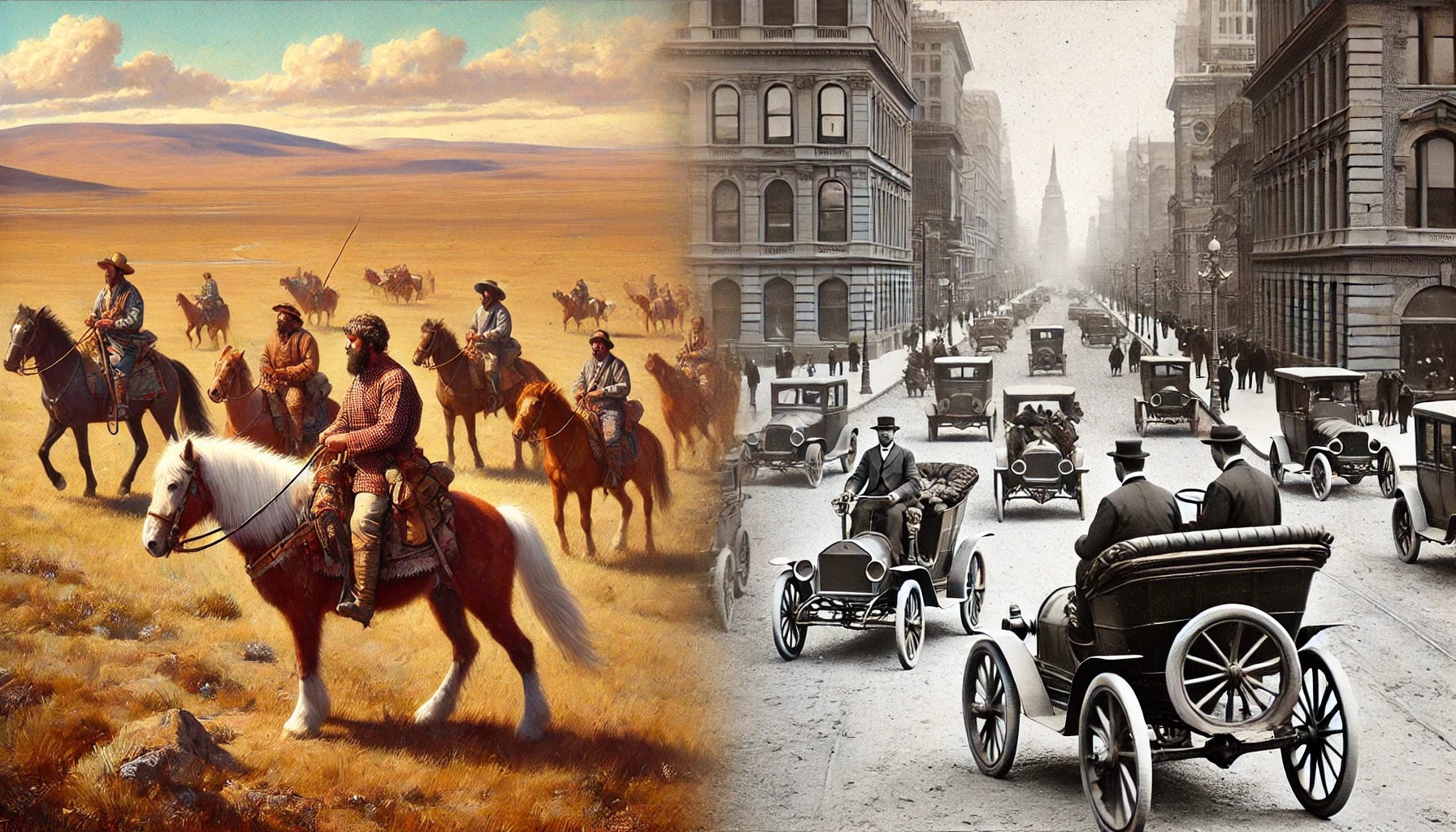
The rise and fall of the horse, how it relates to gold and a question
Description
Good Sunday afternoon to you,
I was blown away by the response to Wednesday’s article about weight loss. The Twitter/X summary got more than 10 million views. Here it is, in case you missed it.
Going forward, I am thinking of writing more alternative health stuff, as there seems to be a huge appetite for it. But today it’s business as usual: gold.
And I have a question for you …
The Great Steppe stretches approximately 5,000 miles from the Pacific coast of China through Mongolia, Siberia, Xinjiang, Kazakhstan, Russia, Ukraine, and Romania, reaching the Danube Delta and Hungary.
Vast stretches of grassland, savanna, and shrubland—harsh and dry, devoid of trees and large vegetation—are sandwiched between forests to the north and mountains and deserts to the south. This region has connected Central Europe, Eastern Europe, Western Asia, Central Asia, East Asia, and South Asia since the Paleolithic Age, serving as a predecessor to the Silk Road and the Eurasian land bridge.
This ocean of grass is one of the world’s largest ecosystems. Many remarkable species—elk, gazelle, brown bear, leopard, and tiger—have made it their home. So have many great nomadic empires—the Xiongnu, the Scythians, the Mongols, the Huns, and the Göktürk Khaganate—all famous for their ferocity, horsemanship, and military might.
The open space gives rise to mighty extremes of weather—howling winds, unbearable heat by day, and freezing cold by night. Humans could only survive by breeding creatures—goats, sheep, camels, and cattle—even hardier than themselves. Of all of these, perhaps the most essential to human survival and evolution was the horse.
The horse was first domesticated on the Steppe about 6,000 years ago, probably by the Botai people in present-day Kazakhstan. Their horses—likely similar to today’s Mongolian horse—were small, stocky, and hardy, able to travel long distances in trying conditions. The horse enabled tribes to guide their flocks over large distances as they searched for new grazing lands. It facilitated trade and exchange, and allowed them to form huge and terrifying armies.
The fearsome Scythians were the first to use horses in battle, carrying stones, clubs, and bows as weapons. These marauding armies inspired fear. Their warriors were such brilliant horsemen that it seemed they and their horses were one creature, giving rise to the Greek myth of the centaur: wild, untamed, and violent; strong, fast, and ferocious; drunken, lawless, and lustful, with the upper body of a man and the lower body of a horse.
The Greeks had a complicated relationship with the Scythians, both admiring and fearing them. Chiron, one of the centaurs famous for his wisdom and knowledge of medicine, tutored many of the greatest Greek heroes, including Hercules, Achilles, and Jason. Perhaps the Greeks exaggerated their barbarity to contrast it with their own sophistication and culture.
In any case, while the centaur has endured in myth, it was not long before it was realized that man and beast were not one, and the practice of horse-riding spread beyond the Great Steppe. The horse became the primary mode of land transport for thousands of years.
You really should subscribe.
Then the Industrial Revolution came along.
The first steam locomotive was developed in England in 1804. By the mid-19th century, railroads had become the primary mode of transportation for people and goods across much of the world. It was the beginning of the end for horses as a primary mode of transportation.
In the late 19th and early 20th centuries, the automobile emerged. “Horseless carriages,” they were called. Karl Benz developed the first gasoline-powered car in 1885. By the early 1900s, cars had become a common sight on many roads, further diminishing the need for horses.
Inventor Alexander Wint