Episode Details
Back to Episodes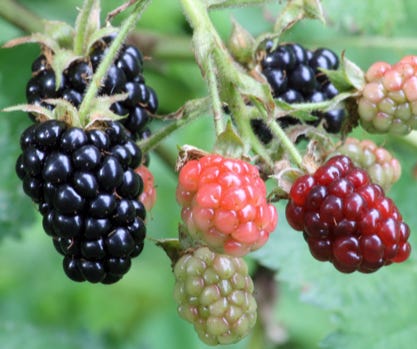
Why Are the Blackberries Turning White?
Description
If you’re wondering about blackberry discoloration this summer, you won’t find that information in the podcast (above). What you will find for your ears: great information about superior blackberry varieties to grow, along with tips for pruning and trellising blackberries.
As to why you might start seeing some discoloration in your blackberry patch right now might be due to the weather.
But before we shine a light on that, here’s what you may have missed in last Friday’s Garden Basics with Farmer Fred podcast, Ep. 349: “Stressed? Your Garden Can Help.” And haven’t we all seen an increase in the stress levels this past couple of weeks. One easy way to soothe the worried mind: single malt Scotch Take a whiff of the garden. Really!
America’s Favorite Retired College Horticulture Professor, Debbie Flower, and myself sniff out the answers that may be in your own yard.
• Gardening and spending time in nature can help reduce stress and anxiety.
• Forest bathing, or enjoying a slow walk or sit in a natural environment, can have calming effects.
• Having a garden or indoor plants can provide stress relief and improve mental well-being.
• Aromatic plants, such as jasmine, lavender, and mint, can have a soothing effect on the mind and body.
Why Are the Blackberries Turning White?
From the garden e-mail bag, Teri asks: "What is wrong with my blackberries?"
Dewey & Ann write: "What is causing this problem with my Chester blackberries? This is on the majority of them. I had it last year too. I checked with the local Hmong community farmers, and they also had it and said it was the 111 degrees we had in Oroville. We are at 2500 feet and 10 degrees cooler, but it wasn’t this hot last year. My Black Satin Blackberries were forming and doing well and I thought the problem was only with the Chester. Well, pretty soon I see it on them also. Am I missing something in our soil? It’s not on every one of them. It’s a dried seed eventually, but goes from a pink to beige and then worse if you don’t pick them. I would like to get to bottom of this. Can you help me?"Your local Hmong are wise horticulturists. The recent week of very sunny 100+ temperatures, along with several of triple digit scorchers in the first week of July, could very well be the culprit.Usually when we think of heat stressed plants, the cool season ones that tend to croak when it gets hot come to mind, such as lettuce plants in early summer or snow pea vines by Memorial Day weekend.Even warm season vegetables that like sunlight, especially tomatoes, can be adversely effected by too much high intensity sun. Abiotic disorders such as cracking, solar yellowing or green shoulders are common this time of year on young tomato crops.
One remedy for those tomatoes: don't prune off any of the leaf canopy of tomato plants; or, cover with a lightweight row cover to provide some more shade.
And now, you can add blackberries to the list of crops that develop problems when it gets too sunny, too hot, dry and windy, especially because of extended heatwaves. The problem is known as White Drupelet Disorder (WDD).
According to the UC Integrated Pest Management Guidelines for Caneberries:"White drupelet is a tan-to-white discoloration of one to many drupelets on the fruit. Most often, white drupelets will appear when there has been an abrupt increase in temperature accompanied by a drop in humidity; it is especially pronounced when there is wind. In the Monterey Bay area, white drupelet typically occurs when temperatures that are fairly steady around 70 degrees suddenly go above 90 degrees, and there is an absence of fog.While white drupelets may seem to be directly caused by weather, they are actually caused