Episode Details
Back to EpisodesNero: Myth and Monster
Description
Emperor Nero’s reputation for wickedness and depravity had already attained mythic status within a century of his death, making him a prototype for early Christian beliefs regarding the Antichrist.
We begin the show with a look at the role poison played in Nero’s ascent, putting him on the throne at the age of 17 in 54AD. After her marriage to Emperor Claudius, Nero’s Mother, Agrippina the Younger, appears to have recruited the notorious poisoner Locusta, to do away with the Emperor when he began to show preference for his other son Britannicus over Nero. And it was Nero himself who later recruited Locusta to do away with the troubling Britannicus.
Agrippina’s role in Nero’s life constituted another kind of poison. If we are to believe what the historian Tacitus describes as “rumors” (rumors affirmed as true by the historian Suetonius), Agrippina seems to have shared her brother Caligula’s inclination toward sexual depravity. Shocking details regarding her relationship with her son are naturally provided.
However, Agrippina seems to have been more driven by lust for power (via her son) than sexual desire. Part of her scheme to set him on the throne had been his marriage to Claudius’ daughter Octavia, who suffered greatly as a result. We hear a bit about her shoddy treatment and arranged “suicide” as well as the rise of Nero’s second wife and former mistress Poppaea Sabina, who is (according to Suetonius) later kicked to death by the emperor. More deaths of potential familial rivals are detailed.
Nero’s overweening Mother likewise falls afoul of her son, and we hear of some particularly bizarre and cartoonish attempts he makes on her life eventually ending with another “suicide” five years after Nero has taken the throne.
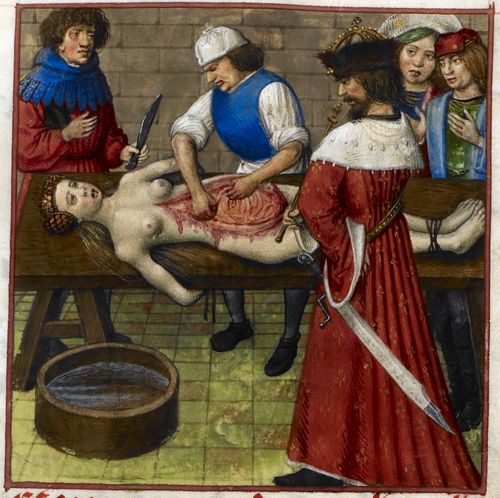
Agrippina’s alleged final words to her assassin — “Smite my womb” — expressing her regret over birthing her monstrous son, were woven into other legends amplified in the Middle Ages into a particularly strange narrative involving dissected bodies and frogs. Mrs. Karswell reads for us the relevant passage from Jacobus de Varagine’s 1275 compilation of hagiographies and related stories, The Golden Legend.
Along the way, we also hear some tales of Nero’s vanity (his endless mandatory-attendance lyre concerts), excesses (pet tigers and Felliniesque parties) and further sexual aberrations (castration and marriage to his male “wife” Sporus in 67AD.)
As for the Great Fire of Rome in 64AD, his musical performance celebrating the event is treated as historical fact by the majority of ancient chroniclers, but it involves neither lyre nor fiddle. The association with the fiddle is explained along the way, and we also hear a snippet of Jimmy Collie 1956 country-western song, “Nero Played His Fiddle (While Rome Burned)” At least two sources (Sueton