Episode Details
Back to Episodes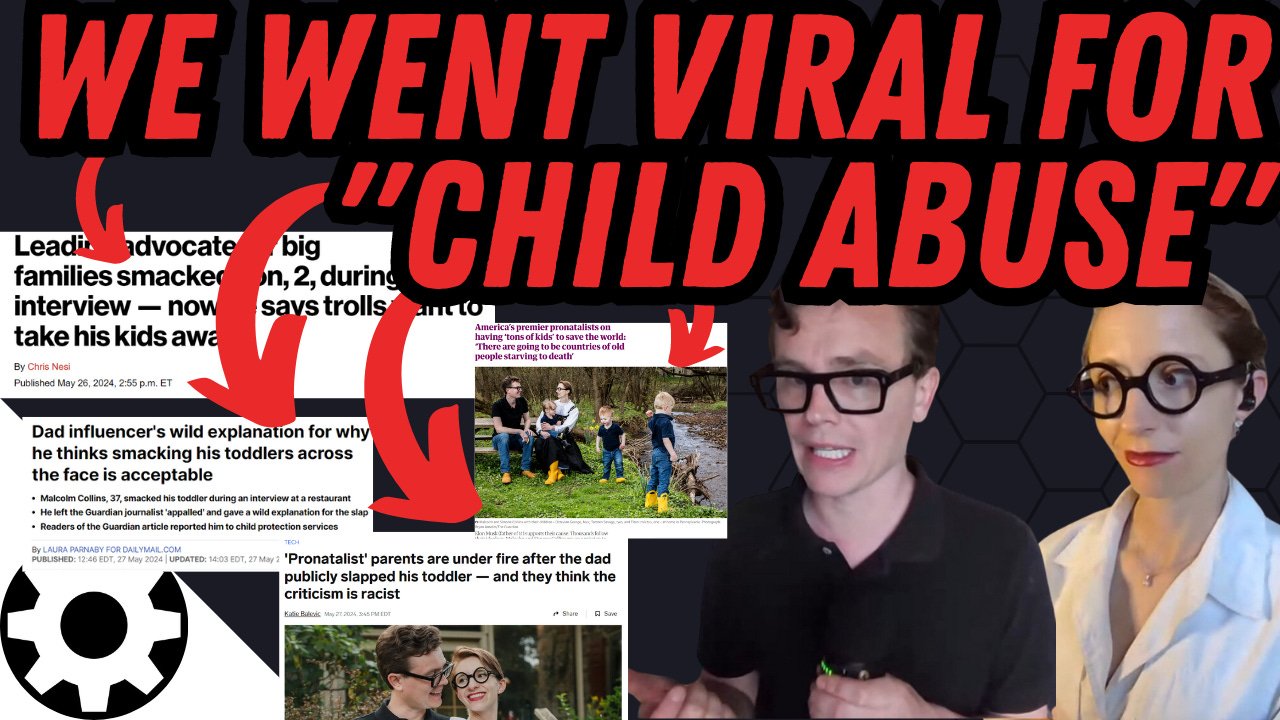
We Went Viral for "Child Abuse"
Description
In this candid discussion, Malcolm and Simone Collins share their unconventional parenting approach, which includes a form of physical correction they call "bopping." Despite the controversy surrounding their methods, the couple argues that their approach is rooted in cultural practices and evolutionary psychology. They discuss the differences between abuse and discipline, the importance of setting boundaries, and why they believe their methods are ultimately in the best interest of their children.
Malcolm and Simone also delve into the challenges of parenting in the modern world, the limitations of existing research on corporal punishment, and the potential consequences of relying solely on emotional punishment. While they acknowledge that their approach may not be suitable for every child or family, they stand firm in their belief that parents should have the right to raise their children in accordance with their cultural values.'
[00:00:00] We can't do it, man! That's discipline!
We don't believe in rules like we gave them up when we started living like freaky beatniks. . Yeah, you've got to help us, Doc. We've tried nothing and we're all out of ideas.
Most, perhaps all, the blame rests with the parents. Have you ever tried simply turning off the TV, sitting down with your children, and hitting them?
lost your god damn mind! I guess I just hate to see a child go unbeaten.
Malcolm Collins: now I need to talk for a few minutes about why I find the research so distrustworthy in this space.
One, you're proceeding into the research from a prior that this is a human rights abuse. Whenever anyone says every expert in a field agrees on something, I pretty much immediately dismiss it.
Because I'm like, that just doesn't happen in science when science is
Simone Collins: happening correctly. There is always nuance in finding what's happening
Malcolm Collins: correctly If you look [00:01:00] at what the research is saying, it's this has a massive IQ effect. This has a massive effect on aggression.
These people become antisocial and aren't able to They hate their parents, et cetera. If these things were true at the levels that they're saying these things are true. Every single long lived culture on Earth would not have convergently evolved this method of interacting with children during this developmental stage.
What is really negative and what we are against is. Is any form of punishment where the pain is the point of the punishment? what happens during a bop? It is a light slap on the child's nose or face that is meant to shock and redirect and refocus attention. The reason we do the face is because It requires much less pain to get the same reaction than doing something like slapping the wrist.
Don't really do this for four year olds and up with our kids two to four range, because with my [00:02:00] four year old, I can say this could kill you and he can begin to cognitively understand that.
Two to four, you don't really get that. And so when you need to denote, no, this is an extra level of don't do this when compared to other things I have told you not to do the only way to denote that other than physicality. Is by emotionally elevating the conversation. And I think that causes more emotional damage
if you read the article, it says exactly what happened in the context. He was about to push over a table I did the bop to reorient him because he knew he wasn't supposed to be doing that, but then I immediately tell him I love him. Now, this isn't something I can do if I'm punishing him through the emotional means. Exactly. If I had elevated the conversation emotionally, now I need to say daddy's mad at you, instead of saying, bop, you crossed a line, but daddy loves you,
and this is the problem, right? So the urban monoculture would say to us, what you're doing is culturally non normativ