Episode Details
Back to Episodes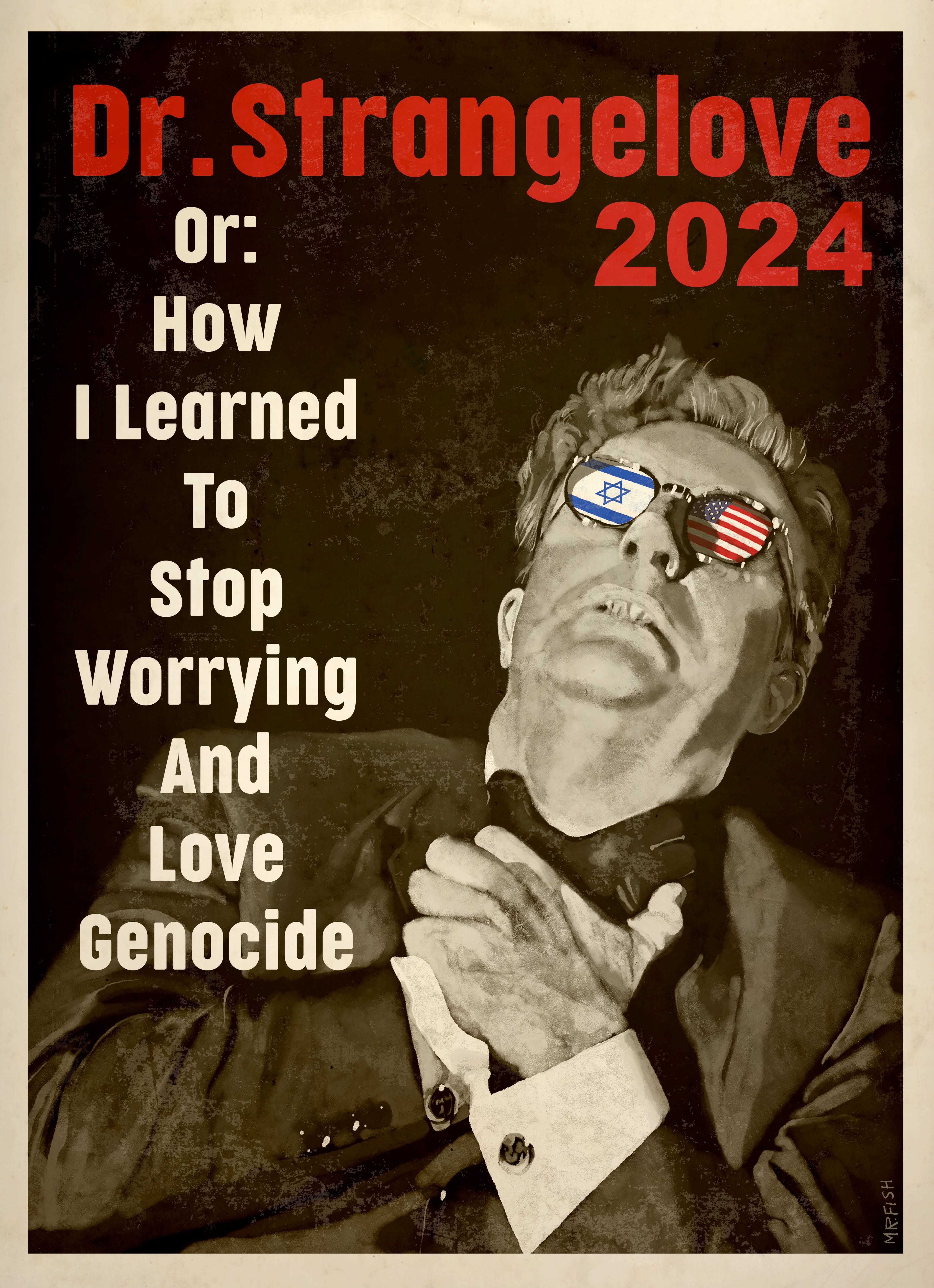
The Nation’s Conscience, Part II - Read by Eunice Wong
Description
Text Originally published May 08, 2024
Strangelove 2024 — by Mr. Fish
University President Christopher Eisgruber met with the hunger strikers – the first meeting by school administrators with protesters since Oct. 7 – but dismissed their demands.
“This is probably the most important thing I’ve done here,” says Areeq Hasan, a senior who is going to do a PhD in applied physics next year at Stanford, who is also part of the hunger strike. “If we’re on a scale of one to 10, this is a 10. Since the start of encampment, I have tried to become a better person. We have pillars of faith. One of them is sunnah, which is prayer. That’s a place where you train yourself to become a better person. It is linked to spirituality. That’s something I’ve been emphasizing more during my time at Princeton. There’s another aspect of faith. Zakat. It means charity, but you can read it more generally as justice…economic justice and social justice. I’m training myself, but to what end? This encampment is not just about trying to cultivate, to purify my heart to try to become a better person, but about trying to stand for justice and actively use these skills that I’m learning to command what I feel to be right and to forbid what I believe to be wrong, to stand up for oppressed people around the world.”
Anha Khan, a Princeton student on hunger strike whose family is from Bangladesh, sits with her knees tucked up in front of her. She is wearing blue sweatpants that say Looney Tunes and has an engagement ring that every so often glints in the light. She sees in Bangladesh’s history of colonialism, dispossession and genocide, the experience of Palestinians.
“So much was taken from my people,” she says. “We haven’t had the time or the resources to recuperate from the terrible times we’ve gone through. Not only did my people go through a genocide in 1971, but we were also victims of the partition that happened in 1947 and then civil disputes between West and East Pakistan throughout the forties, the fifties and the sixties. It makes me angry. If we weren’t colonized by the British throughout the eighteenth, nineteenth and twentieth century, and if we weren’t occupied, we would have had time to develop and create a more prosperous society. Now we’re staggering because so much was taken from us. It’s not fair.”
The hostility of the university has radicalized the students, who see university administrators attempting to placate external pressures from wealthy donors, the weapons manufacturers and the Israel lobby, rather than deal with the internal realities of the non-violent protests and the genocide.
“The administration doesn’t care about the well being, health or safety of their students,” Khan tells me. “We have tried to get at least tents out at night. Since we are on a 24-hour liquid fast, not eating anything, our bodies are working overtime to stay resilient. Our immune systems are not as strong. Yet the university tells us we can’t pitch up tents to keep ourselves safe at night from the cold and the winds. It’s abhorrent for me. I feel a lot more physical weakness. My headaches are worse. There is an inability to even climb up stairs now. It made me realize that for the past seven months what Gazans have been facing is a million times worse. You can’t understand their plight unless you experience that kind of starvation that they’re experiencing, although I’m not experiencing the atrocities they’re experiencing.”
The hunger strikers, while getting a lot of support on social media, have also been the targets of death threats and hateful messages from conservative influencers. “I give them 10 hours before they call DoorDash,” someone
Listen Now
Love PodBriefly?
If you like Podbriefly.com, please consider donating to support the ongoing development.
Support Us