Episode Details
Back to Episodes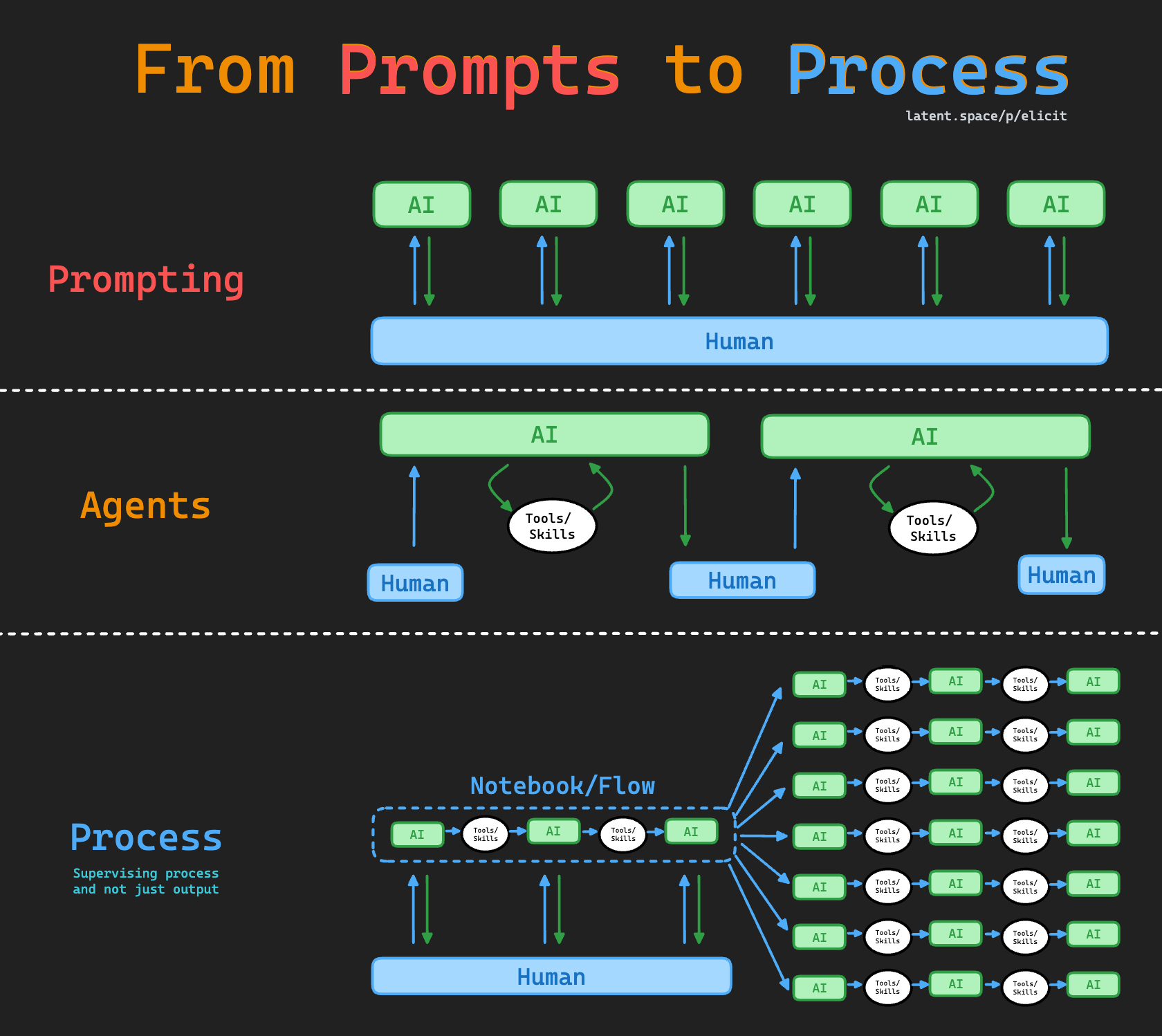
Supervise the Process of AI Research — with Jungwon Byun and Andreas Stuhlmüller of Elicit
Description
Maggie, Linus, Geoffrey, and the LS crew are reuniting for our second annual AI UX demo day in SF on Apr 28. Sign up to demo here! And don’t forget tickets for the AI Engineer World’s Fair — for early birds who join before keynote announcements!
It’s become fashionable for many AI startups to project themselves as “the next Google” - while the search engine is so 2000s, both Perplexity and Exa referred to themselves as a “research engine” or “answer engine” in our NeurIPS pod. However these searches tend to be relatively shallow, and it is challenging to zoom up and down the ladders of abstraction to garner insights. For serious researchers, this level of simple one-off search will not cut it.
We’ve commented in our Jan 2024 Recap that Flow Engineering (simply; multi-turn processes over many-shot single prompts) seems to offer far more performance, control and reliability for a given cost budget. Our experiments with Devin and our understanding of what the new Elicit Notebooks offer a glimpse into the potential for very deep, open ended, thoughtful human-AI collaboration at scale.
It starts with prompts
When ChatGPT exploded in popularity in November 2022 everyone was turned into a prompt engineer. While generative models were good at "vibe based" outcomes (tell me a joke, write a poem, etc) with basic prompts, they struggled with more complex questions, especially in symbolic fields like math, logic, etc. Two of the most important "tricks" that people picked up on were:
* Chain of Thought prompting strategy proposed by Wei et al in the “Chain-of-Thought Prompting Elicits Reasoning in Large Language Models”. Rather than doing traditional few-shot prompting with just question and answers, adding the thinking process that led to the answer resulted in much better outcomes.
* Adding "Let's think step by step" to the prompt as a way to boost zero-shot reasoning, which was popularized by Kojima et al in the Large Language Models are Zero-Shot Reasoners paper from NeurIPS 2022. This bumped accuracy from 17% to 79% compared to zero-shot.
Nowadays, prompts include everything from promises of monetary rewards to… whatever the Nous folks are doing to turn a model into a world simulator. At the end of the day, the goal of prompt engineering is increasing accuracy, structure, and repeatability in the generation of a model.
From prompts to agents
As prompt engineering got more and more popular, agents (see “The Anatomy of Autonomy”) took over Twitter with cool demos and AutoGPT became the fastest growing repo in Github history. The thing about AutoGPT that fascinated people was the ability to simpl