Episode Details
Back to Episodes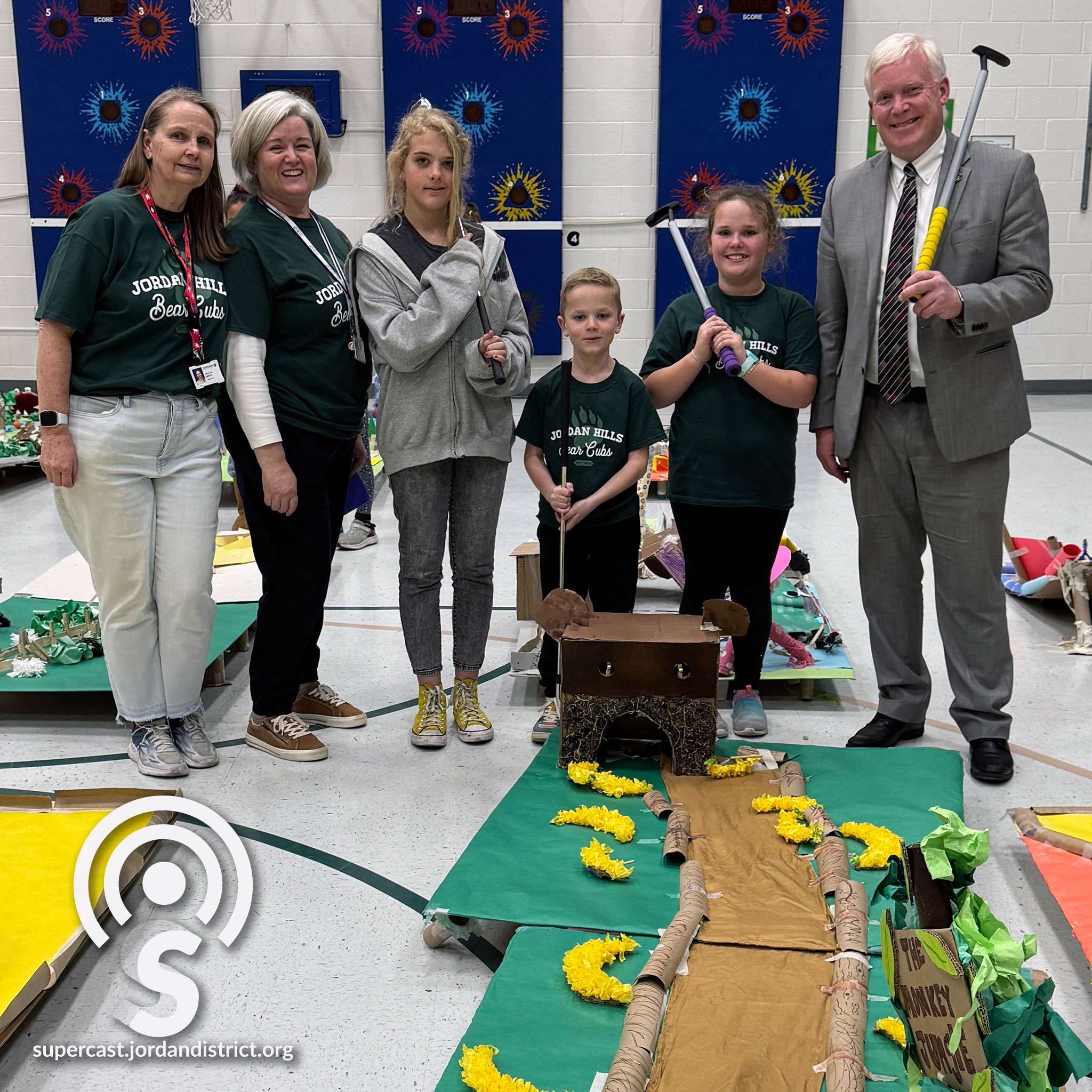
A “Hole-In-One” Championship Kind of STEM Course at Jordan Hills Elementary School
Description
They were asked to take a swing at designing miniature golf courses and the students proved concentrating on teamwork can pay off.
On this episode of the Supercast, we take you to Jordan Hills Elementary School where STEM specialists gathered groups of students in the gym for a unique lesson. The students were asked to use engineering skills and work in teams to create challenging mini golf courses worthy of a hole-in-one. It was a STEM exercise that was educational and a whole lot of fun.
Audio Transcription
[Music]Anthony Godfrey:
Hello and welcome to the Supercast. I'm your host, Superintendent Anthony Godfrey. They were asked to take a swing at designing miniature golf courses, and these students showed that concentrating on teamwork pays off.
On this episode of the Supercast, we take you to Jordan Hills Elementary School, where STEM teachers gather groups of students in the gym for a unique lesson. The students were asked to use engineering skills and to work in teams to create challenging mini-golf courses worthy of a hole-in-one. It was a STEM exercise that was educational and a whole lot of fun.
[Music]We're here with Susan Smith, one of the STEM specialists at Jordan Hills Elementary, to talk about your inaugural mini-golf course here. It fills the gym. It looks fantastic. It's very colorful. I'm not sure what the fire marshal would say. It's a lot of cardboard and paper.
Susan Smith:
It is. Yes.
Anthony Godfrey:
I think it looks fabulous. And it looks like every single hole has a different theme. Tell me a little bit about how this came to be. As the STEM specialist, of course, you're focused on engineering, math, science, technology, and giving students opportunities to do some real-world sort of work in that area. Tell me all about this project. It looks really cool.
Susan Smith:
Well, for six years, we've been working here as the STEM specialists when the program first started. I have been getting all my ideas off of the internet. We saw this idea several years ago and wanted to try it, but it seemed daunting.
Anthony Godfrey:
And this is the year?
Susan Smith:
This is the year. We decided to really give it a go. We came up with a couple dozen themes, separate themes for each of the classes. None of these classes have the same theme. We all decided they got to pick out of a few of those themes, which ones they wanted their class to do. And so every theme– I mean, there's farm, outer space, RSL soccer.
Anthony Godfrey:
Oh, wow. We're going to take a walk-through. Tell me what are some of the things that you wanted students to take away from this project? What did you want them to learn?
Susan Smith:
The main thing was for them to work together and to cooperate and to collaborate as a class.
Anthony Godfrey:
I love that. Yeah, that's great.
Susan Smith:
It doesn't really matter how well the golf course turned out, although some of them really did turn out well. But no, we really wanted them to learn about collaboration and working together.
Anthony Godfrey:
And how did that turn out?
Susan Smith:
Beautifully. It was awesome. They all just really got excited about it and worked together to come up with all of their different ideas for their individual class course.
Anthony Godfrey:
So is each one a different class? So the whole class worked on the hole.
Susan Smith:
Yes. The whole class made one hole.
Anthony Godfrey:
Oh, wow.
Susan Smith:
Well, the ALPS classes, since they're larger, made two courses.
Anthony Godfrey:
Wow. That looks fantastic. So now, you know, when Arnold Palmer or any of the pros design a course, it's their signature course.
Susan Smith:
Right.
Anthony Godfrey:
So this is like