Episode Details
Back to Episodes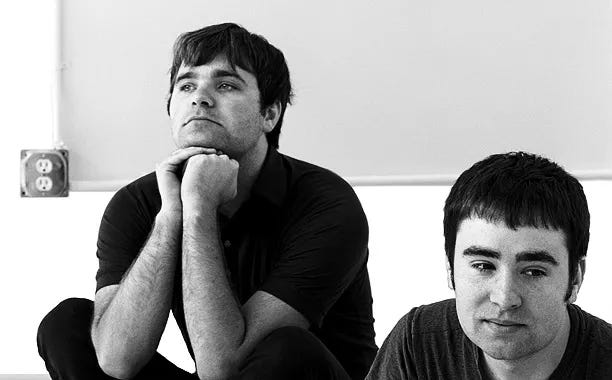
Narrated Essay: The District Sleeps Alone Tonight
Description
Never in my life have I met anyone who felt music so intensely as my father. He could not help listening to it; when he heard music that pleased him he became excited and there was a contraction in his throat; he sobbed and shed tears. The feelings aroused in him were unreasoning emotion and excitement. Sometimes it excited him against his will and even tormented him, and he would say: que me veut cette musique? (what does that music want of me?) - Tolstoy, C. S., & Maude, A. (1926). Music in Tolstoy’s Life. The Musical Times, 67(1000), 516–518.
A few weeks ago, while circling the driveway of an elementary school, I received a directive from an old friend via text: listen for nostalgia. Another bell tone followed, delivering a link to an interview about a song I had nearly forgotten in the decade since I last heard it. I am not in the habit of listening to music podcasts. Rarely have I memorized lyrics or researched the story behind a song, believing instead in the primacy of learning a song by heart, through its melodic currents and timbre. But I can understand Tolstoy’s question what does that music want of me? If I find myself intrigued by a song, I like to get quiet and listen with my whole body, and then return again and again until the song becomes a friend and I notice myself asking strange questions like what’s happening here? and why does this feel meaningful to me?
I first heard the song “The District Sleeps Alone Tonight” as a freshman in college. It opens with three incantatory notes from a synthesized organ (C, Dm, Am) and then begins to layer disarmingly self-conscious lyrics, smeared black ink, your palms are sweaty, I’m barely listening, swelling into a melodious revelation: I am finally seeing why I was the one worth leaving. The bridge repeatedly chimes where I am, where I am, offering a gentle allowance to accept where we are and have been.
For those of us for whom Washington, DC in the early 2000s was not just a city but the proving ground of our relational lives, “The District Sleeps Alone Tonight” touched a relatable quality of loneliness, an effervescent tension between wanting to sense our worthiness and dignity on one hand, and the public absurdities and private regrets that are emblematic of a certain chapter of life on the other.
From Hrishikesh Hirway’s recently remastered interview with Jimmy Tamborello and Ben Gibbard, the unlikely halves of an indie-electronic duo called The Postal Service, I learned some informative details. Their collaboration began at the fringes of their early twenties, when, living in different cities, broke, and barely acquainted, they began mailing fragments of songs back and forth to each other. Fresh musical layers were decanted in the days between sending and receiving them. Gibbard would walk through his neighborhood at night listening to that day’s delivery through wire headphones; his mind would slide around with Tamborello’s instrumentals until an unexpected image or memory would emerge; then he would pull a notebook out of his pocket and start scribbling. It was a faithful process. They asked another acquaintance, Jenny Lewis, to contribute harmonies, and, after some months, they christened their first and only album Give Up.
Give Up was a good one, as it turned out. It is considered a landmark album for its unique fusion of indie-rock and electronic elements; to the artists’ surprise, it sold more than a million records. Warm vocals stream above experimental sounds in what Tamborello and Gibbard dubbed an “80’s electro-pop revival record.” Even now, the songs feel at once familiar and yet serendipitous. We sense two artists on their way somewhere else, but just available enough to slip into a creative portal meant just for them.
Of the album’s first song, Gibbard explains that