Episode Details
Back to Episodes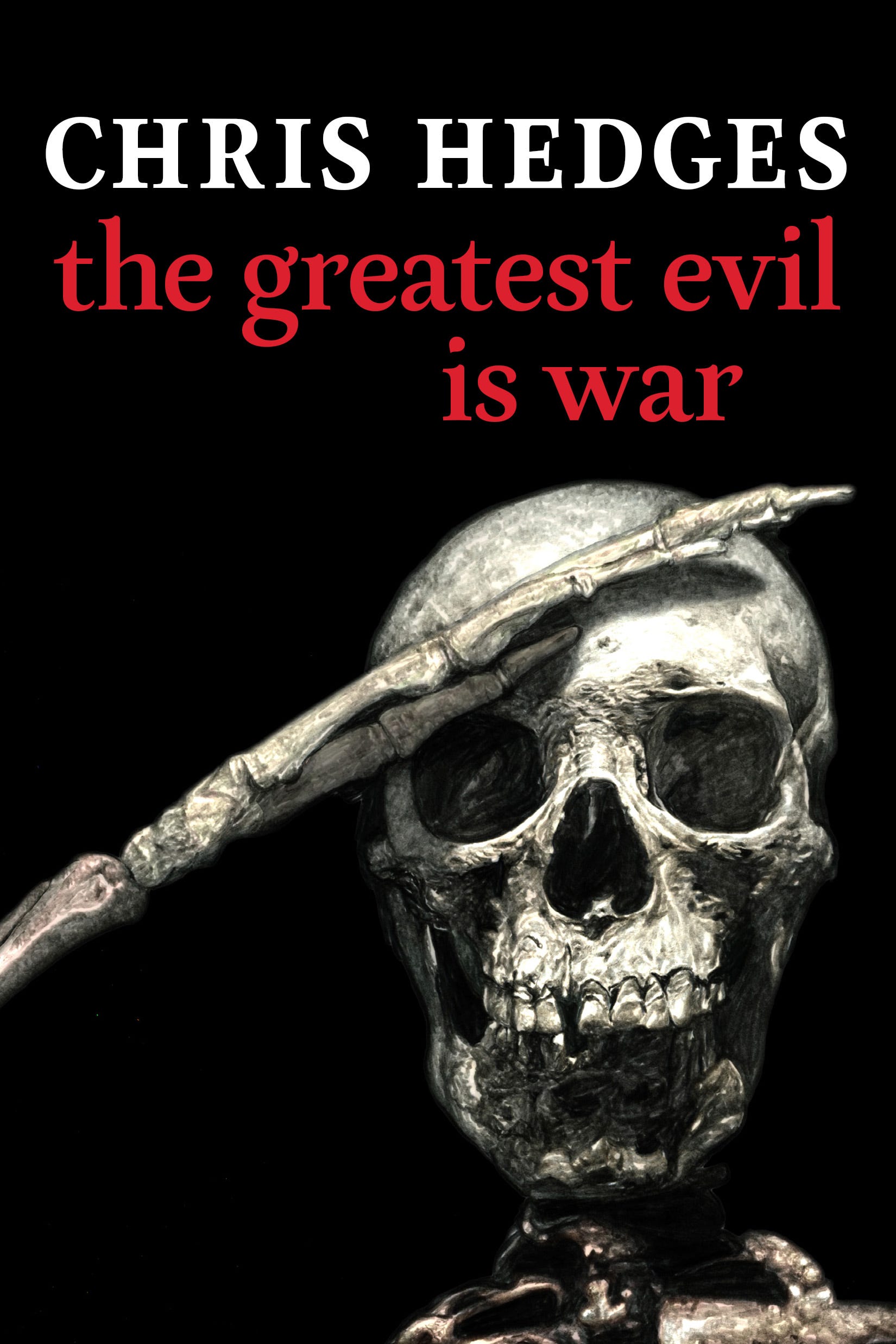
Listen to this Article: "Writing on War"
Description
Narrated by Eunice Wong
Cover Design by Mr. Fish
Writing on War
And Living in a World from Hell
By Chris Hedges
As this century began, I was writing War Is a Force That Gives Us Meaning, my reflections on two decades as a war correspondent, 15 of them with the New York Times, in Central America, the Middle East, Africa, Bosnia, and Kosovo. I worked in a small, sparsely furnished studio apartment on First Avenue in New York City. The room had a desk, chair, futon, and a couple of bookshelves — not enough to accommodate my extensive library, leaving piles of books stacked against the wall. The single window overlooked a back alley.
The super, who lived in the first-floor apartment, smoked prodigious amounts of weed, leaving the grimy lobby stinking of pot. When he found out I was writing a book, he suggested I chronicle his moment of glory during the six days of clashes known as the Stonewall Riots, triggered by a 1969 police raid on the Stonewall Inn, a gay club in Greenwich Village. He claimed he had thrown a trash can through the front window of a police cruiser.
It was a solitary life, broken by periodic visits to a small antique bookstore in the neighborhood that had a copy of the 1910-1911 Encyclopedia Britannica, the last edition published for scholars. I couldn’t afford it, but the owner generously let me read entries from those 29 volumes written by the likes of Algernon Charles Swinburne, John Muir, T.H. Huxley, and Bertrand Russell. The entry for Catullus, several of whose poems I could recite from memory in Latin, read: “The greatest lyric poet of Rome.” I loved the certainty of that judgment — one that scholars today would not, I suspect, make, much less print.
There were days when I could not write. I would sit in despair, overcome by emotion, unable to cope with a sense of loss, of hurt, and the hundreds of violent images I carry within me. Writing about war was not cathartic. It was painful. I was forced to unwrap memories carefully swaddled in the cotton wool of forgetfulness. The advance on the book was modest: $25,000. Neither the publisher nor I expected many people to read it, especially with such an ungainly title. I wrote out of a sense of obligation, a belief that, given my deep familiarity with the culture of war, I should set it down. But I vowed, once done, never to willfully dredge up those memories again.
To the publisher’s surprise, the book exploded. Hundreds of thousands of copies were eventually sold. Big publishers, dollar signs in their eyes, dangled significant offers for another book on war. But I refused. I didn’t want to dilute what I had written or go through that experience again. I did not want to be ghettoized into writing about war for the rest of my life. I was done. To this day, I’m still unable to reread it.
The Open Wound of War
Yet it’s not true that I fled war. I fled my wars but would continue to write about other people’s wars. I know the wounds and scars. I know what’s often hidden. I know the anguish and guilt. It’s strangely comforting to be with others maimed by war. We don’t need words to communicate. Silence is enough.
I wanted to reach teenagers, the fodde