Episode Details
Back to Episodes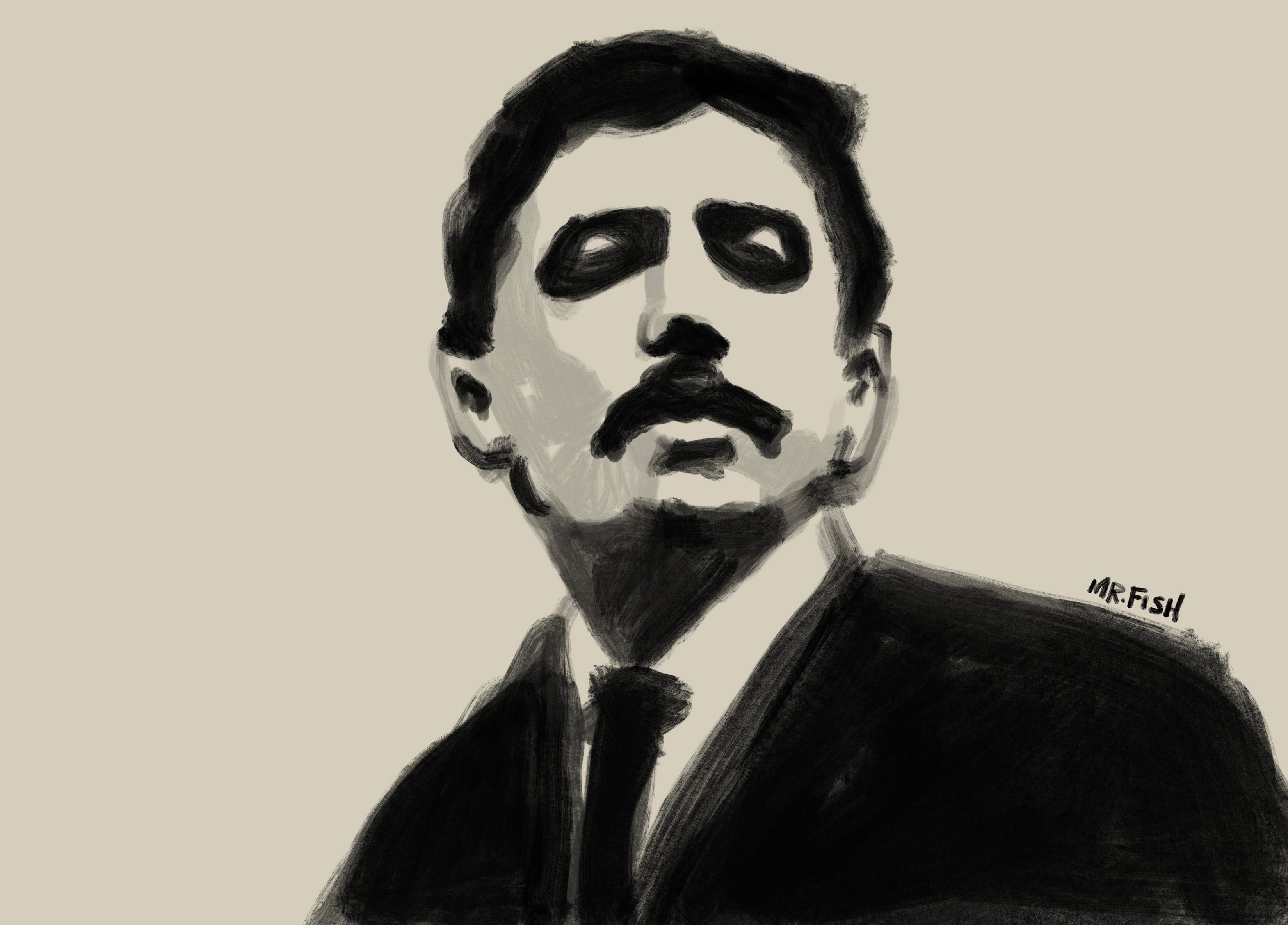
Listen to this Article: "Reading Proust in War"
Description
Narrated by Eunice Wong
Text originally published Nov. 20, 2022
Marcel Proust - by Mr. Fish
During the war in Bosnia, I worked my way through the seven volumes of Marcel Proust’s “In Search of Lost Time.” The novel, populated with 400 characters, was not an escape from the war. The specter of death and the expiring world of La Belle Époque haunts Proust’s work. He wrote it as he was dying; in fact, Proust was making corrections to the manuscript the night before his death in his hermetically sealed, cork-lined bedroom in Paris.
The novel was a lens that allowed me to reflect on the disintegration, delusions and mortality around me. Proust gave me the words to describe aspects of the human condition I knew instinctively, but had trouble articulating. He elucidates the conflicting ways we perceive reality, exacerbated in war, and how each of us comes to our own peculiar and self-serving truths. He explores the fragility of human goodness, the seduction and hollowness of power and social status, the inconstancy of the human heart and racism, especially antisemitism.
Those who see in his work a retreat from the world are poor readers of Proust. His power is his Freudian understanding of the subterranean forces that shape human existence. The novel is grounded in the bitter wisdom of Ecclesiastes: The beauty of youth, the allure of fame, wealth, success, power, along with literary and artistic brilliance, reap a horrendous toll on those beguiled by them, for they are transitory, and perish.
I was in Croatia as Serb villages were being ethnically cleansed by the Croatian army. I watched an elderly veteran of the partisan war being pushed out of his home, which he would never again inhabit, in a wheelchair, bedecked with his World War II medals on his chest. The rise of ethnic nationalism had extinguished the old Yugoslavia and with it his status and place in society.
The last volume of “In Search of Lost Time” is populated with the aged shells of once-great actors, writers and aristocrats, forgotten as the crowd flocked to new luminaries. The celebrated actor La Berma, a thinly disguised Sarah Bernhardt, too infirm to take to the stage, is ignored. The courtesan Odette de Crécy, the passion of Charles Swann, one of the central characters in the novel, was once a great beauty who entranced Paris but in senility is relegated to a corner of her daughter’s fashionable salon where she is a figure of ridicule.
She had become “infinitely pathetic; she, who had been unfaithful to Swann and to everybody, found now that the entire universe was unfaithful to her,” Proust writes of Odette.
The pedestals the powerful and the famous stand upon — and believe are immovable — disintegrate, leaving them like King Lear, naked on the heath. When Swann denounces the persecution of the Jewish army Captain Alfred Dreyfus, wrongly accused of treason, he becomes a nonperson and, along with other “Dreyfusards,” is blacklisted. Émile Zola, France’s most famous novelist at the time, was forced into exile because he defended Dreyfus.
“For the instinct of imitation and absence of courage govern society and the mob alike,” Proust notes. “And we all of us laugh at a person whom we see being made fun of, though it does not prevent us from venerating him ten years later in a circle where he is admired.”
War elucidates these Proustian truths. Death, a