Episode Details
Back to Episodes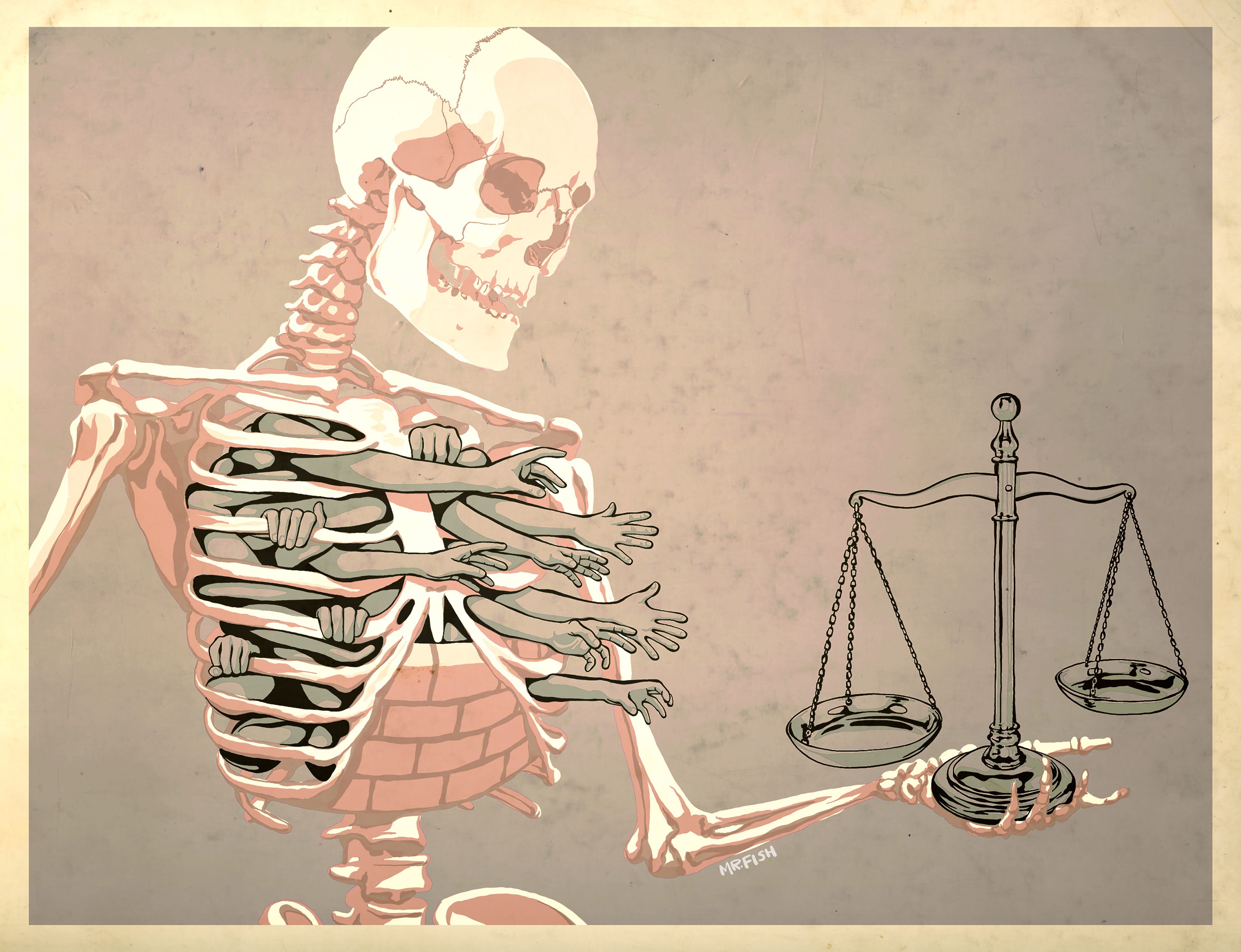
Listen to This Article: "Teaching Aleksandr Solzhenitsyn’s The Gulag Archipelago in Prison"
Description
Narrated by Eunice Wong
Original Text published December 18, 2022
No Justice No Peace - by Mr. Fish
Two nights a week for the last four months, I plowed my way through the three volumes of Aleksandr Solzhenitsyn’s The Gulag Archipelago with 17 students in the college degree program offered by Rutgers University in the New Jersey prison system. No one in my class endures the extremities imposed on the millions who worked as slave labor, and often died, in the Soviet gulag, or work camps, set up after the Russian revolution. The last remnants of the hundreds of camps were disbanded in 1987 by Mikhail Gorbachev, himself the grandson of gulag prisoners. Nor do they experience the treatment of those held in Abu Ghraib, Guantanamo and our secret black sites who undergo mock trials and executions, torture, extreme sensory deprivation and abuse that comes disturbingly close to replicating the hell of the gulag.
Nevertheless, what Solzhenitsyn underwent during his eight years as a prisoner in the labor camps was familiar to my students, most of whom are people of color, poor, often lacking competent legal representation and almost always coerced into signing confessions or accepting plea deals that include crimes, or versions of crimes they were involved with, which were often false. Over 95 percent of prisoners are pressured to plead out in the U.S. court system, which is not capable of providing jury trials for every defendant entitled to one, were they to actually demand one. In 2012, the Supreme Court said that “plea bargaining . . . is not some adjunct to the criminal justice system; it is the criminal justice system.”
My students, like Soviet prisoners, or zeks, live in a totalitarian system. They too work as bonded laborers, putting in 40-hour work weeks at prison jobs and being paid $28 a month, money used to buy overpriced basic necessities in the commissary, as was true in the gulag. They too are identified by their assigned numbers, wear prison uniforms and have surrendered the rights that come with citizenship.
They are deprived of nearly all personal possessions; stripped of all the outward markers of biography and individuality; forced to endure humiliation, including stripping naked before the guards; cannot express anger at their captors without severe retribution; endure military-style regimentation; cope with constant surveillance, including, as in the gulag, a network of prison informers; can be sent to prolonged isolation; are cut off from their families, as well as the company of women; and given lengthy sentences that, short of a miracle, will mean many will die in prison. They, too, have been demonized by the wider society, forced, as were those released into exile from the gulag, into a criminal caste system that punishes them for the remainder of their lives.
They live in what the sociologist Gresham Sykes called A Society of Captives, with its peculiar customs, slang, rituals and codes of behavior, all of which were replicated in the gulag as they have been in prisons throughout the centuries.
U.S. prisons, which hold around 20 percent of the world’s prison