Episode Details
Back to Episodes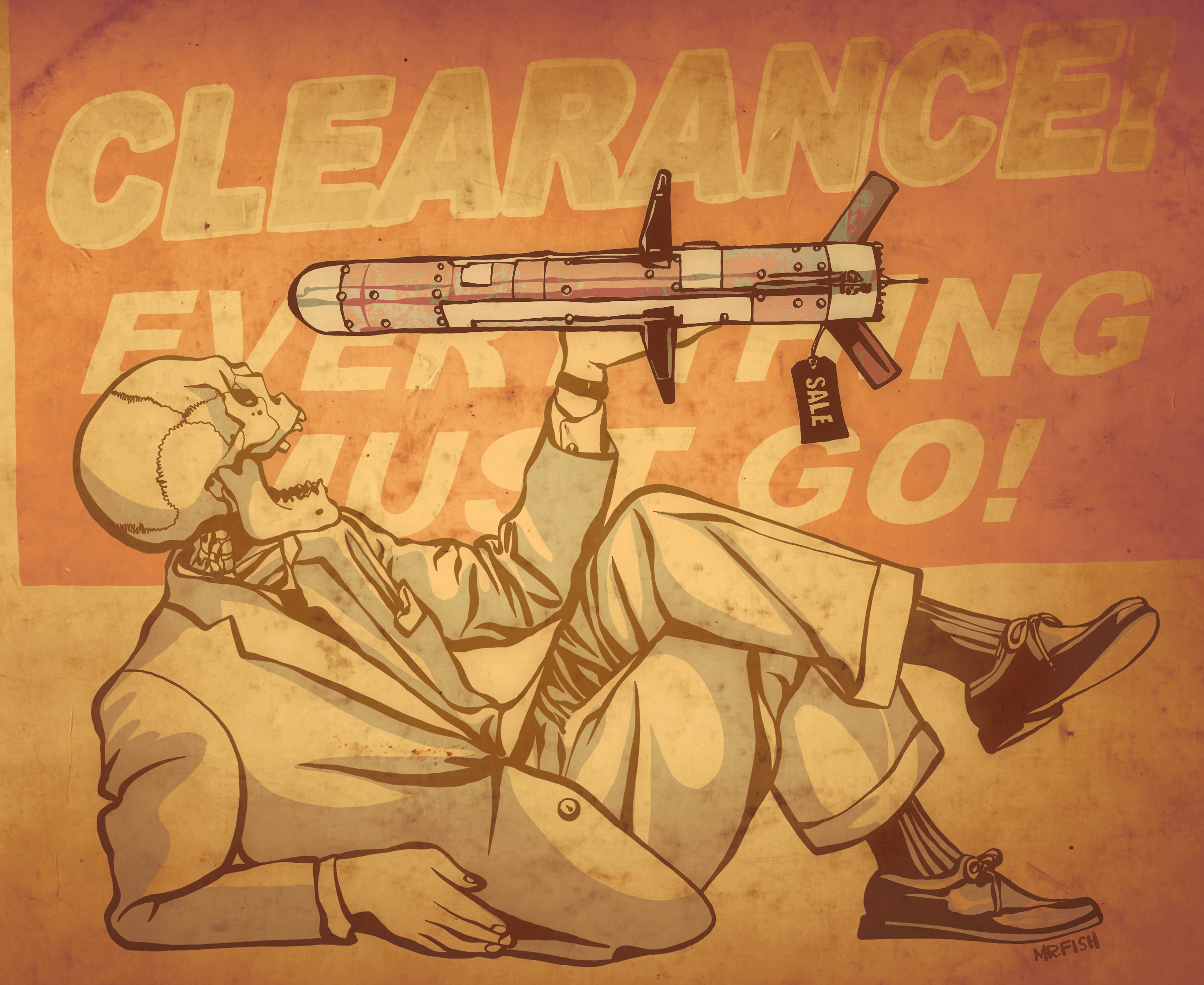
Listen to this Article: "Ukraine: The War That Went Wrong"
Description
Narrated by Eunice Wong
Text originally published: January 29, 2023
Everything Must Go - Mr. Fish
Empires in terminal decline leap from one military fiasco to the next. The war in Ukraine, another bungled attempt to reassert U.S. global hegemony, fits this pattern. The danger is that the more dire things look, the more the U.S. will escalate the conflict, potentially provoking open confrontation with Russia. If Russia carries out retaliatory attacks on supply and training bases in neighboring NATO countries, or uses tactical nuclear weapons, NATO will almost certainly respond by attacking Russian forces. We will have ignited World War III, which could result in a nuclear holocaust.
U.S. military support for Ukraine began with the basics — ammunition and assault weapons. The Biden administration, however, soon crossed several self-imposed red lines to provide a tidal wave of lethal war machinery: Stinger anti-aircraft systems; Javelin anti-armor systems; M777 towed Howitzers; 122mm GRAD rockets; M142 multiple rocket launchers, or HIMARS; Tube-Launched, Optically-Tracked, Wire-Guided (TOW) missiles; Patriot air defense batteries; National Advanced Surface-to-Air Missile Systems (NASAMS); M113 Armored Personnel Carriers; and now 31 M1 Abrams, as part of a new $400 million package. These tanks will be supplemented by 14 German Leopard 2A6 tanks, 14 British Challenger 2 tanks, as well as tanks from other NATO members, including Poland. Next on the list are armor-piercing depleted uranium (DU) ammunition and F-15 and F-16 fighter jets.
Since Russia invaded on February 24, 2022, Congress has approved more than $113 billion in aid to Ukraine and allied nations supporting the war in Ukraine. Three-fifths of this aid, $67 billion, has been allocated for military expenditures. There are 28 countries transferring weapons to Ukraine. All of them, with the exception of Australia, Canada and the U.S., are in Europe.
The rapid upgrade of sophisticated military hardware and aid provided to Ukraine is not a good sign for the NATO alliance. It takes many months, if not years, of training to operate and coordinate these weapons systems. Tank battles — I was in the last major tank battle outside Kuwait City during the first Gulf war as a reporter — are highly choreographed and complex operations. Armor must work in close concert with air power, warships, infantry and artillery batteries. It will be many, many months, if not years, before Ukrainian forces receive adequate training to operate this equipment and coordinate the diverse components of a modern battlefield. Indeed, the U.S. never succeeded in training the Iraqi and Afghan armies in combined arms maneuver warfare, despite two decades of occupation.
I was with Marine Corps units in February 1991 that pushed Iraqi forces out of the Saudi Arabian town of Khafji. Supplied with superior military equipment, the Saudi soldiers that held Khafji offered ineffectual resistance. As we entered the city, we saw Saudi troops in commandeered fire trucks, hightailing it south to escape the fighting. All the fancy military hardware, which the Saudis had purchased from the U.S., proved worthless because they did not know how to use it.
NATO military commanders understand that the infusion of these weapons systems into the war will not alter what is, at best, a stalemate, defined largely by