Episode Details
Back to Episodes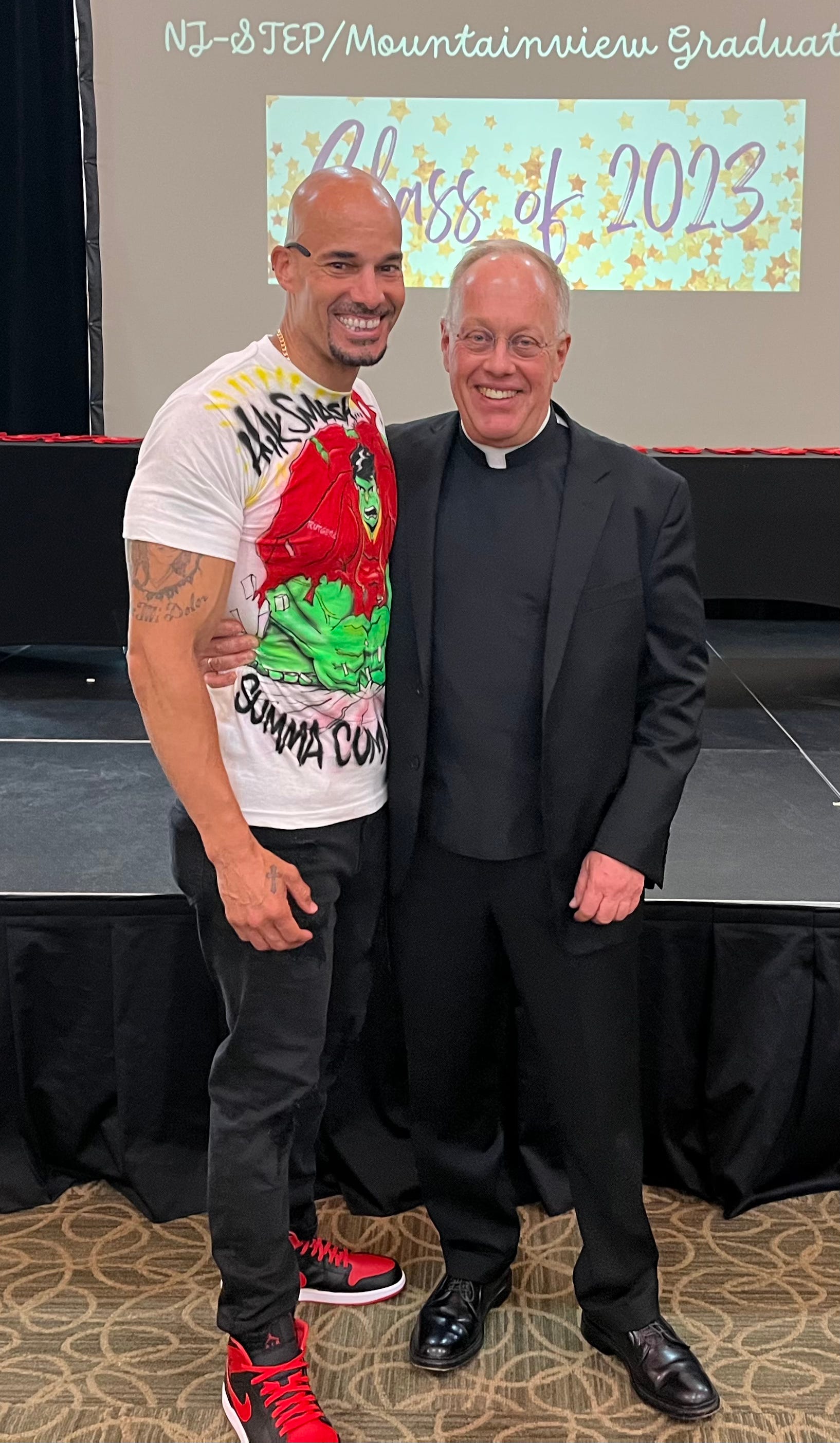
Listen to this Article: "Sammy Goes to School"
Description
Narrated by Eunice Wong
Text originally published May 12, 2023
With Sammy at the graduation ceremony for formerly incarcerated students at Rutgers University in Newark on Friday
Newark, N.J. — We know the story. The absent father who leaves when his son is five-years-old and moves back to Puerto Rico. The single mother, rarely at home because she works long hours to keep her three children fed and pay the rent. The poverty. The crime. The instability. Later, the stepfather who drinks, uses drugs and beats his stepchildren. The child acting up. Dropping out of school. Joining a gang. The robberies. The one that went wrong and left a man dead. Prison.
The students I teach in prison have variations of the same story. They are funneled into the maw of the prison-industrial-complex, the largest in the world, and spat out decades later, even more lost and traumatized, to wander the streets like ghosts until most, unequipped to survive on the outside and without support, find themselves back in the old familiar cages.
But I tell this story because it needs to be told. I tell it because this time the end will be different. This time the system will not win. I tell it because neglected and abused children, no matter what crime they commit, should not be imprisoned as if they were adults. I tell it because we are complicit. I tell it because until we stop investing in systems of control and start investing in people, especially children, nothing will change. It will only get worse.
“I come from a very violent childhood,” says Sammy Quiles, who was released from prison after serving a 30-year sentence a few weeks ago. “My mother — once my father was out of the picture — worked and partied. Me and my sisters were relegated to making it on our own or with babysitters. And then when she met my stepfather that was only exacerbated. He was a drunk, drug-abuser and very violent. I was hit with fists, bats, hangers, you name it. It was physical, emotional and verbal abuse.”
I taught Sammy in East Jersey State Prison in Rahway, New Jersey, in the Rutgers college degree program. I did not know his story until he was released. I never know the stories of my students. They are not their crime. And years, often decades later, they are not who they were. Sammy, in my classroom, was reserved, determined, hardworking, brilliant and unfailingly courteous. That is who Sammy is. Who he was, to me, is irrelevant.
That is not how Sammy was seen as a child, a troubled boy coping with abandonment and terrible abuse. He threw temper tantrums. He could not sit still. He was disruptive. The school system labeled him “emotionally disturbed.” He was placed in special education classes in the second grade.
“Decisions were made early on in my life that I would serve the service sector of society,” he says. “I wasn’t taught innovative curriculums. They sent me to woodshop or auto mechanic schools.”
He dropped out of school in the 10th grade. At 15 he left home “because the streets seemed safer for me.”
“I tried to get fast-food jobs, but I didn’t last long,” he says. “My behavior was erratic, problematic. I didn’t do well with authority and structured environments. I robbed and stole. I became a car thief, a stick-up kid. That’s how I ate.”
He found the Latin Kings.
“Every government institution abandoned me or punished me for my behavior, but it was a gang member that helped me with homelessness, with putting clothes on my back, putting a few dollars in my pocket, fed me — his family fed me,” he recalls. “I understand today that they exploited my aggressive behavior, but they’re the ones that helped me when I left home. It felt like I had a community. They taught me about my culture. They instilled this pride in me. There was protection.”
He was initiated into the Latin Kin