Episode Details
Back to Episodes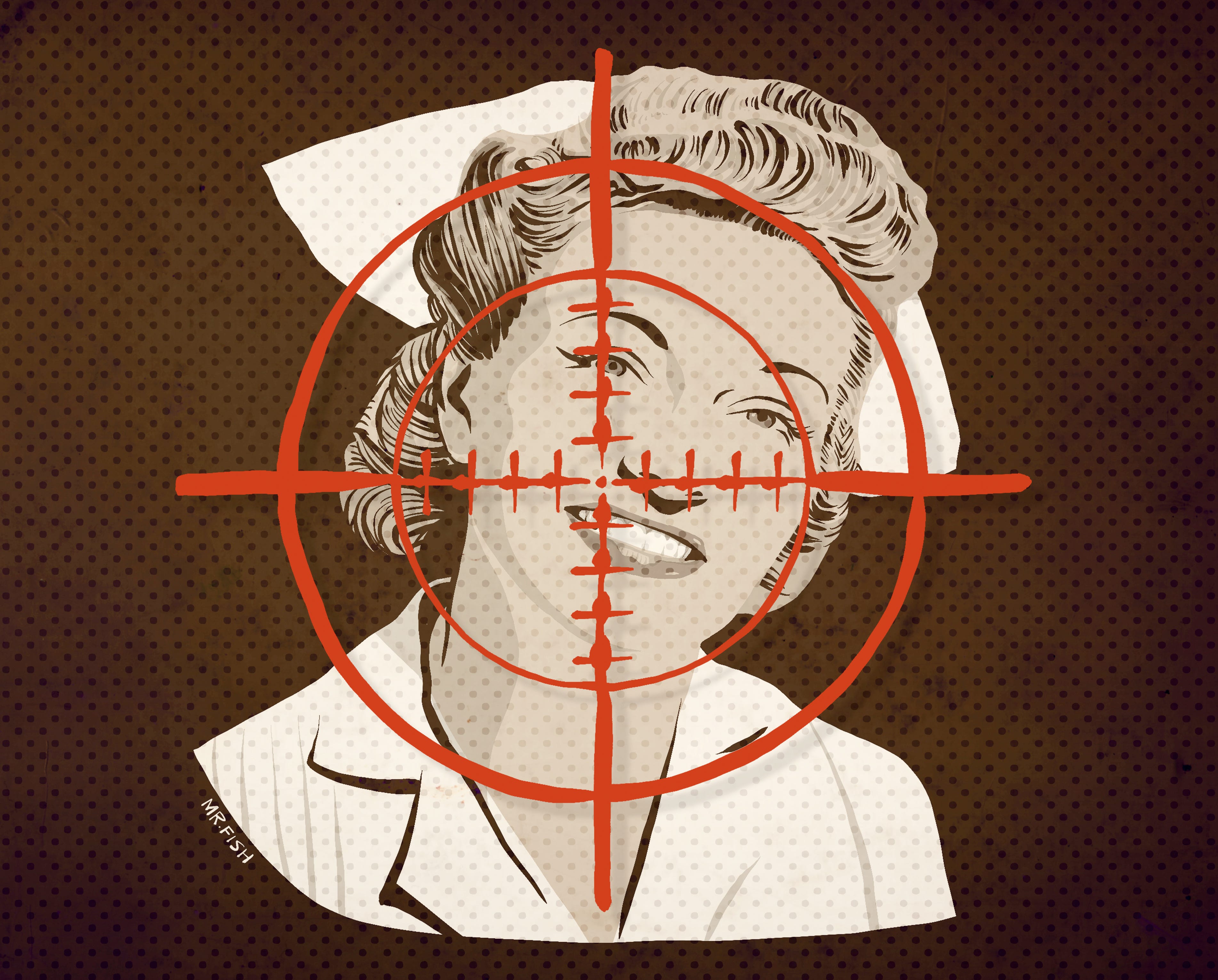
Listen to this Article: "Nurses Fight Godzilla"
Description
Narrated by Eunice Wong
Text originally published Aug. 3, 2023
Red Crosshairs - by Mr. Fish
NEW BRUNSWICK, N.J. — Judy Danella, president of United Steel Workers Local 4-200 — the union that represents Robert Wood Johnson University Hospital’s more than 1,700 nurses — stands in a church basement before a room full of her union members. Her voice quavers slightly as she delivers grim news. The hospital management, whose top administrators earn salaries in the millions of dollars, has refused to concede to any of the nurse’s core demands. Friday at 7:00 a.m. they will be locked out of the hospital and on strike.
But it is not only the strike that concerns Danella, who is wearing a blue T-shirt that reads: “Safe Staffing Saves Lives.”
“It is 100 percent my belief that the goal is to break the union,” says Danella, who has worked at the hospital for 28 years. “This is about the future of nursing.”
The front line against corporate tyranny is not the ballot box. It is in the desperate struggle by the overworked and underpaid to prevent corporate behemoths from turning everyone into gig workers without health and retirement benefits, job security, sustainable incomes or equitable working conditions. Nurses, battered by the almost inhuman demands put on them during the pandemic, have been especially hard hit. Almost one-third of New Jersey’s nurses have left the profession in the last three years.
“We went from heroes to zeroes,” says Jessica Aquino, a nurse who has been at the hospital for 16 years.
RWJBarnabas Health, which owns 12 acute care hospitals, including Robert Wood Johnson University Hospital, and four specialty hospitals, is the largest healthcare provider in the state of New Jersey. Its 37,000 employees, including 9,000 physicians, care for more than three million patients a year. It has $6.6 billion in annual revenue. It is registered as a 501(c) (3) not-for-profit charitable organization.
The company, Danella suspects, plans to make the punishing working conditions and staff reductions permanent. Unchecked, they will continue to raise insurance premiums, which can cost a nurse with a family $500 a month. They will refuse to increase salaries, which range between $43 and $64 per hour, including the paltry $5 per hour rate, which the hospital management offered to increase to $6, for on-call nurses waiting at home. The union asked for the minimum wage for on-call nurses and then offered to drop the hourly amount to $10. The on-call nurses receive their standard pay rate once they clock in. They will, if union demands are not met, be denied retirement medical benefits and retention bonuses. The crippling attrition rate will continue.
At least 700 replacement nurses, known as travelers, from states including Alabama, Mississippi, Tennessee and Kentucky, have been relocated to New Brunswick in the last few days and set up in area hotels to replace the striking nurses. These travelers, paid as much as $120 per hour and given housing and travel allowances, earn more than the unionized nurses. But travelers have no control over their wo