Episode Details
Back to Episodes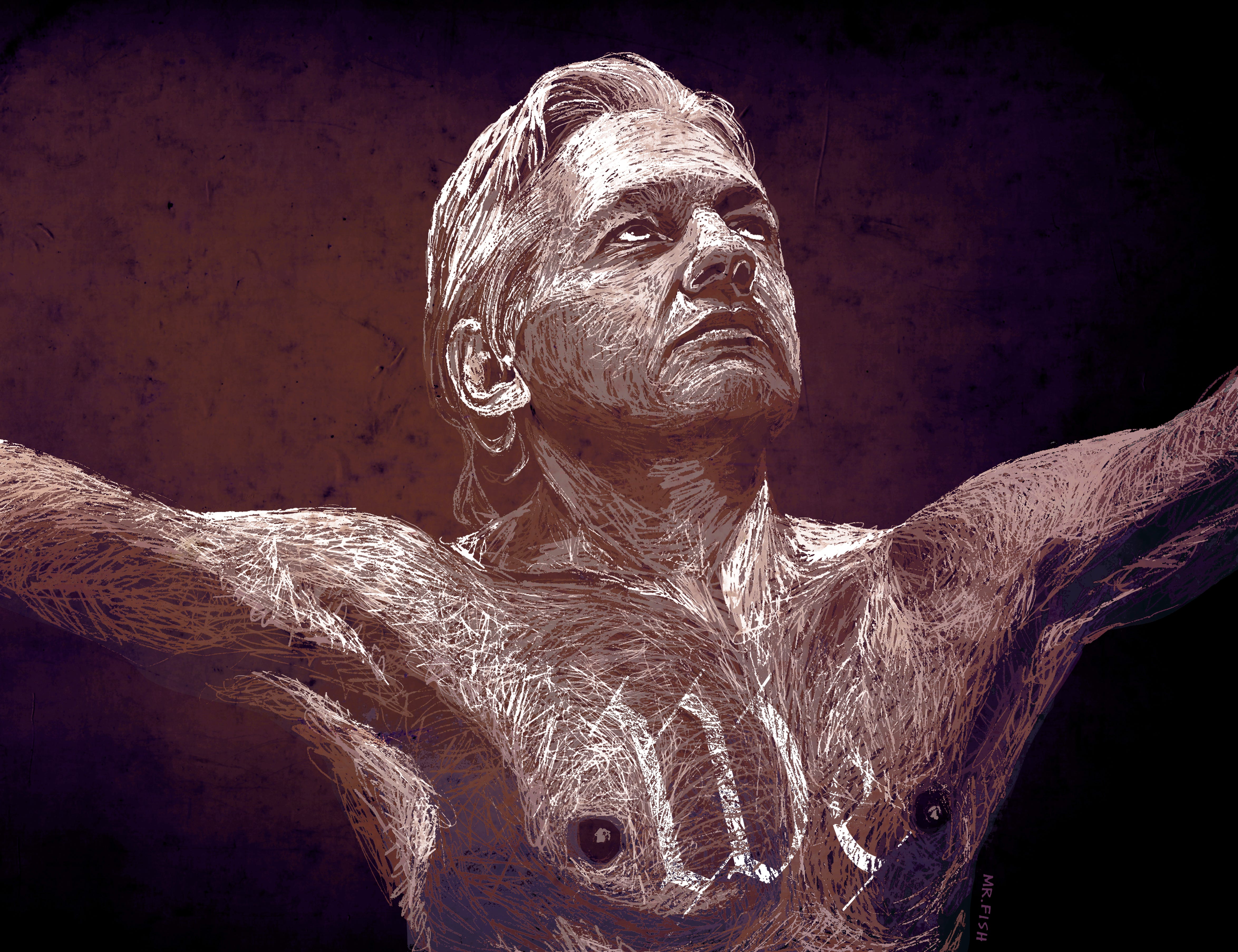
Listen to this Sermon: The Crucifixion of Julian Assange
Description
The Crucifixion of Julian Assange - by Mr. Fish
I dedicate this sermon to my mentor at Harvard Divinity School, Bishop Krister Stendhal.
Prophets are notoriously difficult people. They are not saints. They are people of agony, as Rabbi Abraham Heschel writes, whose “life and soul are at stake.” The prophet is moved by human anguish. Prophets are not soothsayers. They do not divine the future. Injustice, for the prophet, “assumes almost cosmic proportions.” A prophet, consumed by an unnatural fury, gives witness to “the divine pathos.” “God,” Heschel writes, “is raging in the prophet’s words.” He or she stands unflinchingly with the crucified of the earth, even to the point of their own destruction. “While the world is at ease and asleep,” Heschel writes, “the prophet feels the blast from heaven.” The prophet says “No” to his or her society, “condemning its habits and assumptions, its complacency, waywardness, and syncretism.” And the prophet “is often compelled to proclaim the very opposite of what his [or her] heart desires.”
Prophets believe in justice even when the world around them says there will be no justice. It is not that they transcend reality. It is that they are compelled to strike out against it, refusing to be silent no matter how hard life becomes. They are gripped by what Reinhold Niebuhr calls “a sublime madness in the soul,” for “nothing but such madness will do battle with malignant power” and “spiritual wickedness in high places.” This madness is dangerous, but vital because without it “truth is obscured.” Liberalism, Niebuhr goes on, “lacks the spirit of enthusiasm, not to say fanaticism, which is so necessary to move the world out of its beaten tracks. It is too intellectual and too little emotional to be an efficient force in history.”
But as the priest Amaziah says of the prophet Amos, “The land is not able to bear all his words.”
The Biblical prophets — Elijah, Amos, Jeremiah, Isaiah — believed that anything worth living for was worth dying for. Their enemy was not only suffering, calumny, poverty, injustice, but a life devoid of meaning. “You have to be prepared to die before you can begin to live,” the civil rights icon Fred Shuttlesworth said. Prophets cannot be intimidated. They cannot be bought. They are single-mindedly obsessed. James Baldwin, himself a prophet, understands. He writes:
“Ultimately, the artist and the revolutionary function as they function, and pay whatever dues they must pay behind it because they are both possessed by a vision, and they do not so much follow this vision as find themselves driven by it. Otherwise, they could never endure, much less embrace, the lives they are compelled to lead.”
The powerful and the rich make war on the prophet. They slander and insult the prophet. They question the prophet’s sanity and motives. They make it hard for the prophet to survive removing the prophet’s meager source of income. They punish and marginalize those who stand with the prophet. They silence the prophet’s voice, through censorship, imprisonment and often murder. The list of martyred prophets is long. Socrates. Joan of Arc. Isaac Babel. Federico García Lorca. Miklós Radnóti. Irène Némirovsky. Malcolm X. Martin Luther King Jr. Victor Jara. Ken Saro-Wiwa.
The truth grips the prophet so that he or she is bound so strongly to it that nothing but death can separate them from it. In that truth they find God.
“One can never wrestle enough with God if one does so out of a pure regard for truth,” Simone Weil writes. “Christ likes for us to prefer truth to him because, before being Christ, he is truth. If one turns aside from him to go towar