Episode Details
Back to EpisodesThe Lover's Head
Description
The motif of lovers retaining the head of a decapitated partner is surprisingly widespread. In this — our romantic Valentine’s Day episode — we have a look at old ballads, literature, fairy tales, legends, and even a few historical anecdotes in which such things occur.
We begin with the English murder ballad, “In Bruton Town,” also known as “The Bramble Briar,” “The Jealous Brothers,” or “The Constant Farmer’s Son.” It might seem a strange inclusion at first as there is actually no decapitated lover in the song, but it’s widely recognized by scholars as having derived from a 14th-century story identical in all other elements of the narrative. Though no heads are removed, there is a murder, namely that of a suitor courting the sister of two brothers who find his social status unacceptable (as well as the fact that he is slipping into their sister’s bedroom along the way). There is also a visitation by the ghost of the dead lover, in which he reveals the location of his corpse, with whom the woman lives for three days in the woods before being forced home by hunger — all of which may remind some listeners to the lover’s ghost in “Fair Margaret and Sweet William” discussed in our Undead Lovers episode. The segment begins with a snippet from a version of the song given a enthusiastically gothic treatment by The Transmutations. The a cappella version is by A.L. Lloyd.
The probable source story for the ballad is from Giovanni Boccaccio’s Decameron, a tale told to entertain her fellow travelers by Filomena, one of the refugees fleeing plague-stricken Florence in the novel’s frame story. She describes the tragic romance of Lisabetta and Lorenzo. As in our ballad, Lorenzo is an unworthy suitor engaging in secret rendezvous with Lisabetta, whose brothers are similarly protective of her and their sister and family status. Lorenzo meets his end when invited by the brothers to join them on an excursion out beyond the city. He later appears in a dream to reveal the location of his corpse.
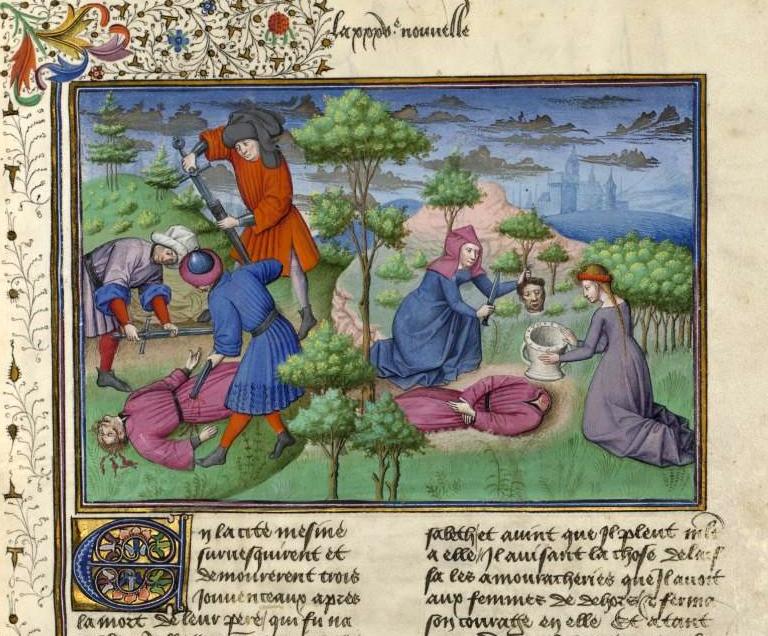
As she grieves over her lover’s body, Lisabetta recognizes that she is physically unable to transport it back for burial, and so does the next best thing, removing the head with a handy razor. The rest of the story relates how the head is hidden in pot planted with basil, the discovery of which causes the brothers to flee from justice. Mrs. Karswell reads for us all the grisly details Boccaccio provides.
Roughly three centuries later, we find a lover’s remains planted in a pot in Italian poet Giambattista Basile’s Pentamerone or “The Tale of Tales,” perhaps the earliest compilation of European fairy tales. The story, “The Myrtle,” presents a fairy who lives in a sprig of mirtle kept by a prince who nightly makes love to her as