Episode Details
Back to Episodes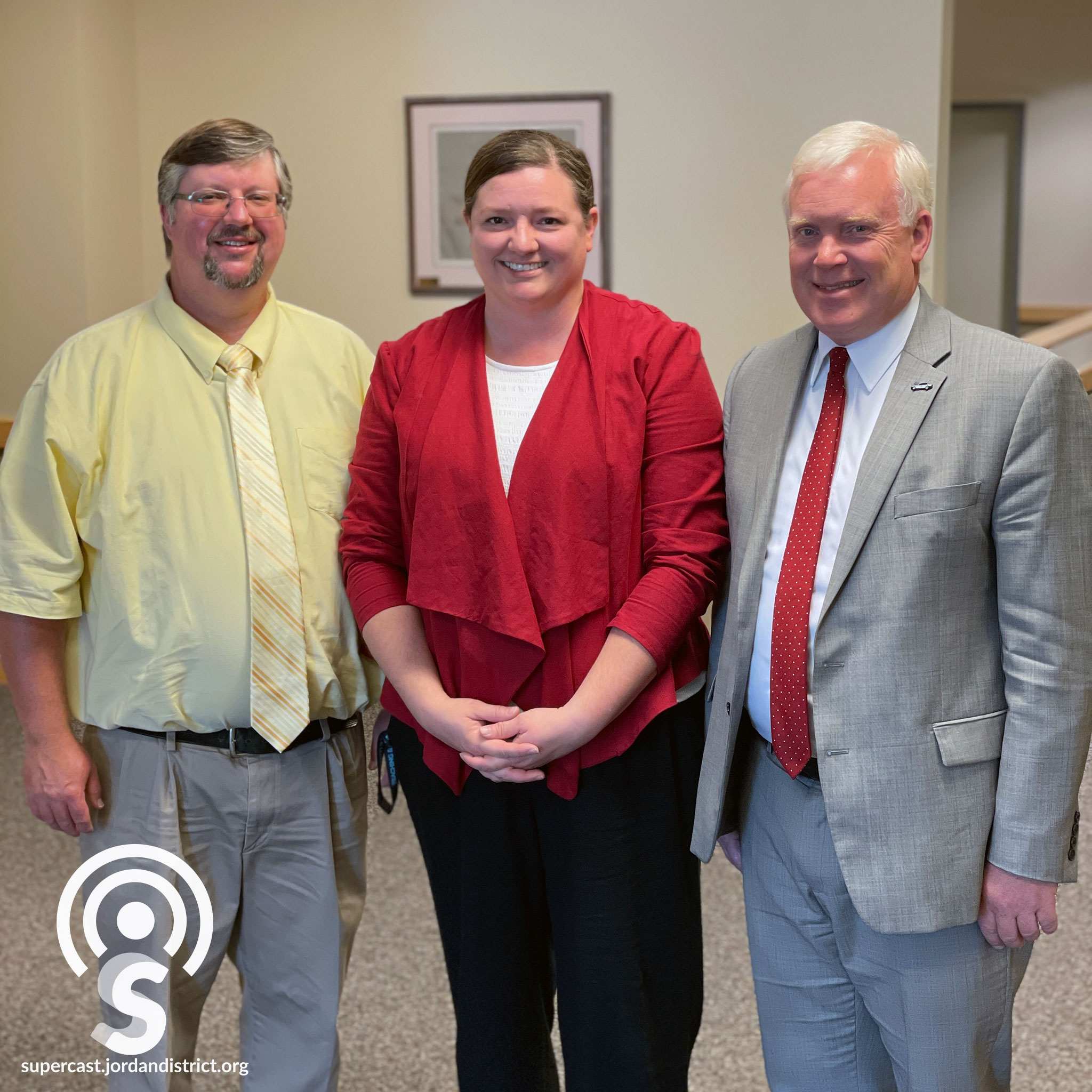
From Grades to Graduation Rates How JSD Students are Stacking Up
Description
In Jordan School District tracking everything from literacy and math scores to senior graduation rates, rising enrollment, and more is essential to the work we do. Tracking shows us trends so we can improve and celebrate student success.
On this episode of the Supercast, we sit down with the dedicated team responsible for research, evaluation, and sorting out Jordan School District by the numbers.
Audio Transcription
[Music]Anthony Godfrey:
Hello and welcome to the Supercast. I'm your host, Superintendent Anthony Godfrey. In Jordan School District, tracking data on everything from literacy and math scores to student graduation rates, rising enrollment, and more is essential to the work we do. Following the data shows us trends so we can improve and celebrate student success.
On this episode of the Supercast, we sit down with the dedicated team responsible for research, evaluation, and sorting out Jordan School District by the numbers.
We're talking today with the Department of Evaluation, Research, and Accountability here in Jordan School District to talk about Jordan by the numbers. Thanks for joining us. Introduce yourselves and let's talk Jordan by the numbers.
Ben Jameson:
Awesome, well, I'm Ben Jameson. I get to be the department's director and it's a pleasure to be with you today.
Brooke Anderson:
Hi, my name is Brooke Anderson. I'm the data scientist working for Jordan District and working with Ben, and it's very exciting to be here.
Anthony Godfrey:
The newly appointed data scientist. It's very exciting to have you in that role.
Brooke Anderson:
This is my first day as a data scientist at Jordan District.
Anthony Godfrey:
Well, I'm glad we can memorialize it through the podcast here. Let's just start off with talking a little bit about what your roles are. Your role is brand new, Brooke, so you get to make it whatever you want it to be. But Ben, let's start with you.
Ben Jameson:
So I supervise quite a few assessments that are state and federally mandated as well as a few district-mandated assessments. And then we're responsible for disseminating that data and making sure that people understand what it is and know how to make data-driven decisions based on that data.
Anthony Godfrey:
And many of those assessments, as you indicated, really are not district-required assessments. Those come from the state or the federal level. A vast majority of them, in fact.
Ben Jameson:
Yeah, the vast majority actually come from the state. We've got a couple from the federal government as well. Yep.
Anthony Godfrey:
And Brooke, tell us about what you have been doing in the department and about your new role as a data scientist because that may be a term that many are not familiar with.
Brooke Anderson:
Well, I've been working as a teacher specialist in evaluation research and accountability and in that role, I was cleaning and analyzing all of this assessment data and trying to combine it with all of the other data available that we have about students to ask and answer bigger and better questions about student learning. That's really the goal. The role of a data scientist specifically works on asking questions that are important to the organization and in combining data from multiple sources to make sense of it. To make sure that we can get all the data from the different information systems that we use. Turn it into usable data and analytics that can lead to knowledge that can lead to action. So a data scientist is all about making it easier to make decisions.
Anthony Godfrey:
And to make data-driven decisions.
Brooke Anderson:
Right.
Anthony Godfrey:
So it's really exciting to talk with you both about this. If you've ever watched Shark Tank, the panel of entrepreneurs on Shark