Episode Details
Back to Episodes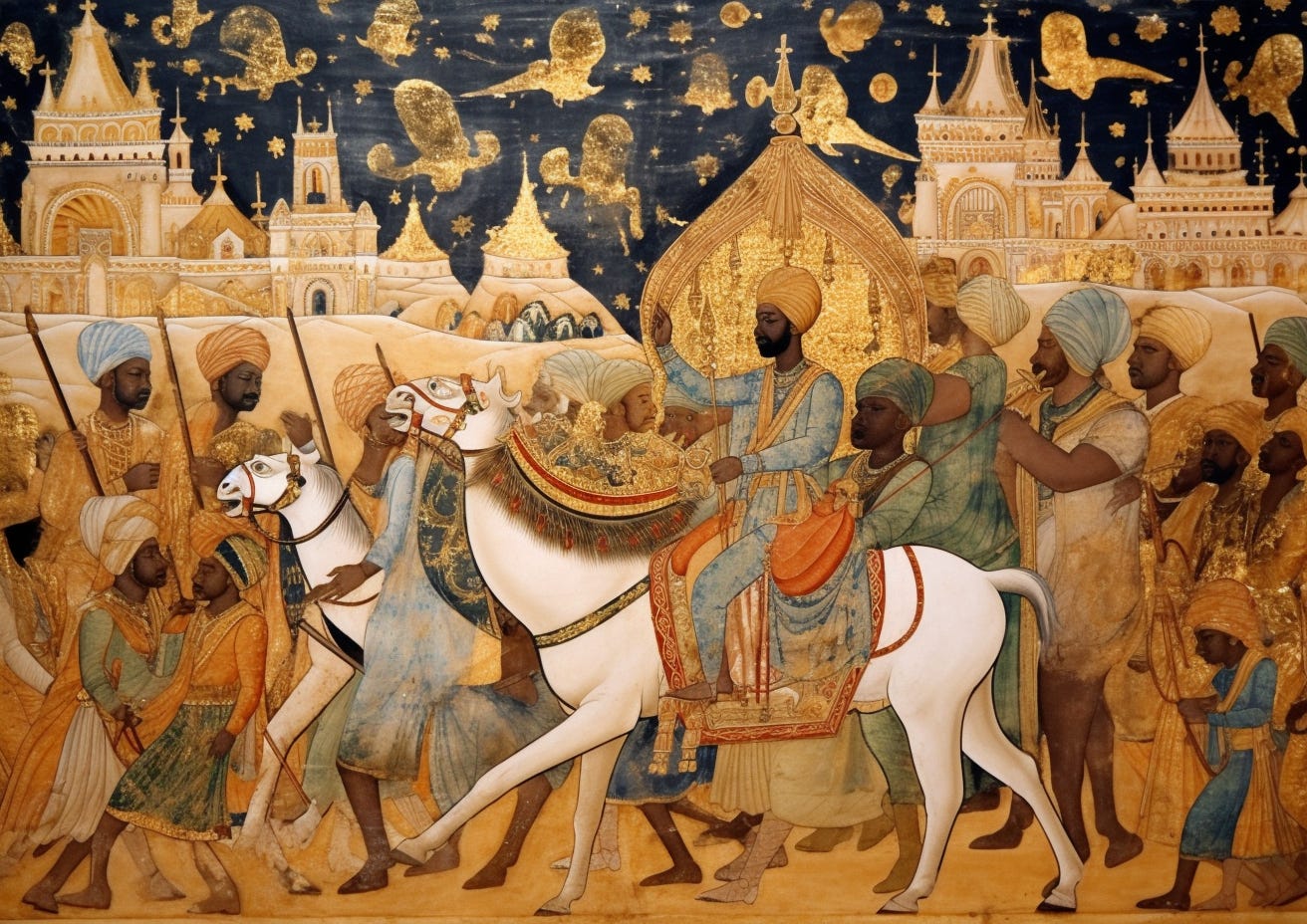
The Richest Man In History
Description
I once presented a documentary for Italian TV which declared that Jakob Fugger - Fugger the Rich - was the richest man in history. He was a German who made his fortune in the 16th century through gold and copper mines, lending money to kings and popes and, above all, by selling absolution. By the time he died his net worth was equivalent to nearly 2.5% of European GDP, tantamount to half a trillion dollars in today’s money.
But, according to the internet (and we all know the internet is never wrong) there was someone even richer - a Malian gentleman, Mansa Musa the Ninth, or King Musa IX.
The BBC deems his wealth “indescribable”, placing him above the likes of Augustus Caesar, Andrew Carnegie, John D Rockefeller, William The Conqueror and Colonel Gaddafi in its Wealth Hall of Fame. Fugger doesn’t even get a look in.
So who was this Mansa Musa the Ninth?
Musa was born in 1280 in Mali in West Africa. At some point in his early 20s he became Mansa. The eighth Mansa, his brother Abu Bakr, had wanted to go and explore the edge of the Atlantic Ocean and Musa stood in for him while he was gone. Bakr never came back and so did Musa become Mansa.
Many of those out there with a dark view of human nature argue that Musa actually saw to it that Bakr never came back. The whole “exploring the edge of the Atlantic Ocean” thing was just a ruse. Who knows? Perhaps Bakr did make it to the edge of the Atlantic Ocean, also known as Brasil, found it to his liking, as many visitors there do, and decided to settle there.
At the time the Mali empire extended through 2,000 miles of West Africa - from what today is Niger in the east, through parts of Mali, Burkina Faso, Guinea, Senegal, Mauritania, Sierra Leone and Gambia. With land ownership came ownership of the natural resources that lay within - and that’s how Musa came to be so rich. Salt, gold and slaves. He sold hundreds of thousands of slaves to the Middle East, pioneering a pan African slave trade that still exists to this day. Those slaves he didn’t sell he put to work in his mines.
West Africa has always had lots of gold. Even today Ghana is Africa’s second largest producer, beaten only by South Africa, whose premium deposit, the Witswatersrand Basin, was only discovered in 1886 by an Australian mining prospector called George Harrison.
Harrison, by the way, in what must be considered among the worst business deals in history, worse even than record label Decca passing on Harrison’s namesake’s band, the Beatles, seventy years later, sold his stake for £10. Harrison was never heard of again, but his discovery would provide the world with over 20% of all the gold ever mined.
But, until the Wits Basin, West Africa was top dog. Indeed, according to the British Museum, something like half of the Old World’s gold came from the Mali Empire. Musa sure did enjoy the trappings. He had tens of thousands of slaves to his name and in 1324 set off with 12,000 of them and a retinue of 38,000 others, including soldiers and entertainers - all of them dressed in gold, brocade and silk, apparently - on a pilgrimage to Mecca.
Like today’s mega billionaires, Musa liked attention. He didn’t have rocket ships, Twitter or appearances on Saturday Night Live to get it, so Musa’s means was this hajj - a pilgrimage to Mecca, the spiritual home of Islam. The 2,800 mile round trip took him some two years.
Each slave carried some four pounds of gold, while camels behind towed as many as 300 pounds of gold dust, so that the entire transit had some 18 tons of gold in tow. There were heralds who bore gold staves, and, en route, every Friday, this devo