Episode Details
Back to Episodes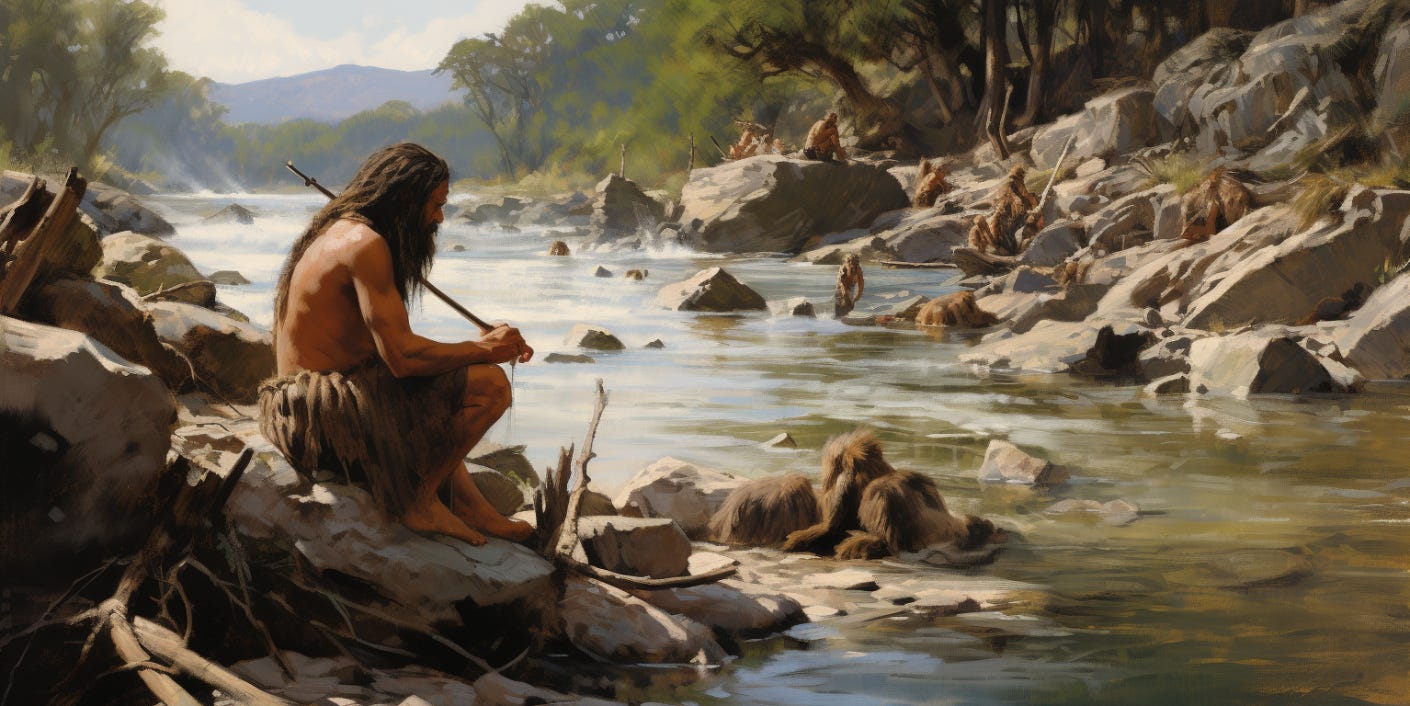
Our Instinct for Gold Is Primal
Description
I’m doing a show about gold at the Edinburgh Fringe. If you are in Scotland between August 4th and August 20th, plesase come. It’s at Panmure House in the room in which Adam Smith wrote Wealth of Nations. You can get tickets here.
Thousands of years before the dawn of civilisation, as prehistoric man hunted and gathered his way through the Stone Age, he might have come across six native metals - metals which occur in nature in a relatively pure state: silver, tin, lead, iron, copper and gold
He found gold in river beds - nuggets, mixed in with sediment, relatively easy to find, collect and shape. Gold doesn’t naturally combine with other metals in nature, so it is easy to identify. It shone, it glistened and so man adorned himself with it - as well as with bones, teeth, precious stones and shells.
Archaeological evidence from Spanish caves shows that gold was used by human societies as early as 40,000 years ago. This predates agriculture and the development of settled communities. It is the earliest example of human use of any kind of metal, and its purpose was as jewellery. The first records of man using copper came tens of thousands of years later. Lead, tin and iron’s first use, when advances in metallurgy took us into the Bronze Age, came even later. The use of gold for personal adornment was an established practice, even in prehistory. (Even copper’s first use was as jewellery). It is easy to make anthropological interpretations. Gold, a symbol of beauty, power and status, also indicates reproductive fitness: Look at me, I have access to this rare, shiny substance.
Stone Age man had the same basic instincts as we do today - the same urges, desires and compulsions: fear, desire, love, hate, greed. Nothing inspires greed like gold.
Survival is the most basic compulsion: to find water, food and shelter, for yourself and for those close to you. Then there is the survival of your species: the need to reproduce. If you are to survive, thrive and reproduce, so does the species as a whole grow stronger. Thus can an individual’s self-interest be good for the species as a whole.
What often goes unmentioned, though, is our instinct for beauty. What we find beautiful is also often good for us in some way. We are instinctively repulsed or alarmed by things that are dangerous – snakes, spiders, a cliff edge, loud noises - but things that aid our survival we find beautiful - the sound of running water, a fit and healthy potential mate, an open landscape with water, varied animal and plant life, good visibility and shelter. And we find gold beautiful.
The experience of beauty, whether derived from nature, art, music or even mathematics, correlates with activity in the emotional brain - in the medial orbito-frontal cortex. Beauty has long been associated by philosophers with truth and purity – also qualities commonly associated with gold. Our instinct for gold and the emotions it inspires from beauty to desire are basic. There has not been a culture in all history that did not appreciate the value of gold. It is a primal instinct. “The desire for gold,” said Wall Street trader Gerald Loeb, “is the most universal and deeply rooted commercial instinct of the human race.”
The artefacts found in those Spanish caves suggest that the people who lived in them had some basic skills. (Gold, which is relatively soft, is fairly easy to shape even using simple tools). Like shells, bones, stones, even hand axes, gold would have been used as reward as well as for decoration: as an expression of gratitude, as a prize for completing a task, for heroic deeds, as a tool in barter and exchange - as early money, in other words,. Even in prehistory gold was performing the role it has alw