Episode Details
Back to Episodes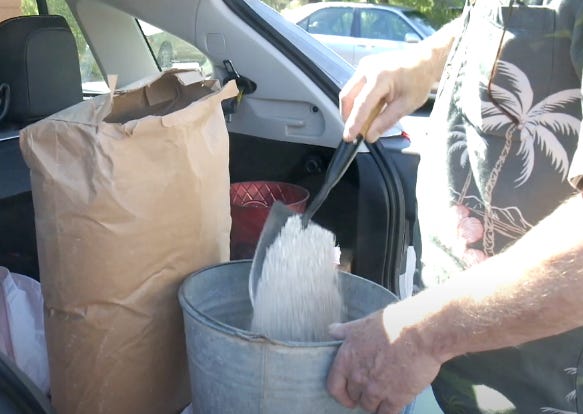
Is Your Fertilizer Radioactive?
Description
Phosphorus, in the world of plant fertilizers, is considered a macronutrient, an important element used by plants. Phosphorus is used to promote root and tuber growth, as well as the production of flowers and seeds. But, do you really need to add it every time you fertilize? And why have 13 states - as well as several municipalities - placed restrictions on the use of phosphorus?
Phosphorus is the “P” in “N-P-K”, the percentage of macronutrients found listed on the front of a container of fertilizer. But how much phosphorus do your plants need for sufficient growth?
Apparently, not as much as Calcium or Magnesium, according to this chart presented as evidence by the University of Wisconsin. Should phosphorus be getting as much credit as Nitrogen or Potassium, every time you look at a bag of fertilizer? Garden author Robert Kourik (“Sustainable Food Gardens”) points out that not only is Phosphorus over applied by gardeners, it may not be organic, and it is certainly detrimental to the health of aquatic life when it is allowed to runoff into local streams. And speaking of detrimental, in today’s newsletter podcast (above), Kourik talks about the time he took a bag of phosphorus fertilizer to the local radiation analyst. Things started clicking! He has video, too:
According to the Chicago Botanic Garden, when too much phosphorus is applied or is applied at the wrong time—such as right before it rains—most of it is washed away and ends up in the local waterways. This type of pollution is called nonpoint source pollution. It causes eutrophication (a reduction of dissolved oxygen in water bodies caused by an increase of minerals and organic nutrients) of rivers and lakes. This reduced level of oxygen in water ends up suffocating fish. Several municipalities have banned the use of phosphorus-containing fertilizers for turf or lawn areas. These laws are designed to protect local water quality in lakes, streams, and ponds. According to several experts, in most cases, phosphorus is not needed to maintain a healthy lawn. Retailers near towns that have enacted a ban are required to alert customers about the prohibition of phosphorus in fertilizers for lawn and turf by posting a sign where fertilizers are sold.
At least 11 states ban phosphorus fertilizer use or sale: Illinois, Maine, Maryland, Michigan, Minnesota, New Jersey, New York, Vermont, Virginia, Washington, and Wisconsin.
More are joining that group, including Pennsylvania and Florida, as well as several cities and counties, especially those that border large bodies of water. But it isn’t just lawns. Phosphorus, as well as nitrogen, are facing restrictions in all fertilizers offered for sale there.
Consider these controversial restrictions that are in Brevard County Florida:
“Spring is a popular time to fertilize the lawn, but did you know there are wrong ways to fertilize plants? Are you aware that a fertilizer ban goes into effect on June 1?
Follow these fertilizer ordinances throughout Brevard County which state:
* No nitrogen or phosphorus can be applied to any plants between June 1 and Sept. 30.
* When applying a fertilizer with nitrogen, it must contain a minimum of 50% slow-release nitrogen and must be applied at a maximum rate of 1 pound of nitrogen per 1,000 square feet per application.
* Phosphorus can only be applied if a soil tes