Episode Details
Back to Episodes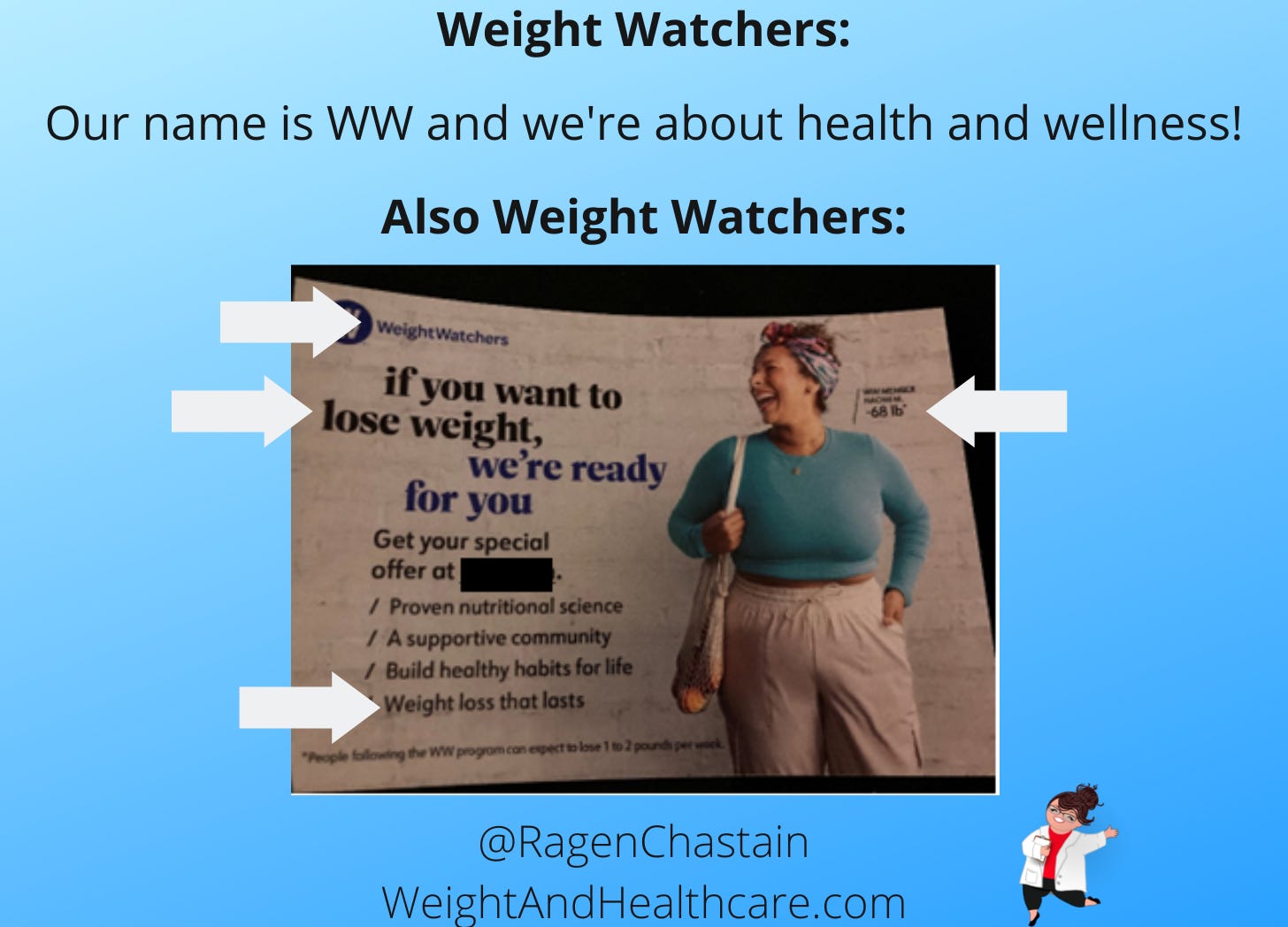
Weight Watchers - Up To Their Old Tricks
Description
This is the Weight and Healthcare newsletter! If you appreciate the content here, please consider supporting the newsletter by subscribing and/or sharing!
In 2018, Weight Watchers changed its name to “WW” added the tagline “wellness that works” and started using language about “health” and “wellness” and “beyond the scale.” Per a Fast Company article this happened because “In this new era of body image acceptance and feel-good wellness communities, Weight Watchers learned that the term “diet” was rife with negative connotations.”
Another way to put this is that weight-neutral health and fat acceptance advocates had made tremendous headway in pointing out that, even according to Weight Watchers’ own research, their program almost never creates significant long-term weight loss. Thus, this seemed to be a fairly transparent attempt to co-opt the work of weight-neutral advocates and fat acceptance activists in order to keep selling a program that almost never works.
The thing that they seem to have going for them is an uncanny ability to convince their clients (and everyone else) to credit Weight Watchers for short-term weight loss (the first part of the biological response to restriction) and then get their clients (and everyone else) to blame themselves for the weight regain that almost everyone experiences (the second part of the biological response to restriction.) In this way, they convince people to keep coming back for multiple rounds, which forms the nucleus of their repeat business model.
According to an article by Traci Mann called “Oprah’s Investment in Weight Watchers Was Smart Because the Program Doesn’t Work”:
“[Weight Watchers] brags about this to its shareholders. According to Weight Watchers’ business plan from 2001 (which I viewed in hard-copy form at a library), its members have “demonstrated a consistent pattern of repeat enrollment over a number of years,” signing up for an average of four separate program cycles. And in an interview for the documentary The Men Who Made Us Thin, former CFO Richard Samber explained that the reason the business was successful was because the majority of customers regained the weight they lost, or as he put it: “That’s where your business comes from.”
Their rebrand to wellness builds on this scam. Which brings us to the postcard I received in the mail recently.
Image Description: A postcard with a gray background
Text: At the top left is the WW logo next to the words WeightWatchers
If you want to lose weight, we’re ready for youGet your special offer at [redacted]
· Proven nutritional science
· A supportive community
· Build healthy habits for life
· Weight loss that lasts
Image:A smiling woman in a blue long-sleeve crop top and beige drawstring pants carrying a canvas bag with a scarf in her hair smiles with an open mouth. Beside her it says “New Member Naomi M -68 lb*” The * says “People following the WW program can expect to lose 1 to 2 pounds per week.
Here we see their old and new tricks on display:
Old tricks
* Showing someone with a relatively large amount of weight loss with an asterisk that goes to a disclaimer.
* The disclaimer is completely unclear. It makes it sounds like the average Weight Watchers participant will have the same results as the model within 34-68 weeks, but the research absolutely does NOT support that
* They claim “weight loss that lasts” even though their own research (and a century of data) say that it is a straight-up lie
New tricks:They market publicly about “health” and “wellness” to avoid the ne