Episode Details
Back to Episodes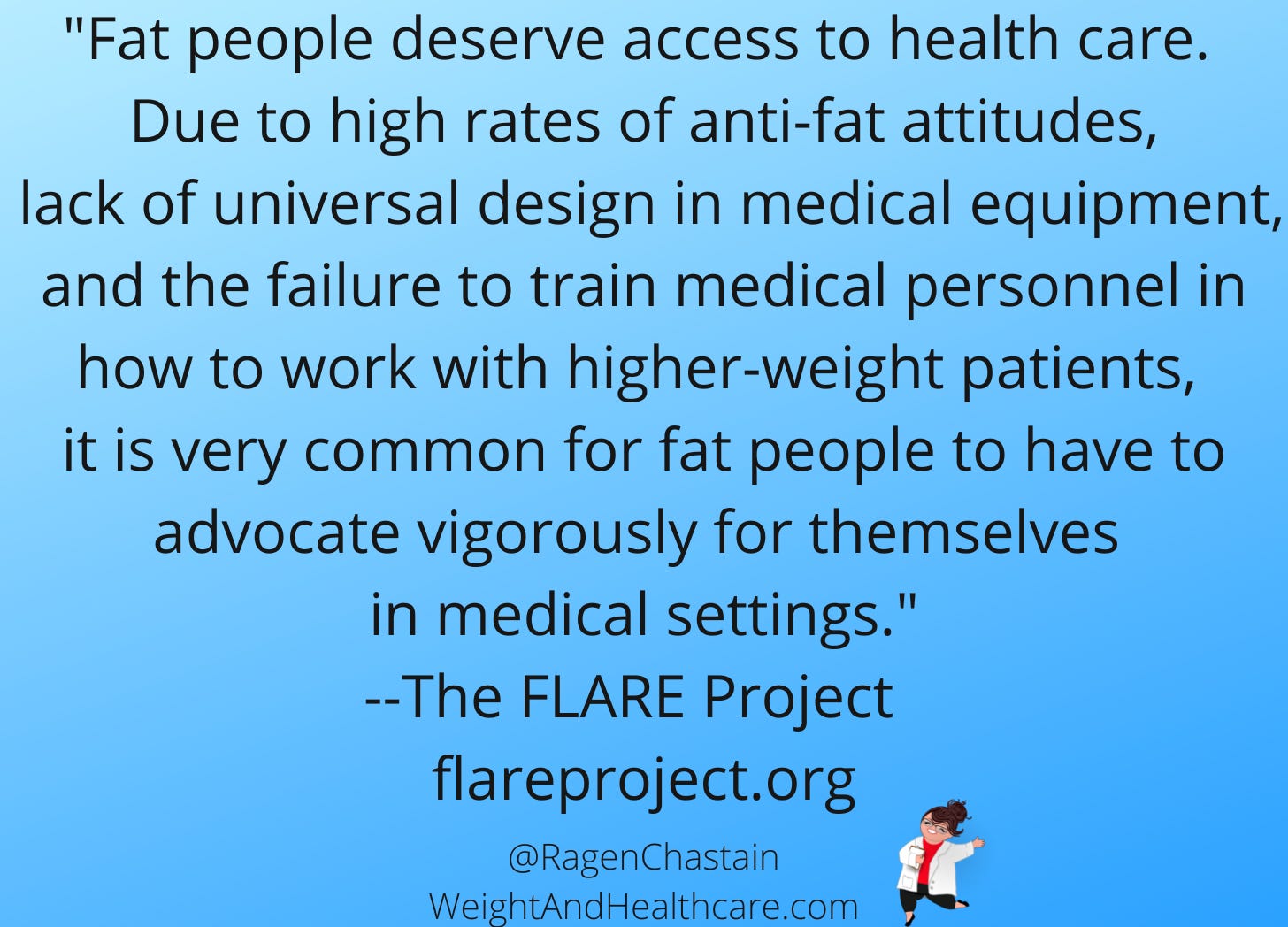
Asking for Accommodations as a Higher-Weight Person - Part 2
Description
In Part 1 we talked about some general information about asking for accommodations as a higher-weight person. To get more insight into the legalities of this, I reached out to the brilliant folks at The Fat Legal Advocacy, Rights, and Education (FLARE) Project to write this guest column. The rest of this newsletter is their wise words.
FLARE’s approach to health care access: Fat people deserve access to health care. Due to high rates of anti-fat attitudes, lack of universal design in medical equipment, and the failure to train medical personnel in how to work with higher-weight patients, it is very common for fat people to have to advocate vigorously for themselves in medical settings. When advocating, it’s helpful to know if you are in one of the few locations that specifically prohibit weight discrimination. In other locations, higher-weight people may be protected under disability laws even if no “fat laws” exist there.
Here are some tips from the FLARE Project that may help:
In most locations (where weight discrimination laws have not yet been passed) the following questions or statements might apply:
* What tests or treatments would I be receiving if I was not higher weight?
* What, if any, are the reasons I cannot receive those same tests or treatments?
* If the reason for denial is an objective reason (such as a weight limit for a piece of equipment or a test that does not work on higher-weight bodies):
* “If I cannot receive a particular test or treatment due to weight, what are the alternative tests or treatments that will result in similar findings or improvements?”
* If the reason for denial is policy-based, rather than an objective reason like a weight limit for a piece of equipment or a test that does not work on higher-weight bodies:
* “I am requesting a reasonable accommodation so that I can receive equitable, nondiscriminatory treatment. Making a policy exception is a type of reasonable accommodation. If you are not authorized to make a policy exception, please let me talk to your supervisor or someone who is authorized.”
* “How can we partner together to ensure that I get the health care that I need, just like I would if I was thin?”
In locations where there is a specific law or court decision (State of Washington) prohibiting weight discrimination:
* What tests or treatments would I be receiving if I was not higher weight?
* What, if any, are the reasons I cannot receive those same tests or treatments?
* If I cannot receive a particular test or treatment due to weight, what are the alternative tests or treatments that will result in similar findings or improvements?
* If the reason for denial is an objective reason (such as a weight limit for a piece of equipment or a test that does not work on higher-weight bodies):
* “The law requires equitable treatment for people of all sizes. If I cannot receive a particular test or treatment due to weight, what are the alternative tests or treatments that will result in similar findings or improvements?”
* If they cannot think of any alternatives try asking:
* “Before this (test or piece of diagnostic equipment) was invented, what approaches were used for diagnosis (or treatment).”
* If the reason for denial is policy-based, rather than an objective reason (such as a weight limit for a piece of equipment or a test that does not work on higher weight bodies):
* “In our location weight-related discrimination is unlawful. Let’s work together to be sure I receive fair, lawful treatment and receive the same quality of care as a thin person would here.”
* “Reasonable accommodations are required by law. I am requesting a reasonable accommodation so that I can receive equitable, nondiscriminatory treatment. Making a policy exception is a type of