Episode Details
Back to Episodes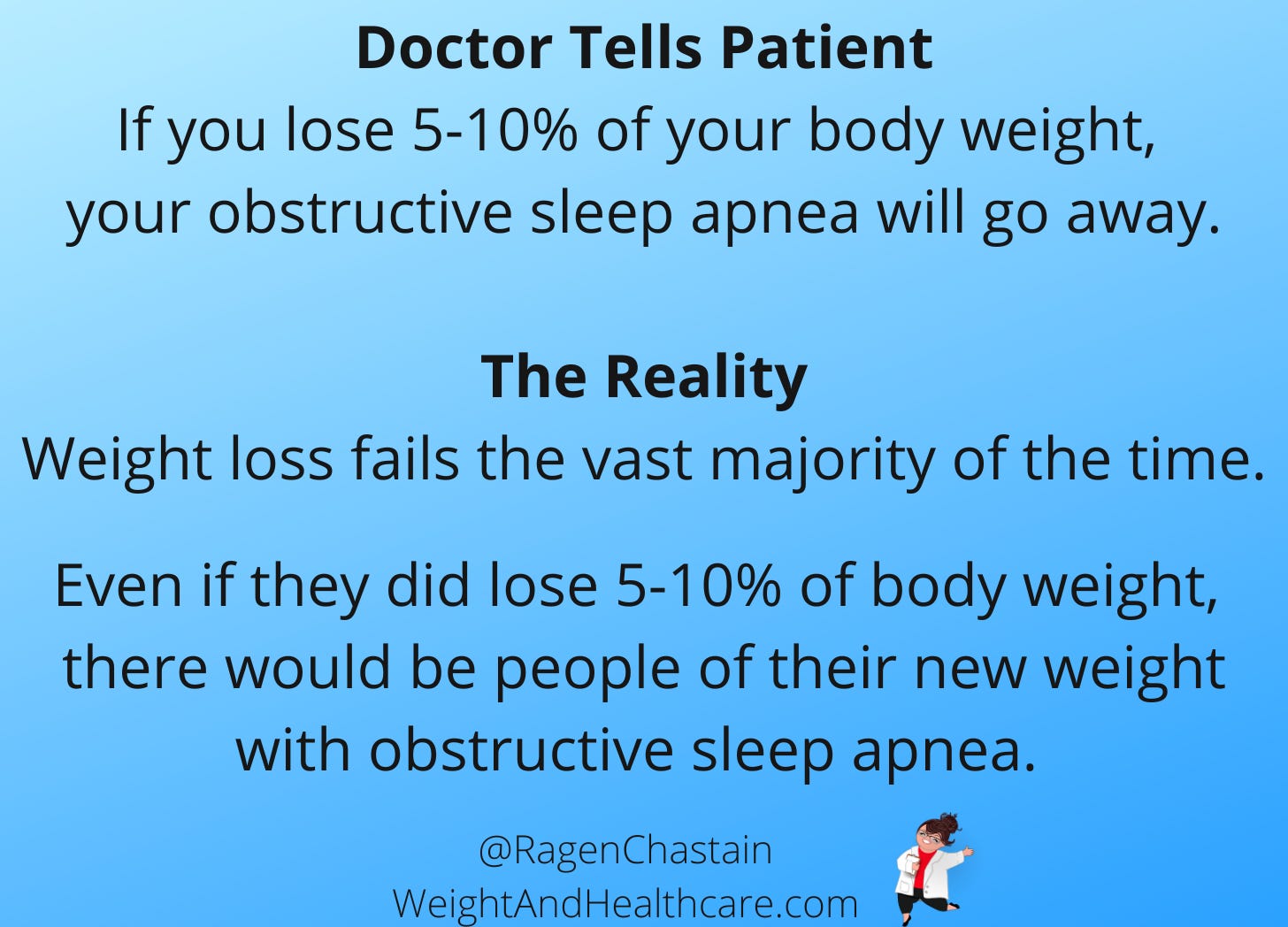
Reader Question - Sleep Apnea and Weight
Description
Transcript This is the Weight and Healthcare newsletter! If you like what you are reading, please consider subscribing and/or sharing!
Reader Marcel sent me the following question:
I just got diagnosed with sleep apnea. My doctor told me that if I could just lose 5-10% of my body weight, it would go away. I’ve yo-yo dieted all my life and sometimes got to 5% lost before it came back, but never even got to 10% and most times I ended up heavier than when I started. I’m nervous to try again, but sleep apnea is really scary.
There are a lot of things that can contribute to obstructive sleep apnea (OSA,) including everything from enlarged tonsils to hereditary structural issues, to heart issues and more. It’s possible that someone’s size and/or the way that their adipose tissue is distributed could contribute to OSA. But it’s complicated, in part because sleep apnea is known to induce weight gain so when they say x percent of people who have sleep apnea are fat, we don’t know to what extent it may be a chicken and egg situation.
It can also simply be a function of the number of fat people who exist. For example (and I’m using made-up numbers for this,) the statistic might say “being fat is a risk factor because 60% of people with sleep apnea in the US are fat.” However, if 70% of people in the US are fat and only 60% of people with sleep apnea are fat, then fat people are actually underrepresented. (Incidentally, I’ve seen a lot of this mistake happening with COVID numbers.) It may also be a function of testing bias – if fat people are tested much more often for sleep apnea than thinner people, then it would not be surprising if fat people had a higher incidence.
It’s also important to understand that even if someone’s sleep apnea is caused by weight/adipose tissue distribution or body size in general (for example, body builders have also been shown to be at higher risk with associations to their BMI and also to their neck circumference,) that still doesn’t mean that weight loss is an appropriate treatment. For that to be true, weight loss would have to meet the requirements of an ethical, evidence-based intervention. Given that it fails the vast majority of the time, and has the opposite of the intended effect up to 66% of the time, it doesn’t qualify.
While there is some short-term research that shows a decrease in OSA symptoms/severity with weight loss, those studies don’t capture the likely weight regain, nor do they separate the impact of the behavior changes that people make from the impact of weight loss (in research around other health issues, it’s been found that it’s likely the behavior changes, not the weight loss that create the health impacts.) There are other studies that find that, for example, “physical activity has been found to have a 32% reduction in the AHI (a reduction of 6.27 events/h) and a 28% reduction in daytime sleepiness, as well as a 5.8% increase in sleep efficiency and a 17.65% increase in VO2peak, having found no significant reduction in the BMI. (The role of physical exercise in obstructive sleep apnea, de Andrade 2016.) This is consistent with other research about movement and health. Of course, this isn’t a deep dive into the research, I just want to make the point that when people claim that the research shows that weight causes OSA and weight loss solves it they are not stating anything resembling a proven fact.
Moving on to Marcel’s doctor’s claim that losing 5-10% of