Episode Details
Back to Episodes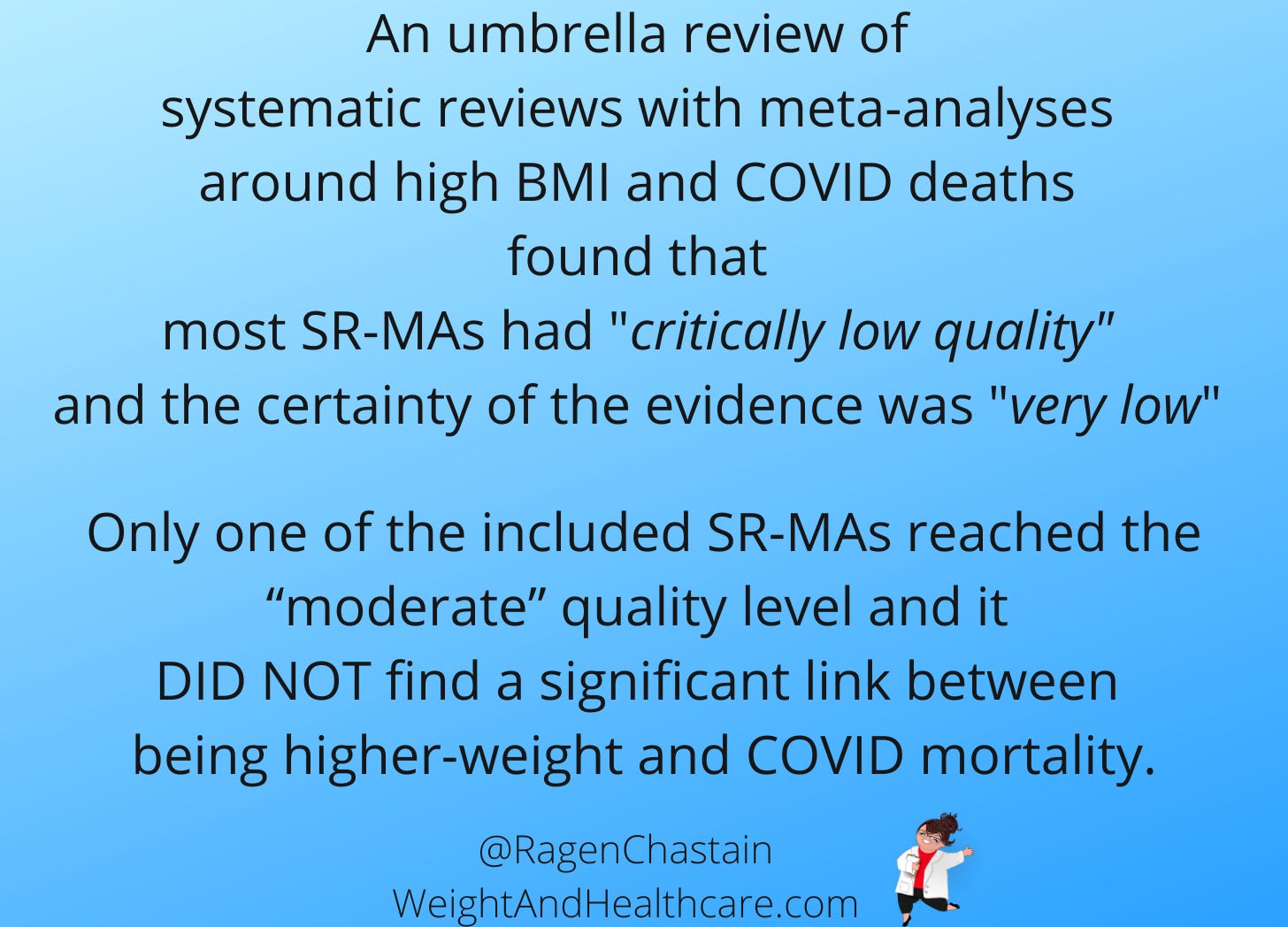
Study Shows Lack of Link Between High BMI and COVID Deaths
Description
This is the Weight and Healthcare newsletter! If you like what you are reading, please consider subscribing and/or sharing!
In the early days of the pandemic studies were rushed out and highlighted in the media claiming that higher-weight people were at higher risk of COVID death. I wrote about the issues with this in my previous blog, as did Christy Harrison, Paul Campos and others.
Now an umbrella review has been published. This is a review of existing systematic reviews and metanalyses.
Quick background. A systematic review (SR) starts with a research question, creates inclusion criteria for evidence, and then attempts to gather and summarize all of the available empirical evidence that fits the inclusion criteria. A meta-analysis (MA) is the application of statistical methods to the results of the studies collected by the systematic review. An umbrella review (UR) synthesizes all of the available systematic reviews and meta-analyses about a broad research question, typically taking into account not just the findings of the SRs and MAs, but also the quality of evidence within them. This is important because if the SR/MAs include poor quality studies, then they risk poor quality summary/analysis/conclusions.
So, this study “Risk of bias and certainty of evidence on the association between ob*sity and mortality in patients with SARS-COV-2: An umbrella review of meta-analyses” by Silva et al, 2023 looked at systemic reviews with meta-analyses (SR-MAs) “to evaluate the risk of bias and the certainty of the evidence of SR-MAs on the association between ob*sity and mortality in patients with SARS-CoV-2.”
They begin that:
“Poorly conducted SR-MAs can lead to inaccurate illustrations of evidence and misleading conclusions, leading to limited applicability.”
Then point out that:
“There are concerns that in the panic to provide answers to help administer the COVID-19 pandemic, SR-MAs are being conducted without many of the keystones of robust methods”
They sought to answer two questions with their UR:
1. What is the quality and certainty of evidence on the association between ob*sity and mortality in patients with SARS-CoV-2?
2. What is the magnitude of the association between ob*sity and mortality in patients with SARS-CoV-2 demonstrated by SR-MAs
They reviewed 24 SR-MAs from multiple countries. Ultimately they found that, while most SR-MAs did show an association between being higher weight and COVID mortality, there were serious questions as to the quality of the research that led to those conclusions.
They found that “most SR-MAs had critically low quality, and…the certainty of the evidence was very low.” In fact, in terms of certainty of evidence, 21 of the 24 SR-MAs were classified as “very low.” In terms of quality, 66.7% of the SR-MAs were “critically low quality,” and 29.2% were “low” quality. Only one of the included SR-MAs reached the “moderate” quality level and it DID NOT find a significant link between being higher-weight and COVID mortality.
The UR author’s explanation for this is that the pandemic created the need for fast information (which is, of course accurate) but that in the rush to get data “many of the keystones of robust methods are being forgotten.” I would add that, as we often talk about in research reviews here, when it comes to weight science, the keystones of robust methods are often thrown out the window regardless of how much tim