Episode Details
Back to Episodes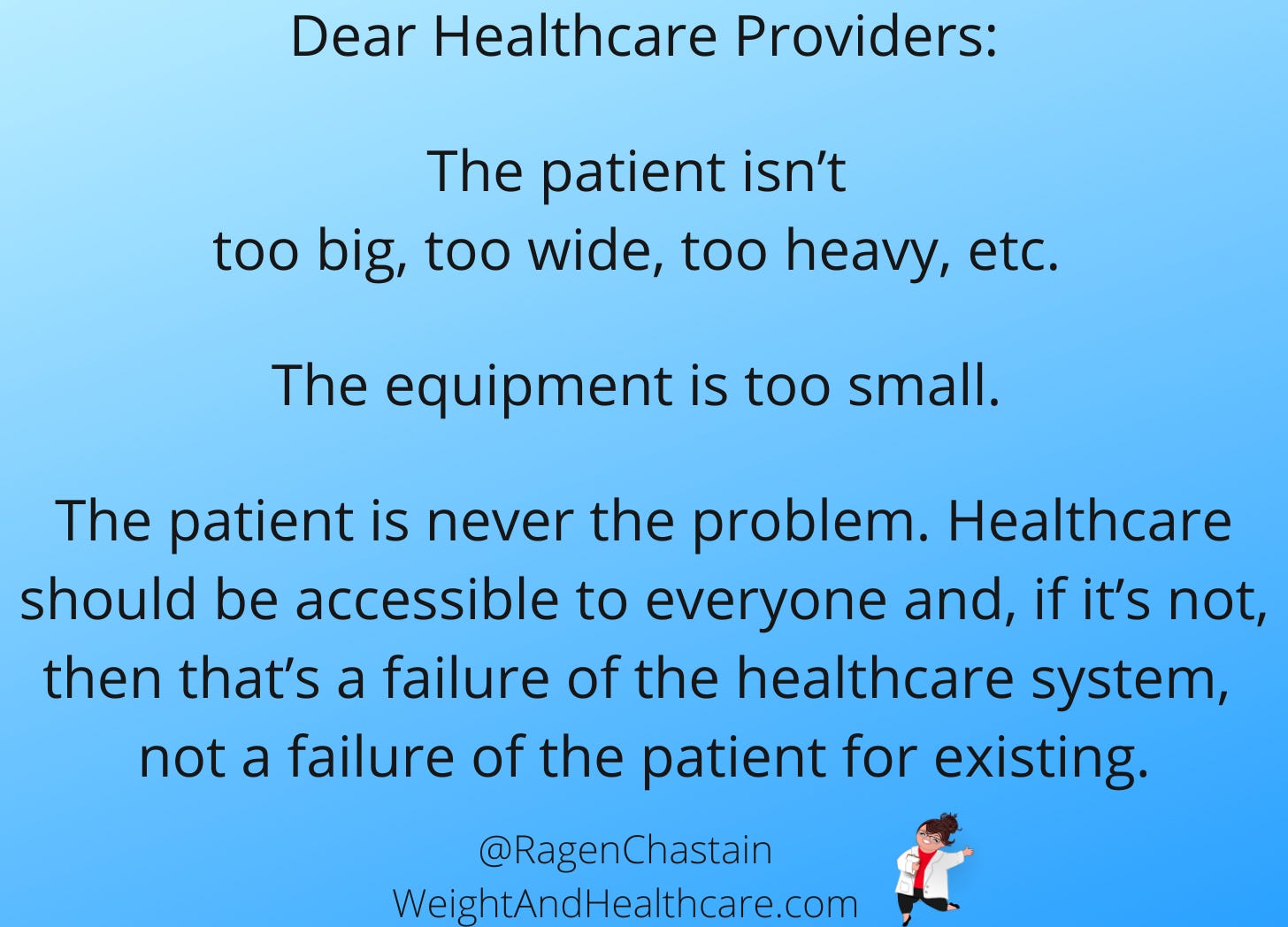
A First Step to Solving Weight Stigma in Healthcare Interactions
Description
This is the Weight and Healthcare newsletter! If you like what you are reading, please consider subscribing and/or sharing!
There are a number of different ways that bias can impact the healthcare that higher-weight patients receive. This includes provider bias and structural bias (when the healthcare system is created for thin bodies and/or to the specific exclusion of fat bodies.) Today I want to talk about what happens when these two types of bias intersect. It’s a perfect storm that both supports and increases this bias. It doesn’t have to be this way, and there is a simple first step (though it’s certainly not the only step,) that healthcare providers can take to interrupt it. Let’s look at some real-world examples (shared anonymously with permission):
A fat patient arrives for a mammogram. They receive a gown but it doesn’t fit, they ask for a larger gown and the tech says “If you’re too big for that one I can give you a second one and you can wear both.”
A fat patient needs an MRI. They get on the table, and it begins to move. But the patient’s hips catch on the sides. The tech stops the table, and says “Your hips are too wide for the MRI, we wont’ be able to do the scan.”
A patient goes to the pharmacist to get Plan B for pregnancy prevention. The pharmacist asks the patient’s weight and then says “Your weight is too high for this pill to be effective.”
A fat patient calls 911 because they have symptoms of a stroke. The paramedics arrive and say “you are too wide to fit on our gurney, we’re calling a special ambulance to transport you.”
A fat patient gets a report back on a CT scan and it says that conclusions could not be drawn because of the “patient’s body habitus.”
A fat, pregnant patient arrives at an Ob/Gyn practice for their first pre-natal visit. The receptionist says “You are too heavy for our tables so we can’t accept you as a patient.”
A fat patient points out to the receptionist that all of the chairs in the waiting room are too small for them, the receptionist says “I’m so sorry but if you don’t fit in the chairs you’ll need to stand.”
A fat patient is at the doctor for their annual pap smear. The gynecologist says “I’m sorry but you are too heavy for our largest speculum, if you want to make another appointment and bring your own, we can proceed.”
A fat patient has injured their knee and sought care in the ER. The doctor says that “there is nothing he can do to help, you’ll need to get an MRI and see an orthopedist and you should keep the knee immobilized and not put any weight on it or you could cause catastrophic injury. Unfortunately, your knee is too big for the immobilization braces we have, and your weight is too high for the crutches. We can let you use a wheelchair to get to your car but then you’re on your own.”
A fat patient has come to the ER for chest pains. An EKG has shown arrhythmias and blood tests show elevated troponin. The nurse explains that the patient is being admitted but says “I apologize but you are too heavy for our ER beds, we are waiting on a bariatric bed to be brought down.”
Again, these are all true stories that have happened to higher-weight patients and there are a LOT of things wrong here that negatively impact patient care. But did you notice the one thing that all of these scenarios had in common? The one thing that, had providers done it differently, could have immediately reduced the weight stigma being experienced by the patient (even though many other steps are necessary to actually solve the problem)?
Feel free to take a minute to think about it, or read on for the answer.
The one thing that each of these scenarios have in common is that healthcare providers blamed the patient’s body for the lack of accommod