Episode Details
Back to Episodes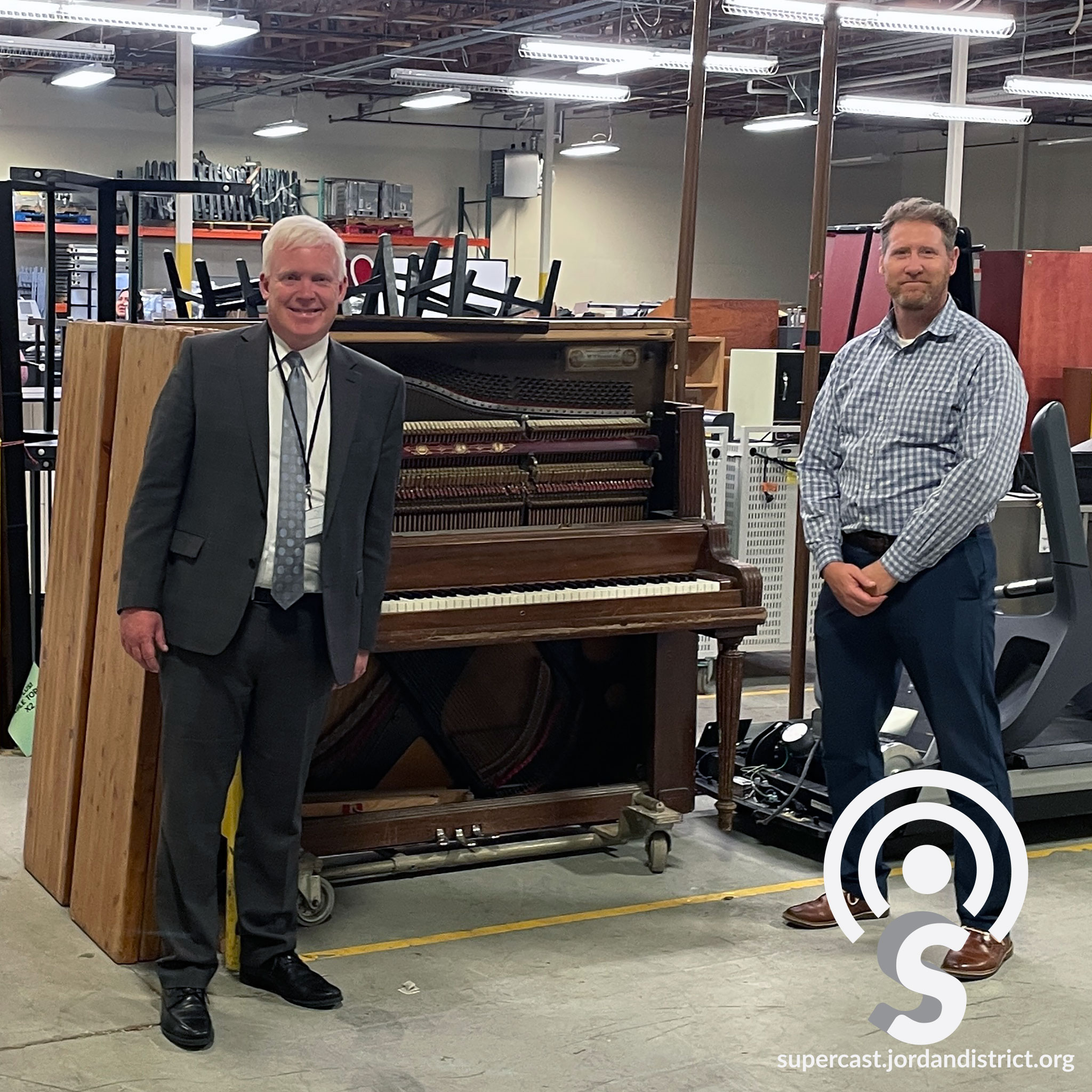
Great Deals and Big Discounts Offered in JSD Surplus Auctions
Description
Are you looking for a great deal on a used piano or other musical instrument, a piece of furniture, practical and industrial kitchenware, even workout equipment?
On this episode of the Supercast, we take you inside the Jordan School District warehouse where surplus items from our schools and buildings are stored and priced to sell pretty fast. Find out how you can get your hands on some great deals and fabulous finds by participating in the monthly online surplus auction.
Audio Transcription
[MUSIC]Anthony Godfrey:
Hello and welcome to the Supercast. I'm your host, Superintendent Anthony Godfrey. Are you looking for a great deal on a used piano or other musical instruments? A piece of furniture, industrial kitchenware, or even workout equipment?
On this episode of the Supercast, we take you inside the Jordan School District Surplus Warehouse, where surplus items from our schools and buildings are stored and priced to sell fast. Find out how you can get your hands on some great deals and fabulous finds by participating in the monthly online surplus auction.
We're here with Kurt Prusse, Director of Purchasing. Thanks for taking time, Kurt.
Kurt Prusse:
Thank you. Great to be here.
Anthony Godfrey:
And we're in the surplus warehouse. We talked with you once from the warehouse before for an earlier episode a couple of years ago. Now we're in the surplus warehouse, also at the Auxiliary Services Building at about 7800 South Redwood Road.
And this is where our surplus items go to be processed for the next stage in their journey. There are lots of chairs around, desks, tables, old equipment of various kinds. I would also add that we work hard as a district to make the very most of the resources that we have. And schools have a greater tendency to hold onto things than they do to let go of things through the surplus process. So I don't wanna give the impression that we buy things and then they're quickly consumed and put into surplus. Would you agree with that?
Kurt Prusse:
Absolutely correct. We get our well use out of those items. And if one school decides they no longer need something or want something, they are brought here. For instance, these Chromebook charging carts they'll buy them at one school and if they go to a one-to-one, they don't need computer labs anymore, then they are made available and another school can grab those at no cost at all. So we can take those schools that are not one-to-one and use them in computer labs. So that's just one example.
Anthony Godfrey:
Tell everyone a little bit about the surplus process, how this works and where all this stuff is headed.
Kurt Prusse:
Great, I'd be happy to. It all starts off when you decide to purchase something, whether it's equipment and there are laws in place to identify equipment. We tagged those originally and they go into a system, into our Skyward system to keep track of. Because we know at the schools, it's for their inventory process to keep track of those things. They can tell them what room numbers are in or where they're located. And so it's easy for them to be accountable for the equipment that they've purchased.
Anthony Godfrey:
And that tags a little blue tag with a number on it. And there are administrative assistants at each school who are responsible for tracking those assets.
Kurt Prusse:
Exactly.
Anthony Godfrey:
And what is it that, what's the threshold? Describe that to everyone, the threshold for something being considered a consumable versus a fixed asset.
Kurt Prusse:
Right, and so originally it was a $500 to $1,000 when I first started, but they raised that, the federal government raised that limit to $5,000. Everything else is considered supply under that dollar amount.
Anthony Godfrey:
So under $5,000 it's consumable, i