Episode Details
Back to Episodes
Special Episode - Quo Vadis (1951) - Part Two
Description
This episode we return to the ‘Golden Age of Hollywood’ with a classic sword and sandal epic, Quo Vadis (1951). This film is available through many streaming platforms and we highly recommend revisiting it.
In Part Two of two episodes on Quo Vadis, we delve into our analysis of the film. If you have not listened to Part One, you might want to check it out for the context.
Special Episode – Quo Vadis (1951) – Part Two
The Wars That Shaped the Movie
Hollywood loves a sure bet and MGM started working on their own adaption after WWII. The legacy of that war can be seen in the depiction of Nero and the Roman people. Nero seems to be a mixture of Mussolini and Hitler, and the use of eagles, fasces and the ‘Roman salute’ must have also dredged up unpleasant memories.
The newly emerging Cold War also had an impact on this movie, with the plot dealing largely with the clash of freedom (Christians) vs tyranny (Romans). The immoral, irreligious Romans could easily be seen as the ‘godless Communists’, whereas the Christians and converts stand for the American way of life. The film was made during the hunt for Communists in Hollywood itself. The first round of the House Un-American Activities Committee (HUAC) had started in 1947 and round two was destined to begin in 1951. These were dark days for many in the industry.
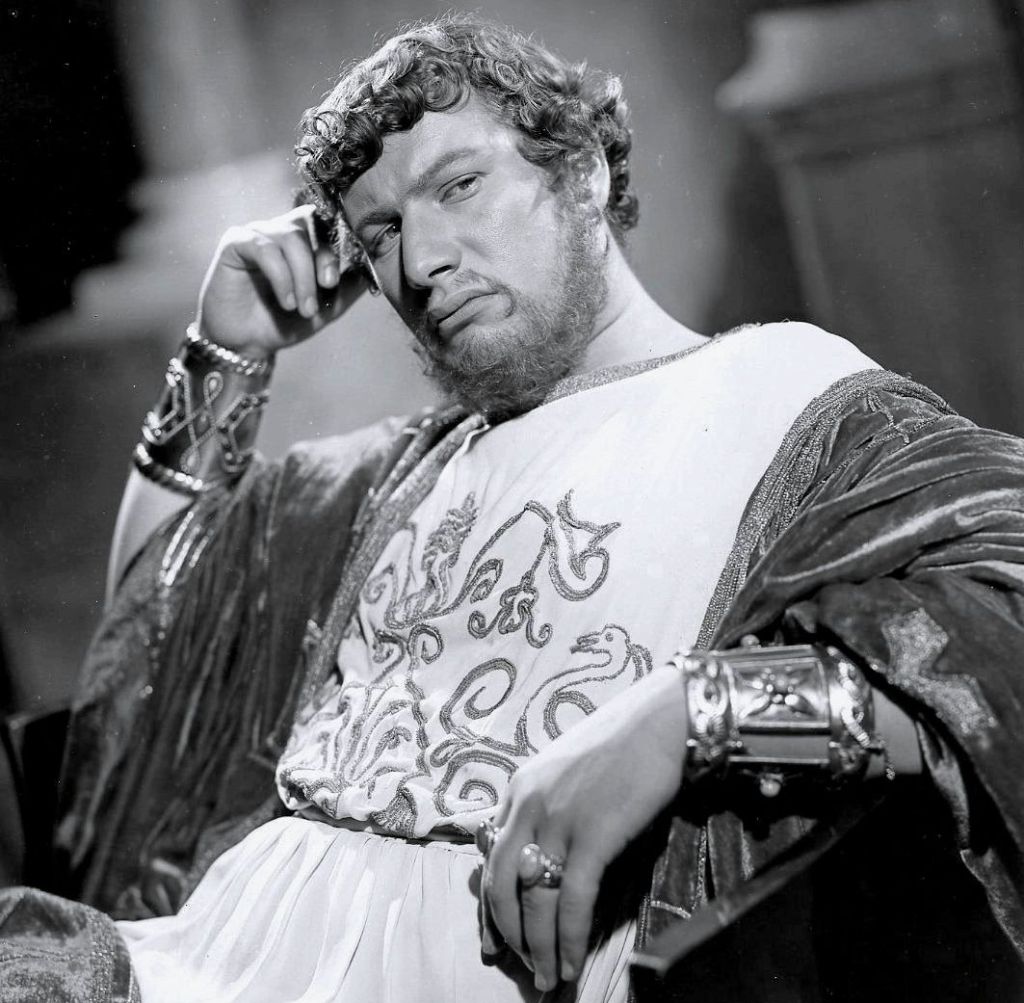
Black and white portrait photo of Peter Ustinov as Nero in Quo Vadis.
He sits in a thoughtful pose and appears unhappy about something.
Source: Pinterest.
HUAC arrives in Hollywood
The head of MGM (Louis B. Mayer) and the male lead of Quo Vadis (Robert Taylor) were intimately connected with the HUAC hearings. Mayer had testified in 1947. Robert Taylor may not be a familiar name, but he was a massive star for MGM in the 30s and 40s. He was also known for his conservative politics and would be the only prominent Hollywood star to name names in front of the Committee. This might all seem to add up, but his testimony had just as much to do with his loyalty to Mayer, a fellow conservative, and MGM as his anti-communism.
Taylor had been forced by MGM and the O