Episode Details
Back to Episodes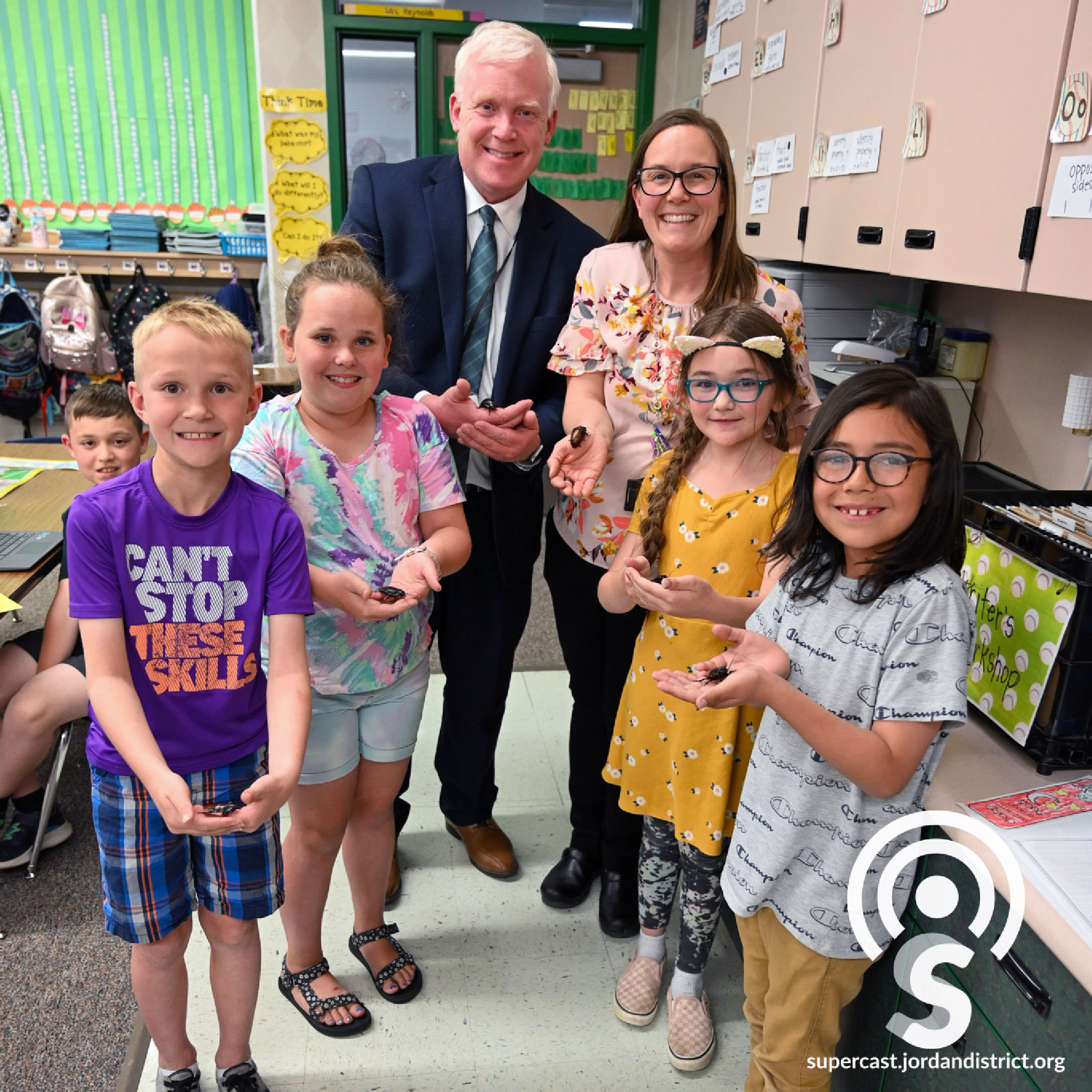
Why are Madagascar Cockroaches in the Classroom?
Description
In some parts of the world they are kept as pets due to their peculiar appearance and interesting behavior. We’re talking about the Madagascar or hissing cockroach.
On this episode of the Supercast, we head to Jordan Hills Elementary School where hissing cockroaches are in one classroom helping students study science and insect behavior. Hear what students have to say about the unique project and how the ancient bugs are contributing to the learning process in a pretty big way.
Audio Transcription
Anthony Godfrey:
Hello and welcome to the Supercast. I'm your host, Superintendent Anthony Godfrey. In some parts of the world, they are kept as pets due to their peculiar appearance and interesting behavior. We're talking about the Madagascar or hissing cockroach.
On this episode of the Supercast, we head to Jordan Hills Elementary School, where hissing cockroaches are in one classroom helping students study science and insect behavior. Hear what students have to say about the unique project and how the ancient bugs are contributing to the learning process in a pretty big way.
We're here at Jordan Hills with third-grade teacher Melissa Reynolds and I can't take the smile off my face because this is perhaps the most unique school visit I've ever made and that is to visit your classroom cockroaches. Tell me a little bit about that.
Melissa Reynolds:
So last year, the FOSS program was new to Jordan Hills, and in the FOSS program, there is an activity about crayfish. And in Utah, it's illegal to transport crayfish from their natural habitat to your home or anywhere else or to another habitat without first killing them, and so we can't bring crayfish in for the FOSS part of that. We're supposed to learn about behaviors and adaptations.
Anthony Godfrey:
So so far, I've already learned that I to be more careful with crayfish. Not that I've ever transported live crayfish like a common criminal, but I will know not to do that in the future.
Melissa Reynolds:
Or you'll be imprisoned.
Anthony Godfrey:
That's right.
Melissa Reynolds:
No, but so there's an alternate activity in the book that says we can use hissing cockroaches instead. So I--
Anthony Godfrey:
No wait, hissing cockroaches.
Melissa Reynolds:
Yes, these are the Madagascar hissing cockroaches, not the yucky kind you find on your kitchen floor. Not my kitchen floor, but others.
Anthony Godfrey:
Yes, other unfortunate kitchen floors, yes.
Melissa Reynolds:
Yes, these are not the yucky, nasty cockroaches. So these are Madagascar hissing cockroaches. And the activity is somewhat the same. They still talk about the different adaptations that they use, the behaviors that they have. You identify different structures on the animals. And so it works well, and it's very guided through the FOSS system.
Anthony Godfrey:
So tell everyone what FOSS is for those who may not know.
Melissa Reynolds:
FOSS is the science program that our district is providing for us. It's really an all-inclusive program. It comes with a couple of bins for each unit that you teach, and I'm doing the Life Structures Unit this year. I say that I'm doing it because, just like Boston was saying, we each decided, as three of the third-grade teachers, we'll each take one and teach it to all the classes in third grade, mostly because the other teachers did not want to do cockroaches.
Anthony Godfrey:
So you are the designated cockroach teacher.
Melissa Reynolds:
Yes, yes. So the kids get really excited to come to my science group because they get to see the cockroaches, they get to hold them. One of the activities we do is what happens when we touch their antenna? What happens when we leave them alone with a cardboard tube, what happens when we touch their abdomen, what h