Episode Details
Back to Episodes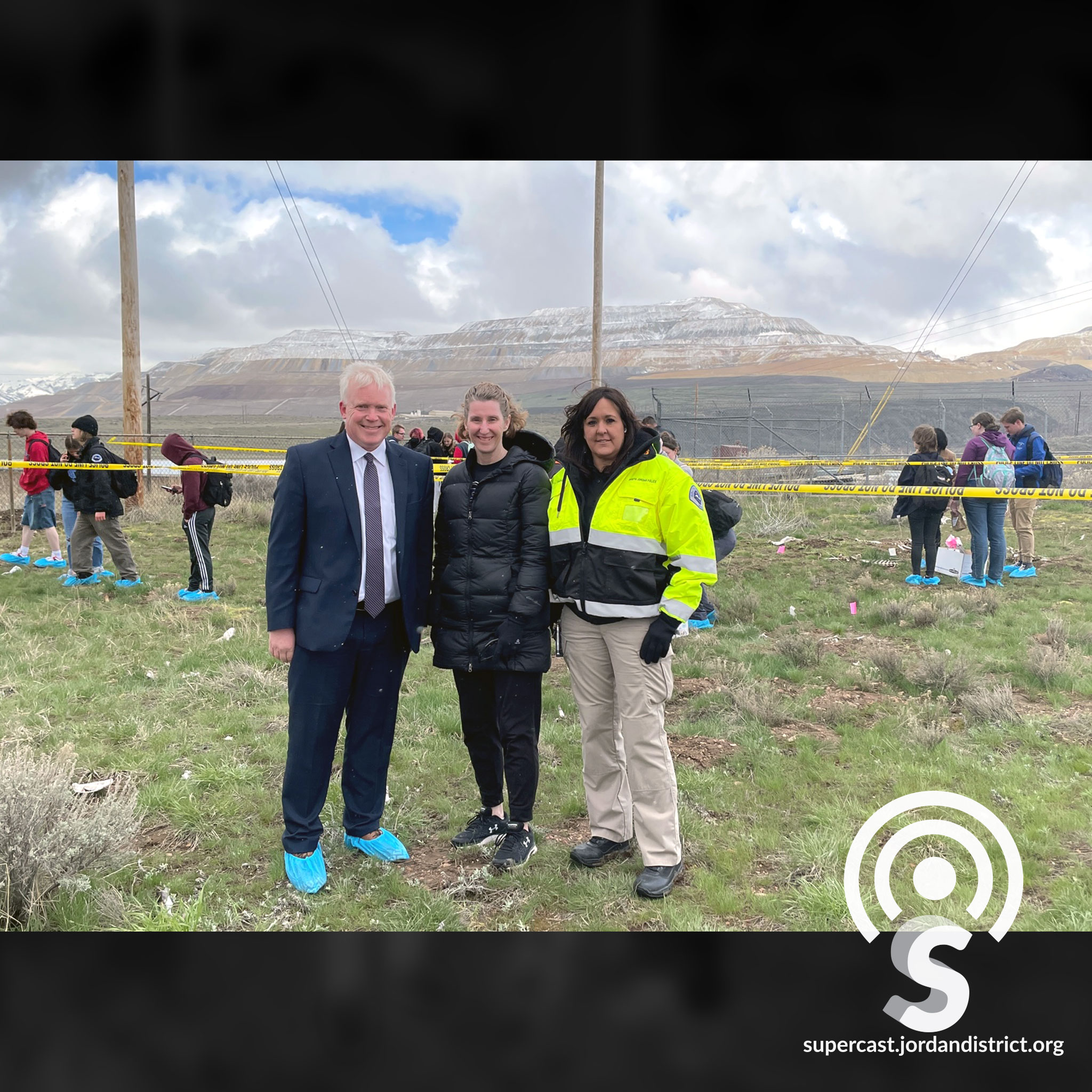
Meet the Crime Solving Students in Bingham High School’s Medical Forensics Class
Description
It is a high school Medical Forensics class which focuses on the proper way of documenting and processing a crime scene and on this day, it does not involve work in the classroom.
On this episode of the Supercast, we will take you on a unique field trip where forensics students are getting their hands dirty, with hands-on learning, digging deep into the science of medical forensics. Surrounded by police cars and crime scene tape they are crime solving students in action.
Audio Transcription
Anthony Godfrey:
Hello and welcome to the Supercast. I'm your host, Superintendent Anthony Godfrey. It is a high school medical forensics class which focuses on the proper way of documenting and processing a crime scene and on this day, it does not involve work in the classroom.
On this episode of the Supercast, we take you on a unique field trip where forensics students are getting their hands dirty, with hands-on learning, digging deep into the science of medical forensics surrounded by police cars and crime scene tape. They are crime-solving students in action.
I’m here with Cynthia Cox out in Copperton, out in the field with her medical forensics class and with the law enforcement class as well. So introduce yourself and tell us a little bit about these classes and today's experience.
Cynthia Cox:
Well, my name is Cynthia Cox and I teach the medical forensics class at Bingham. All year long we've been talking about crime scene investigation, crime scene analysis, identification of evidence, analysis of evidence, packaging of evidence, and so this is kind of a culminating activity where the students come out and it's led by the police department. So the students are getting a real-world view of how to solve a crime from beginning to at least evidence packaged and sent back to the lab.
Anthony Godfrey:
Well, we have a gloomy snowy day that you might have ordered for dark work like this. It's the perfect setting. Tell me about the skills that students learn in class that lead up to this experience.
Cynthia Cox:
Well, we talk all about observation skills and turning off filters during observation, trying to make sure that students are coming in looking at evidence unbiased. We try to, we teach them about how to package all different types of evidence, not just a screwdriver, a piece of wire, but biologic evidence, drug evidence, blood evidence. And so there we teach bone analysis, we look at fingerprint analysis, we look at blood spatter analysis, and through all of those activities we're working on, you know, other workplace skills like problem-solving skills and teamwork skills.
Anthony Godfrey:
Tell me about the bone analysis and the blood splatter analysis.
Cynthia Cox:
Okay, so with blood spatter it can tell a story. We can, based on are we seeing large drops? Is this somebody that was maybe walking away from after they were injured? Or is this a really fine mist that may have come from a fast-moving weapon like a gun? So the angles that spatter hits a surface can tell us whether that person was standing up, whether they were sitting down, were they lying down. We can identify how many times a person might have been hit with blood spatter analysis. So there's lots of things we can learn from that.
With bone analysis and what they're looking at out here, a lot of animal bones that we've put out here, and we allow them to decompose before the students come out here. We can identify gender, we can identify ancestry, we can identify age from the bones, we can identify some of the injuries that might have occurred and left marks on the bones when we're trying to put all the pieces together and figure out what happened.
Anthony Godfrey:
So you indicated that you have animal remains out here that are used as evidence.
Cynthia Cox:
Yes.
Anthony Godfrey