Episode Details
Back to Episodes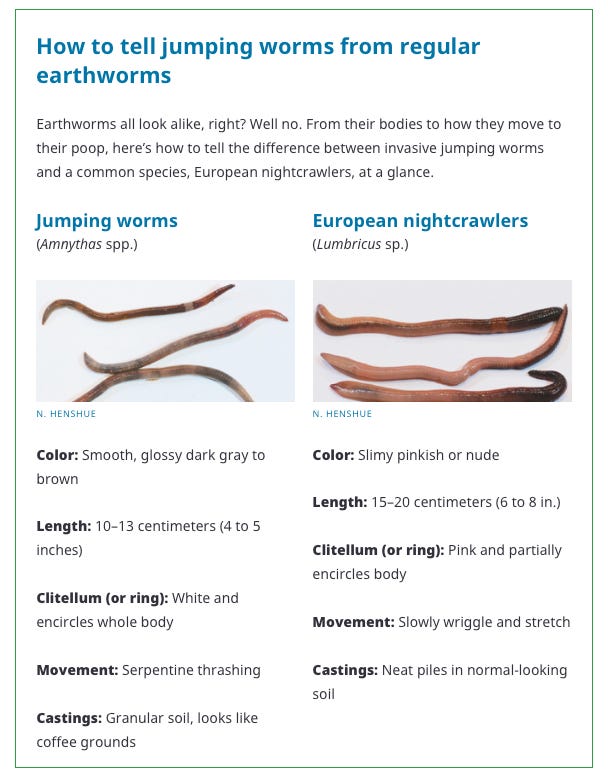
Jumping Worms: An Update, Again
Description
Jumping worms, and the publicity about them, are spreading. Debbie Flower (America’s Favorite Retired College Horticulture Professor) and I talked about this in August of 2021 in Episode 126 of the Garden Basics with Farmer Fred podcast. We provided an update on Episode 217 in August of 2022 (listen to that chat in today’s newsletter podcast).
Jumping worms have been in the United States for more than a half century. And they’re moving around the country, with our unknowing help.
As Debbie pointed out in the podcast (above), one of the biggest threats is their poop. Because they tend to reside near the surface and move horizontally through the mulch layer, their poop is more highly mineralized and not incorporated deeper into the soil. Plus, that poop tends to be hydrophobic: it repels water. As a result, the soil fungi and bacteria that would be incorporating typical castings into forms of nutrients for plant availability isn’t happening. The biggest threat is to emerging native plants that would use the nutrients and moisture normally in the soil to germinate, either as understory plants in the forest, or freestanding wildflowers in pastures or prairies.
Verified, effective controls at this point, are still being studied. From Cornell University, come this:
“Research is currently being conducted on invasive worms at the University of Wisconsin and several practices do show some promise of control. Abrasive materials such as biochar (ground up charcoal) and diatomaceous earth (fossilized diatoms) may show some promise in killing adult jumping worms. Incorporate one of these products into the infested soil to a depth where the worms are located; worms that come in contact with the materials will be adversely affected.”
Again, that is ongoing research. Debbie and I, in the newsletter podcast, suggest other possible control measures, including using mustard to bring them to the surface, identify them as jumping worms, and discard them (the recipe is in the podcast).
Oh, you don’t want to listen? OK, here’s the transcript, which can also be found in Episode 217 of the Garden Basics podcast:
Sarah in Sacramento
Hi, Fred and Debbie. This is Sarah from Sacramento. My question is about jumping worms. I've heard they're very destructive. And unfortunately, I recently found three in my yard. So I'd like to know a little more about them. My question has three parts. First, how much of a concern are these worms for the home gardener? And second, is there anything I could or should be doing about the jumping worms? Should I kill the worms when I find them, or just leave them be? And third, I keep reading that their castings deplete the soil? I'm wondering if that's actually true. And if so, why are these worms so different from other types of worms which are generally good for the soil? I have heard the jumping worms eat organic matter really quickly. So could I offset this by simply adding a lot more mulch? Any other advice for me? Thank you so much.
Farmer Fred
Jumping worms. Yes, indeed. We've tackled this topic before here on the garden basics podcast, but the jumping worms are jumping all over the place. Debbie Flower is here, America's favorite retired college horticultural professor, and golly now we have them in our own backyard, Deb