Episode Details
Back to EpisodesChristmas Devils and the Feast of Fools
Description
From St. Nicholas Day through Christmas, the Devil figured prominently in medieval plays, embodying a subversive seasonal element also celebrated in the Feast of Fools.
We enter the topic of medieval Christmas plays sideways through German composer Carl Orff’s 1935 composition “O Fortuna,” a piece much beloved in Hollywood soundtracks. The lyric Orff set to music happens to belongs to one of 24 11th-century poems preserved in a Benedictine monastery in the Bavarian town of Beuren, providing the collection with its name, Carmina Burana, a Latinized version of “Songs from Beuren.”
After a brief look at some of the rude and blasphemous poems, for which the collection is notorious, we switch to its poem on the Nativity, a much less scandalous composition which formed the basis of one of Europe’s first Christmas plays. We focus on the prominent role given Satan and his demons in that text as well as the comic portrayal of the Antichrist in Ludus de Antichrist, “Play of Antichrist,” preserved in a collection from a nearby monastery in Tegnersee.
From there we switch over to medieval portrayals of another sort of Antichrist, namely King Herod, whose role in the Christmas story is to order the execution of all infant males in his kingdom, hoping thereby to exterminate a potential rival, the “King of the Jews,” rumored to have been born in his kingdom. We discuss some fantastically grisly portrayals of this event from the medieval stage.
We next have a look at some of the stagecraft employed in portraying the Devil and his minions, discussing the fabrication of “Hellmouths,” a set element, which swallowed sinners and vomited up devils on the medieval stage. Alongside this, we examine costumes and pyrotechnics used to enhance the theatricality of demons and their realm.
From there, we turn to another subversive, sometimes violent, undercurrent in holiday celebrations, namely that of the Boy Bishop. Beginning around the 10th century, the title was given to a youth elected to lead mass either on the Feast Day of St. Nicholas or on December 28, the Feast of the Holy Innocents. On the surface, the tradition may sound innocently charming enough, but as we learn from quite a few contemporaneous accounts of mayhem and violence involved in the festivities, this inversion of the hierarchies could quickly lead into Lord of the Flies territory.
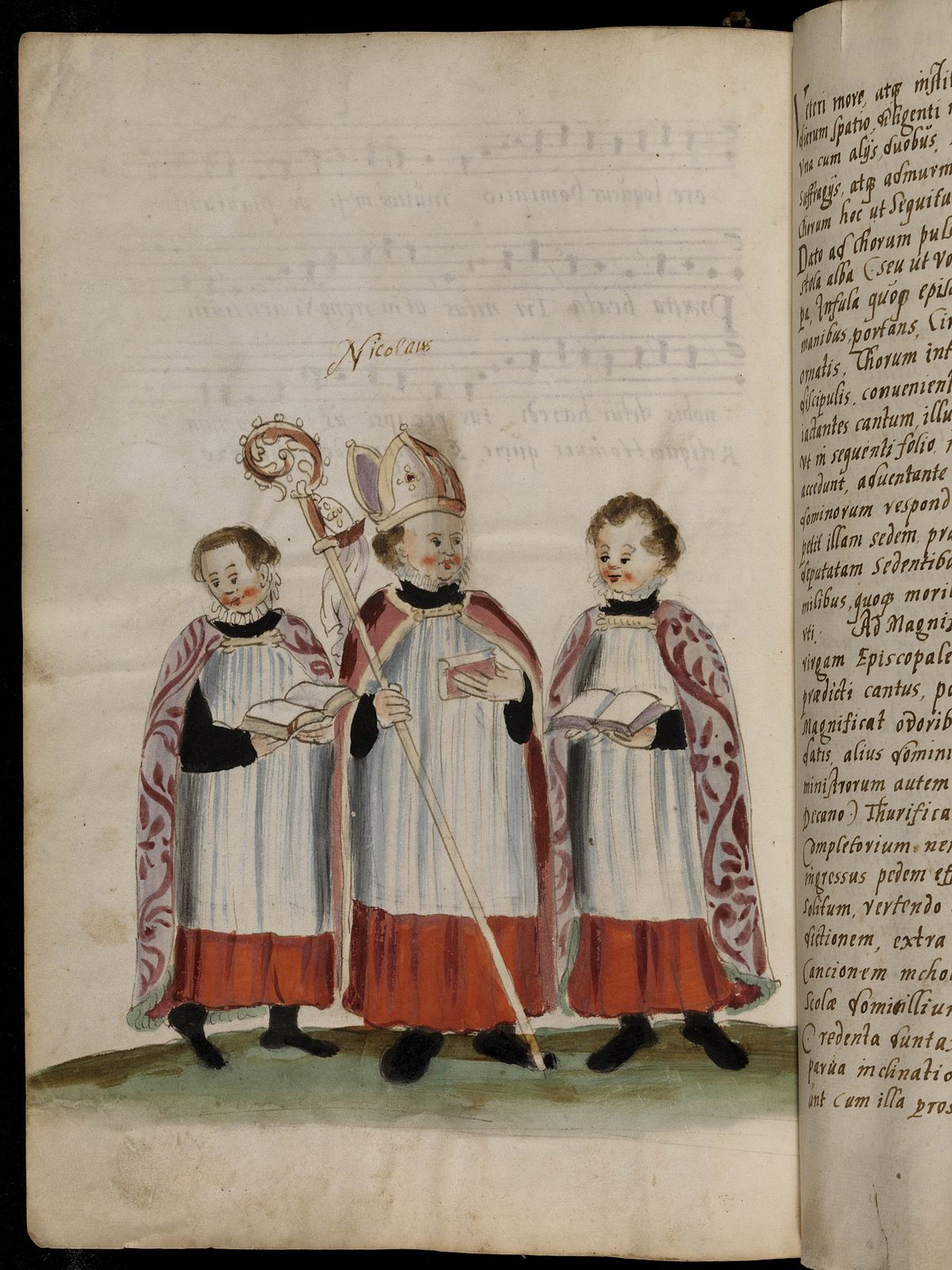
Related to the Boy Bishop tradition, is our next topic, the Feast of Fools. While many listeners will be familiar will be with the carnivalesque street parades, and election of a mock King, Bishop, or Pope of Fools, these chaotic elements were not limited to the secular world. Inde