Episode Details
Back to Episodes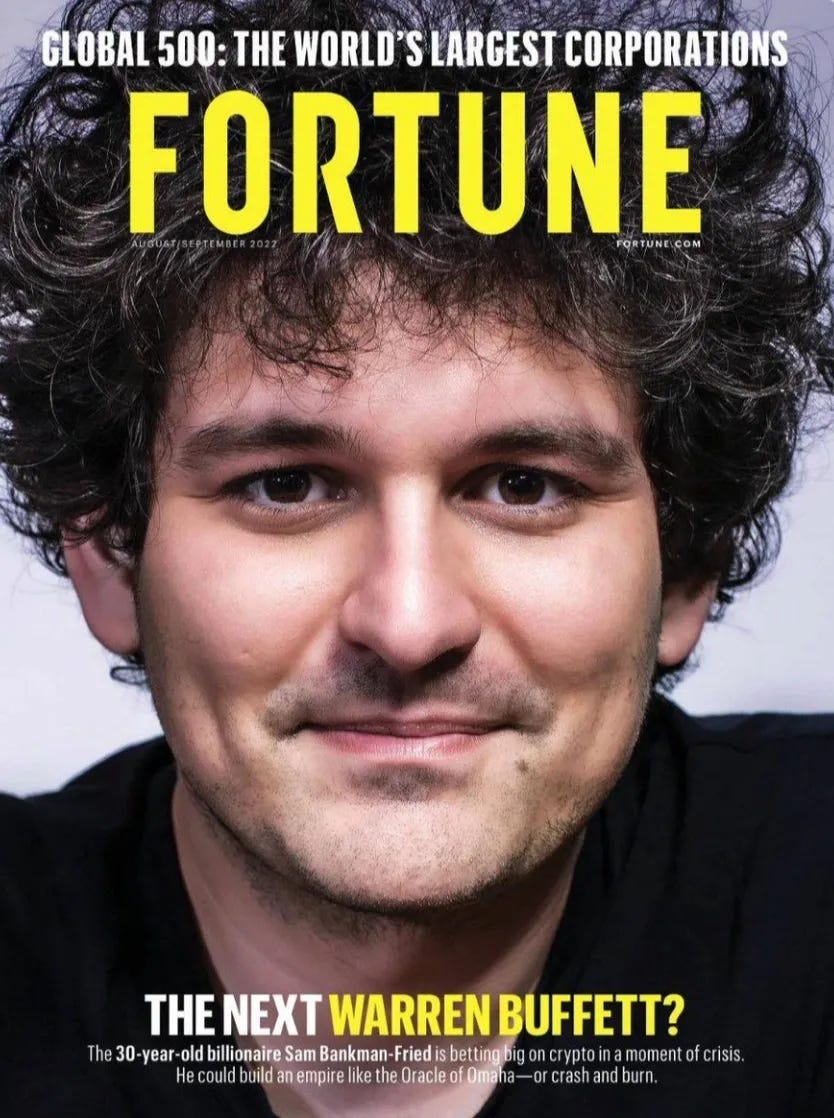
Polyamorous geeks, psychopaths and perhaps the greatest fraud in history
Description
I’m delighted to report that The Flying Frisby is now a Substack Bestseller. Thank you to everyone who supports this bestselling publication!
By popular demand, today we consider bitcoin - and the amazing story that is FTX.
Gosh, this is some story - it’s difficult to know where to start. The more you dig in, the more that comes out. It’s a cautionary tale of the madness that engulfs crowds during investment manias and bubbles, of greed, delusion, risk, and more besides.
I’m sure many of you already know the story, even though there are new developments every day, so I’ll recap it quickly, before moving on to what it means for bitcoin.
Tell everyone you know about this amazing article.
The story of FTX
Sam Bankman-Fried was a geeky young crypto “entrepreneur”, born to an upper-middle-class Jewish family in California. His parents were both professors at Stanford Law School. Ironic.
In 2017 he set up the quantitative trading firm (that would be trading based on mathematical models) Alameda Research . Then, in 2019, came FTX, a crypto exchange that became phenomenally successful, phenomenally quickly.
In July 2021, barely two years into its existence, FTX raised $900m at an $18bn valuation. That was Series A. Three months later came Series B - $420m at a $25bn valuation. Three months after that, in January of this year, it raised another $400m. This time the company was valued at some $32bn.
To put those numbers in some kind of context, the likes of Barclays, Soc Gen and Deutsche Bank - banks that have been around forever - all have smaller market caps in the $20-30bn range.
$32bn would be more than the UK collects in stamp duty in a year. Or fuel duty or alcohol and tobacco duties. It’s roughly five times what it collects in inheritance tax.
Bankman-Fried himself was worth $16bn, and at the age of 30, was on the front cover of Fortune Magazine, along with a headline asking if he was “The Next Warren Buffett?”
FTX’s blue-chip and “smart money” investors included Japan’s SoftBank, venture capital firm Sequoia Capital and hedge fund Tiger Global. Even the Ontario Teachers’ Pension Plan put in $95mn. (What has your pension fund manager been doing with your money?)
There were rumours of another $1bn raise in September. However, that didn’t materialise and the bitcoin bear market meant the tide was going out in the crypto industry. We would soon learn who had been swimming naked.
Subscribe to this amazing publication. It’s a Substack bestseller.
FTX suffers in the bitcoin bear market
Some started asking questions about FTX’s accounting and other practices. Short sellers also started taking notice - they expose frauds more quickly than anyone. Negative coverage started to appear.
On November 6 an article at Coindesk raised doubts about the balance sheet of Bankman-Fried’s sister company, Alameda.
Then things started to unravel quickly.
Changpeng Zhao, CEO of Binance (the world’s biggest crypto exchange), which had been an early investor in FTX, announced that Binance was selling all its FTT coins - as much as $2bn worth. (FTT coins are part of the plumbing of the FTX exchange). The value of FTT started to fall.
Suddenly there was a scramble to withdraw assets from the exchange. It was thought to have had the assets to back the liabilities, Bankman-Fried tried assure everyone that client funds were safe, but it seemed this was no full reserve exchange and FTX didn’t have the funds to meet the run.
In fact, it seems FTX had been using some of the funds - as much as $10bn - to shore up sister company Alameda, which had suffered significant trading losses over the past year.
(Watch the interviews with 28-year-old Alameda CEO Caroline Ellison - said to be in a polyamorous relationship with Bankman-Fried - describing how she “doesn’t like stop losses”.