Episode Details
Back to EpisodesMaster of the Wolves: Transylvanian and Balkan Wolf Lore
Description
The Master of the Wolves is a supernatural figure central to Transylvania’s (modern Romania’s) voluminous body of wolf lore, a mythology that extends more broadly into Balkan regions once occupied, like Romania, by the ancient Dacians.
We begin with a snippet from a contemporary recording of the 1857 poem “St. Andrew’s Night,” by the Romanian poet and statesman Vasile Alecsandri. The poem’s association between the undead strigoi and moroi and the Romanian St. Andrew’s Night (November 30) was explored in our Transylvanian Vampires episode last year, but there is perhaps an even deeper connection between the St. Andrew, Romania, and the wolf.
Naturally, this brings us to the topic of werewolves. There are two wolflike monsters in Romanian folklore, the vârcolac and the pricolici, the latter being a closer match to our idea of the werewolf.
We discuss pricolici superstitions, which overlap largely with beliefs about the undead, of which the pricolici is often said to be a member.
The vârcolac, as we see, is rather different. Originally, it seems to have occupied a very limited and specific mythological niche as a creature that rises into the heavens at night to eat the moon, thereby causing an eclipse, or sometimes, the lunar phases. Over time, the vârcolac seems to have merged with more widespread werewolf beliefs.
The animal form associated with both pricolici and the vârcolac, however, is not always strictly defined as wolf-like. While the pricolici is sometimes said to assume the form of any number of “unholy” (but real-world) animals, the vârcolac has sometimes been compared to a dragon.
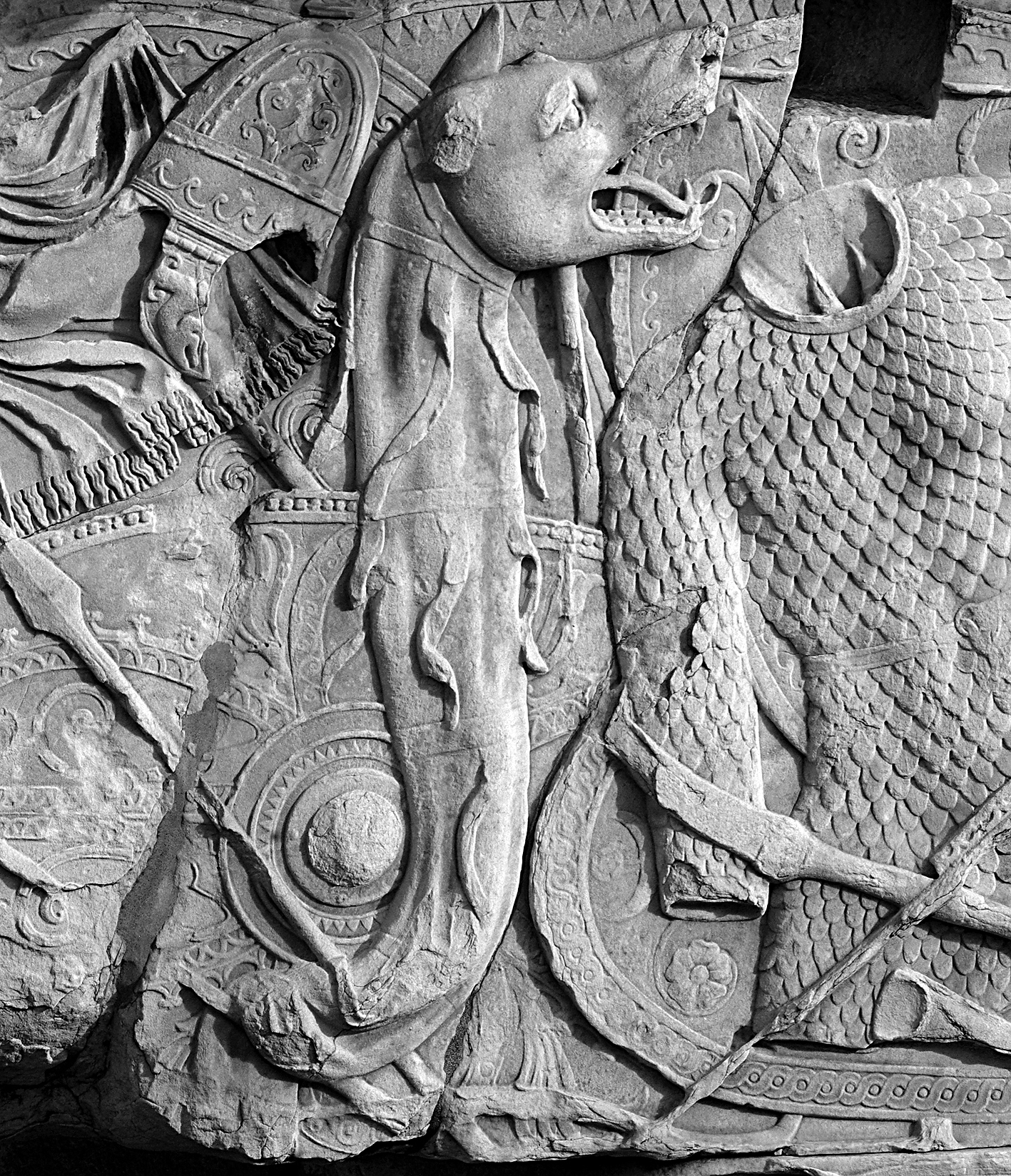
This wolf-dragon hybridization can also be found in the draco battle standard carried into by the Romanian Dacians in their wars against Rome. In its original form, the draco, consisted of a wolf head crafted of light metal, trailing a dragon-like windsock body. When in motion, a sort of whistle within the head emitted a shrieking sound that contributed to the Dacian’s fearsome reputation as warriors.
The historian Herodotus commenting on this reputation, also offered some observations on a particularly brutal Dacian rite, that of sending a “messenger” to their god Zamoxis. Mrs. Karswell provides the gory details in her reading of this account.
More modern Romanian myth-making brings together the man-god Zamolxis and the Dacian wolf, in the legend of The Great White Wolf, also read by Mrs. Karswell. This tale of a wolf leader seems to borrow from genuinely old legends describing St. Andrew as the “Master of